I Want to Take his Face … Off

We all know who Nic Cage is. He’s a dangerously unhinged actor who had a pyramid constructed to house his remains. When you see him screaming, “Not the bees! Not the bees!”; it’s easy to forget that this guy won an Oscar. He is a genuinely good actor, but he owes a lot of money to the IRS, and will take any job he can get.

Nicolas Cage is weird. He named his son Kal-El. He’s plenty weird onscreen too, delivering some of the most bipolar performances in movie history. You can see the same histrionics in the role that won him an Oscar on display when he dresses as a bear and cold-cocks a woman.

In Face/Off, one of his bigger roles, Cage plays a terrorist who switches faces with the FBI agent vowing to bring him to justice. He costars with John Travolta, who plays the FBI agent who switch faces with the terrorist he vows to bring to justice. And then the doves come out.

Face/Off starts out with a little boy, no older than five, getting shot in the head. It’s a John Woo movie, so no punches are going to be pulled. The next scene ends with a plane crash and gun ballet and someone getting flattened in a wind tunnel. This is the first eighteen minutes of this film.

John Woo had a long career in Hong Kong before coming to the US. The first time I saw Hard Boiled, I couldn’t get clips from it out of my head. The grace of the dives, the flash and crack of the guns. A baby urinating on the hero to put out a fire. Hard Boiled was a bloodbath, but sentimental, like all John Woo movies.

I haven’t seen all of his movies, but I have to say that Face/Off is in his top three (that I know about). With a Hollywood budget and stars, he shot a bloody gunfight around a five-year-old boy listening to “Somewhere over the Rainbow.” He ends the movie with a brutal gunfight in a church, followed by a high-speed boat chase that ends when their stunt men are thrown onto the beach. This was a bay seemingly made of napalm because everything blew up.

Face/Off seemed like the last few episodes of a long-running show. Agent Sean Archer and Castor Troy have a long history of failing to kill each other, and it shows. There are so many stories between them, I’m surprised a comic book company never got the licensing rights to do prequels. There are so many characters who have names and are given a personality who are in maybe two scenes, from Archer’s best friend, Tito to the agents at the FBI office, to Castor’s brother Pollax, to the vaguely incestuous Demetri and Sasha, who work with Troy.

Even though Nicolas Cage danced, grinned, and got a little pedo as Castor Troy, the movie is never more entertaining as when he’s John Travolta. When Travolta is Sean Archer, he has all the charisma of a sack of mashed potatoes in a toupee, but if there’s one thing he’s good at, it’s mischief. He plays Castor Troy like a sociopathic thirteen-year-old boy.

With John Travolta as the bad guy, Nicolas Cage gets to be the good guy. Where Travolta’s performance ranges from annoyed to angry, Cage brings in some real pathos. This war is weighing on both of them, and it shows.

John Woo’s career didn’t get any better than this. He made some more movies in America, to diminishing returns, including Mission Impossible 2, as well as Windtalkers, the movie about a Navajo Code Talker where the main character is a white guy. Eventually he went back to Hong Kong and has been making the kinds of movies he wants to make.

This was my favorite movie until it got dethroned two years later. I bonded to the moral grayness—when Travolta is Troy, he becomes a father and a husband, and when Cage is Archer, he steals and lies and commits great acts of violence. I was pretty convinced I was a bad guy back then, and it was good to see that you could be bad and do good things.

I also really dug the gun ballet, as well as the mythos, and the finest, as Jason Mantzoukas calls it, “kabuki acting.” I could talk about this movie forever, like how the Troy brothers are named after the Gemini brothers, but I won’t. I’m not qualified to say if this is his magnum opus. What I will say is that this movie was the work of a mad genius, and I salute you. If there’s one word you can use to describe John Woo, it’s sincerity. I think this is how he sees the world. I think that, most of all, is what I connected with.

Gods Save the Queen

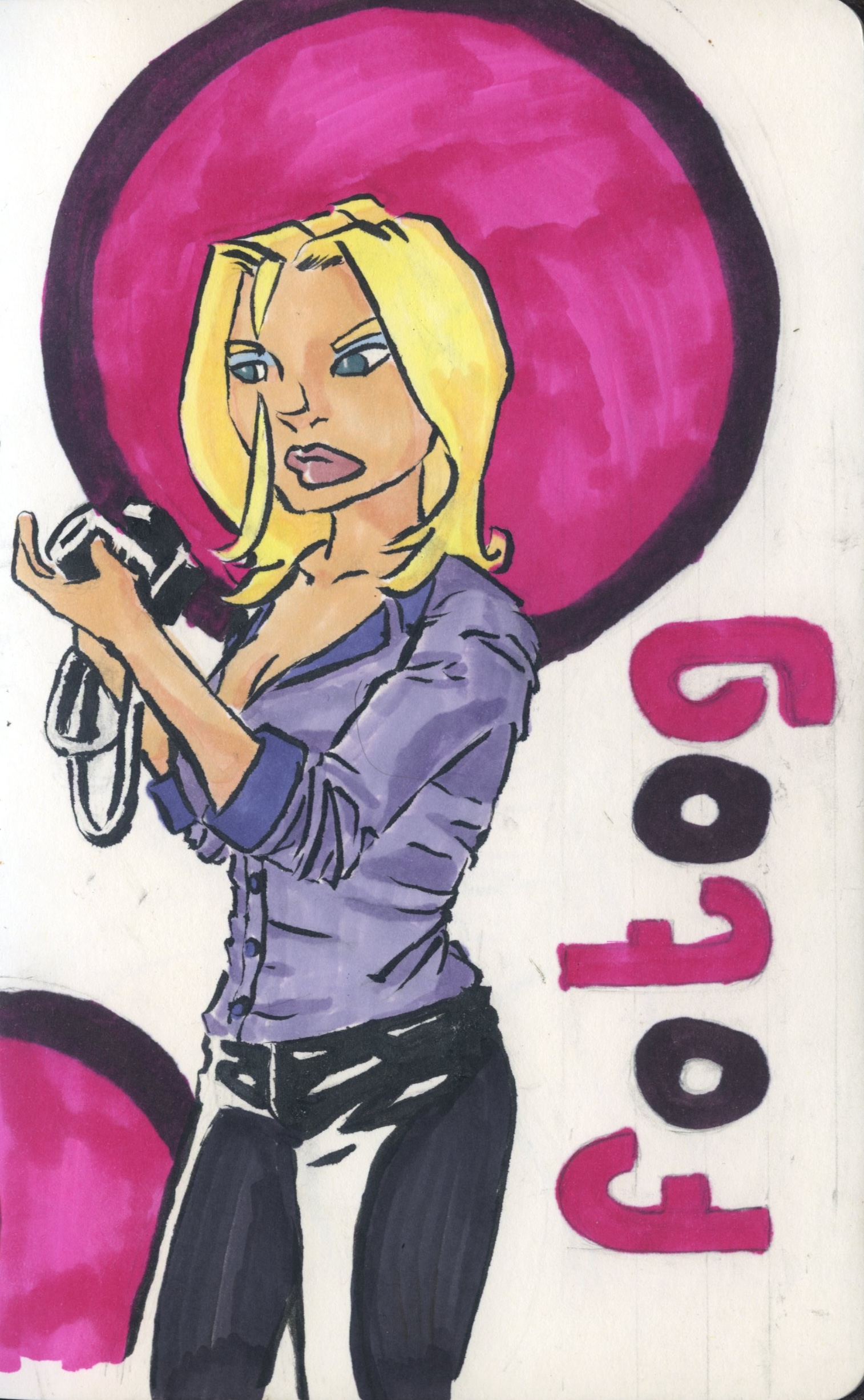
This is Regina de Costa. She was conceived by Kate to be a badass witch named Gina, and her creator asked me to write a novel about her character. I did so, and I added some details of my own.

Regina’s mother is Helena Torres-de Costa, the chief executive officer of a corporation so large and powerful, it has no name. It manipulates politics, sports, pop culture, and finances in order to maximize profit. The corporation is not a democracy, so Regina is heir to the executive office, by virtue of birth, as well as a lifetime of training.

Regina ran away from home twice, once when she was a restless young woman, and once when she was a crusader for justice. She’s clever, she’s ruthless, she’s imaginative, she’s fashionable, she is utterly insane, and she’s a heartbeat away from being the single most powerful person in the United States.

Words, Words, Words

If there’s one thing people know about me, it’s that I’m a writer. This goes all the way back to the fifth grade when I wrote my first short story, a Top Gun fan fiction. I showed it to my dad, and he had notes. Everyone’s a critic.

I have over thirty novels to my name, as well as countless short stories, a well-curated folder of most of my essays and blog entries, as well as a memoir and whatever the fuck “Three Stories in One” is supposed to be. Between “Three Stories in One” and my school newspaper column, writing made me a celebrity in high school. I went to college to learn to write. I moved to New York to become a writer, and while I didn’t become published, I certainly enjoyed the craft.

My marriage was great for me as a writer because she had an idea for a novel (I’d only written short stories so far), she got a lead on a contest I ultimately did pretty well in, and she bullied me into submitting my work. Ten short stories were published in various anthologies, but I got over sixty rejections on a novel I wrote by accident while she was in Namibia.

That basically stopped me from writing until seven years ago, when I entered another season of the contest and decided that I was going to write a novel. I did. And then I wrote the next one. I wrote the novels to write them, and I wasn’t going to kill my self-esteem with dozens more rejection letters. I tried again, submitting my best novel so far, but after thirty-plus rejections, I gave up.

Years later, I saw an ad for a writing service. Among the their many offerings is help (from agents and editors) with writing your query letters and synopses, copyediting for your samples, and help finding the agents and publishers your work is the best match for. I purchased all of these. They found me five agents and five publishers because I didn’t want more than ten rejections. I got nine. The tenth should be publishing me in a few months.

If there’s two things about me that people know, it’s that I’m a writer and a Doctor Who fan from way back. I grew up with Classic Who, where the effects were cheap (but very imaginative), the acting was not Method, and the serials were always one or two episodes too long. Then it got cancelled, and seven years later, there was a movie with flashy effects and motorcycle chases. When that went over like a fart in a car, they rebooted the series nine years later, and it runs to this very day.

I’ve loyally watched all of NuWho (or Who Redux) as they have gone from Doctor to Doctor and showrunner to showrunner. Prior to last year, the latter was Chris Chibnall. It did not go over well. It started going badly before his era even began because the Doctor was going to be played by an icky girl. I defended Chris Chibnall from the Doctor-Who-not-Nurse-Who/Go-Woke-go-broke contingent who were complaining about the writing so they could mask their sexism. However, I wasn’t enjoying the show anymore. When it wasn’t completely forgettable, the mythos was being torn down, and the character was being stripped of everything I loved about them. The problem was indeed the writing. As a writer, I’m not happy to say this.

When a project goes wrong, especially on TV, it’s almost always the writers. And considering how much people complain about the writing, it’s no wonder the studios want to use AIs to do it.

But movie and TV writing is not an art, it’s a science. In a movie, you must, by around page 55, have some kind of conflict. And the audience is so trained to expect this that The Avengers dragged a little in the middle because the epic fight on the Helicarrier took place on page 70. If characters don’t hit their beats like they’re supposed to, people can’t handle it. Look at the reaction to The Last Jedi. I tried writing a pilot, but I couldn’t make it fit into five acts.

Movies have endless script doctors fine-tuning every little thing. A sitcom will have rooms full of writers, fine-tuning every single joke. Producers and studios give their input. Actors love to give their input too, sometimes rewriting their lines. A producer (or a comic book editor) will have an idea, and they’ll make a writer make it happen. The writers everyone is complaining about are a committee, about as far from the process of writing I enjoy.

Don’t get me wrong—I love a good collaboration. Some of my favorite memories are sitting in Shane’s studio, bouncing ideas off of each other and creating a screenplay and a lost screenplay. But that’s not what happens. In movie and TV writing, someone is always reading over your shoulder and telling you they can do it better, unless you’re Neil Gaiman.

I used to want to be Joss Whedon (before we found out he was a violent creep) because he had made a brand for himself. He had fans who would watch anything he wrote, even Dollhouse. They picked apart his mythology, they obsessively watched for Easter eggs. I wish someone would do that to my stuff. Yeah, it would be great to have fans. I wish my other twenty-nine novels had readers.

On the other hand, I sit here in my cozy apartment with my swiftly growing cat, living my life with (mostly) peace and contentment. How miserable would I be if I were a professional writer?

If I were a novelist, I would still need a job because authors get paid shit (there’s a finite amount of money for authors, and it’s all going to JK Rowling). If I were a TV writer, I’d have to hustle just to make minimum wage while the studios figured out ways not to pay me, and I’d have to share my inspiration with a crowd and a belligerent showrunner. If I were a movie writer, the screenplay I poured my life into is going to be ripped up and reassembled, so I won’t recognize it.

The Princess Bride is a classic because of the performances and the art direction and costuming and sets, all brought together by Ron Howard, but every single quirk, every single quotable line came from William Goldman. You can’t have a movie, TV show, or comic book without the writing (though the founders of Image Comics gave it their best shot), but people don’t notice unless it’s bad.

I’m living my best life right now. I’m not famous, and maybe that’s okay. I used to feel like I was supposed to have a bestseller for my twentieth high school reunion, but I don’t want to hand over parts of my soul to people who have no respect for me. I’m a writer. I write. And that’s good enough for me.

Lovely Rita

When terrorists crashed planes into the World Trade Center on September 11, 2001, they inadvertently brought Rita and me together. You have to look on the bright side.

Basically, a high percentage of a tribe of friends in Brooklyn were born in September, so they couldn’t celebrate their birthdays that ear. One of them said “Screw that, we’re celebrating!” and threw what we would now call a rager. My girlfriend’s thirtieth was September 13, so we damned well went. She and I were at a point in our relationship where we were just fine not hanging out, so I partied like I did all my life by smoking cigarettes outside and letting people come to me.

The people I met that night were largely forgettable, except for a pair who came out kind of early with their manly Camels. They were like anime characters—the duo who look almost exactly alike, but one has platinum blonde hair, and the other is a dark, dark brunette. They introduced themselves as Anne Marie and Rita, respectively. I’m pretty sure one of them dropped a bullfrog reference on me, but Rita felt my pain because of the goddamned Beatles.

Rita and Anne Marie were, to be clear, really cute, and I was feeling like Mr. Charm by keeping their attention. Eventually, I became comfortable enough that I opened my wallet, took out the only money I had, and said, “I’ll give you five dollars if you make out.” They said no. “What can I get for five dollars?” They shook hands and took my money.

I probably never would have seen them again were it not for a friend from Nebraska. I had always thought of her and her husband as a unit, but she called to tell me they were getting divorced. I had never been through a friend’s divorce before, and I didn’t have any friends who might tell me what it’s like, so I tracked down Rita, who had described the nightmare of her own divorce in vivid detail.

Also, she and Anne Marie were really cool, and I wanted to hang out again.

Rita and I met at the International Bar, on First Street in Manhattan, between Second and Third. I haven’t been to New York in ten years, but it was still there then. It’s the kind of place you assume has multiple health- and building-code violations. Their bathrooms are single stall, without the space for a sink. It was there, outside, in full view of the entire bar, so if you didn’t wash your hands, we knew. They only served beer in bottles, and the only beer that didn’t taste like watered-down yak piss was Amstel Light. Rita answered my questions, and we became instant friends.

Rita is (still) thin, not as in skinny, but as in lean. One look, and you know she’s as affectionate as a housecat, but she is fully capable of clawing your eyes out if you do the wrong thing. Her eyes are as dark as her hair, and she does his goofy head bop when she listens to cool music.

Whenever I hung out with Rita, it was either one-on-one at the International Bar or we’d go to a larger bar to house the Group. The Group was kind of like a French-style salon. We were vulgar and talked a lot of dumb shit, but we also discussed politics and philosophy until we could drink no more. The group had a rotating cast, and they all had one thing in common: they all were really cool, even the dorky ones.

Did that mean I was at least kind of cool? I did introduce the group to a catchphrase. When someone mildly annoys you, you say in a flat tone of voice, “I never liked you.” We were independently fans of the same hiphoppunkfunkmamboska band. I played a crucial part in one guy’s trip-hop remix of our bar conversations. I kept getting invited back. It’s not like they didn’t know how much of a nerd I was—Rita and I had a sleepover the day I watched my beloved Sam Raimi’s Spider-Man.

Rita had a pet iguana. I do not remember the iguana’s name. I have asked Rita four times for the iguana’s name, and I have forgotten it four times. Next time I ask, she’s going to tattoo it on my arm. On Spider-Man day, I discovered that she had inherited some birds from an aunt (?) and kept them in a cage in her kitchen. She would never hurt them, but if they suddenly fell over dead, she would not be sad.

That was the first half of 2002. After June, we didn’t see each other as much, mostly because I started hanging out with different friends, who I had just met. However, after I bought a leather pea coat and took on the alter ego of Jack Murphy, cop on the edge, she started calling me Jackass Murphy because the true duty of your friend is to take the wind out of your sails.

She came to Jersey City for my going away party in 2004. My ex-wife told me afterward that she had said something mean to one of her friends. This only was the first time my ex would try to distance me from one of my people, but unlike the later times, she did not succeed. This time, I just didn’t believe it. Rita could get very angry, but she was never cruel. I assumed my ex’s friend had misheard something.

Seven years later, I wanted to honor the tenth anniversary of September 11 by making it a celebration of life. What I made it was the celebration of friends. I split the day three separate ways with three friends, each reminding me of an aspect of New York I treasured. Rita was the ability to start a new story, whenever you want. We went for a run in Central Park, we had dinner, and I played with her oldest kid.

Rita told me that, on September 10, 2001, she was shackled to a cubicle during the week and in a dehumanizing marriage. By the time I’d met her, she had gotten rid of both. She swore she’d never marry again, and she was never working in an office again. She hasn’t, twenty-three years and two kids later. It’s one of the things I admire about her.

I’ve always been a bit of a hermit, but for a while there, I was surrounded by people who wanted to hear my thoughts on a subject. They wanted me to tell a joke. Even though I make Obi-Wan Kenobi look like the wedding crashers these days, I did manage to captivate a small crowd on New Year’s Eve. I’d changed my story, and I don’t think I would have done that if not for her.  

Happy Birthday, Rita!

Regenerational Divide

All my life, I’ve been trying to figure out something about the show I’ve been watching since I was a kid: if Doctor Who is the same person, incarnation after incarnation, how are they so different? Like, for example, it’s not easy to picture Jodie Whittaker as the same person as Jon Pertwee.

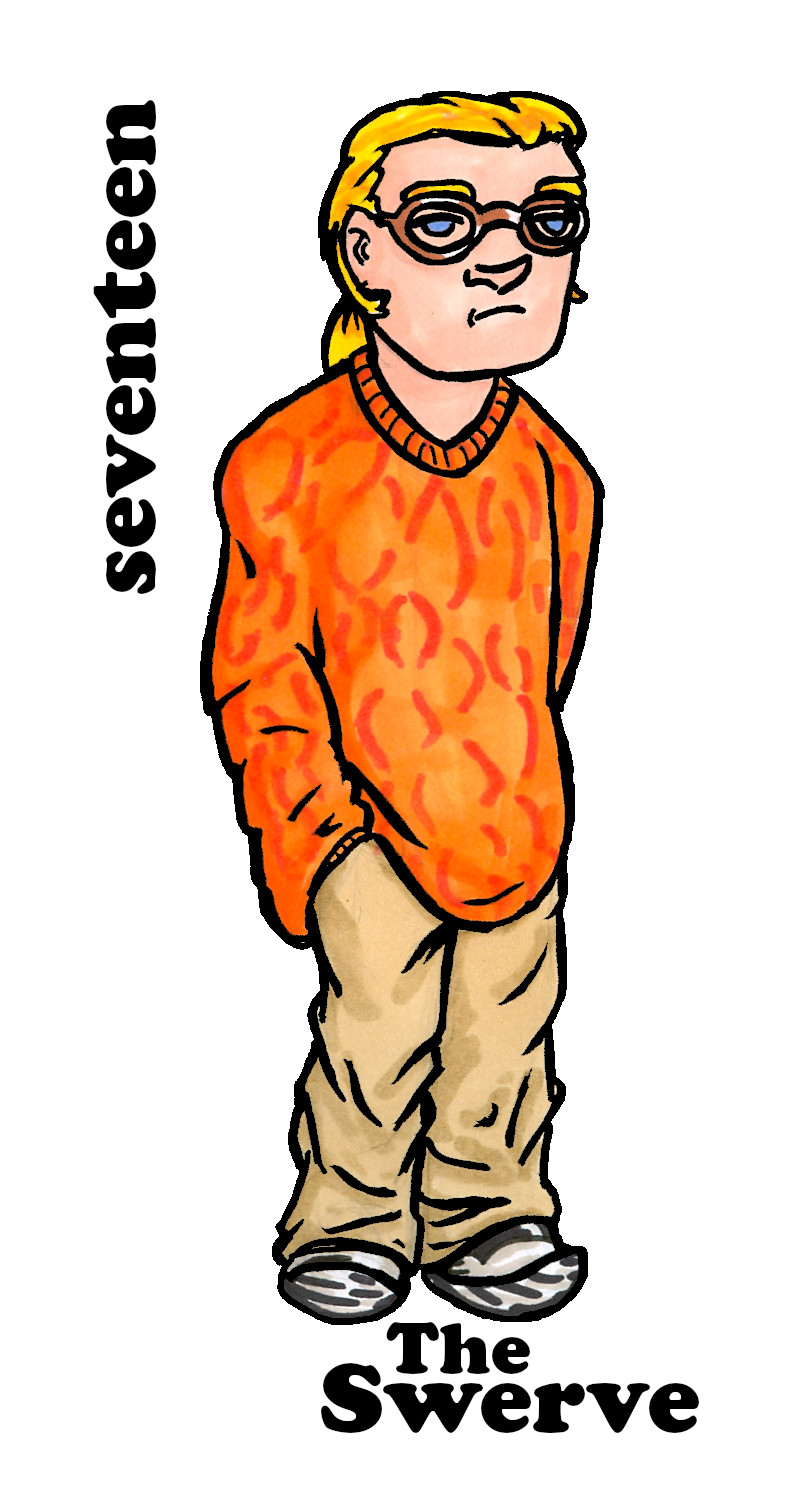
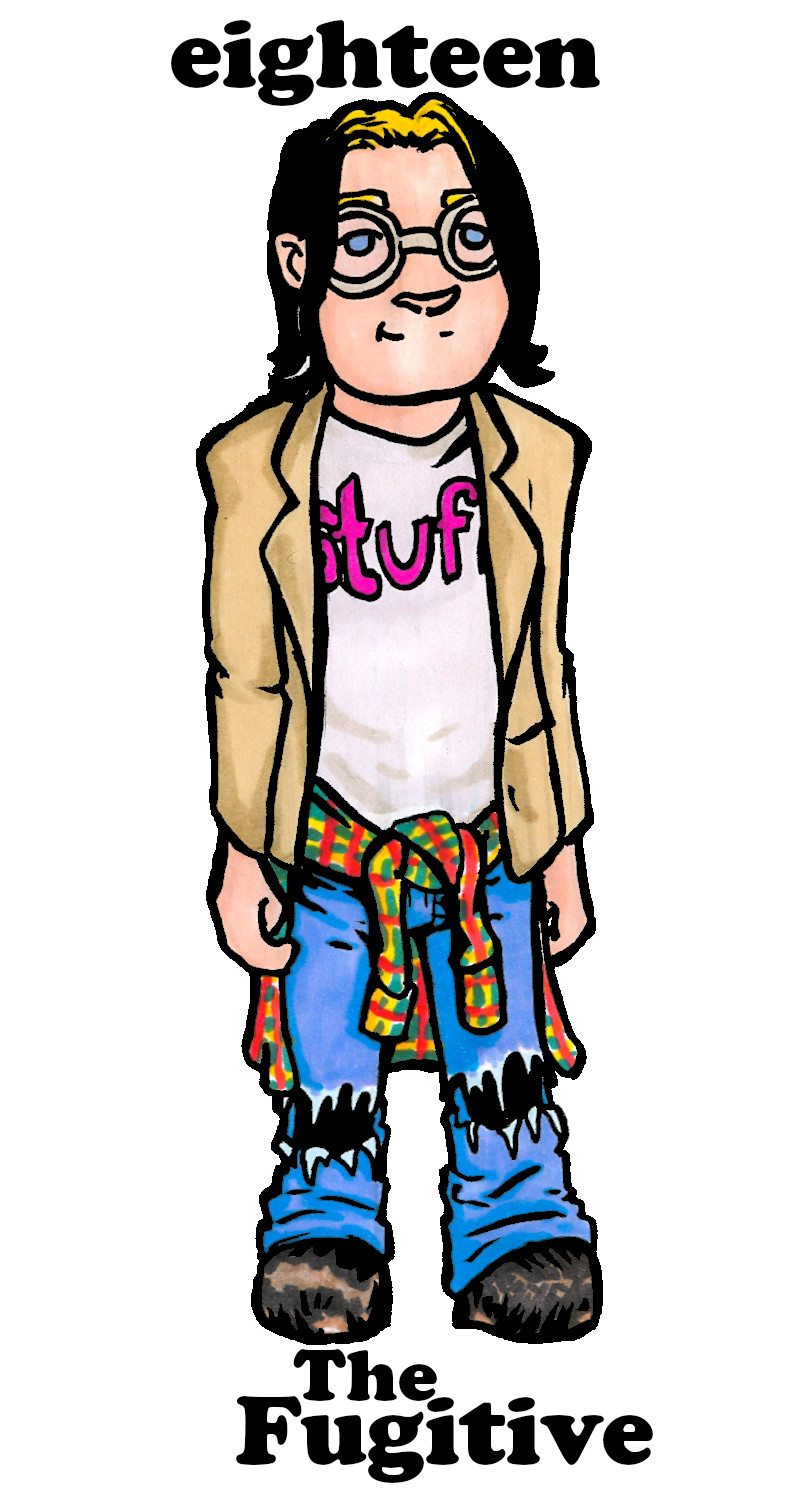
A few years prior, I had illustrated all the Doctors up to that point (including Matt Smith, even though we were still firmly in David Tennant territory), in a very cartoony style, so I took that style and reviewed my life, going back twenty-five years. Each year after that, I’ve drawn myself, including the years when I had otherwise quit drawing altogether (you can tell which years those were).

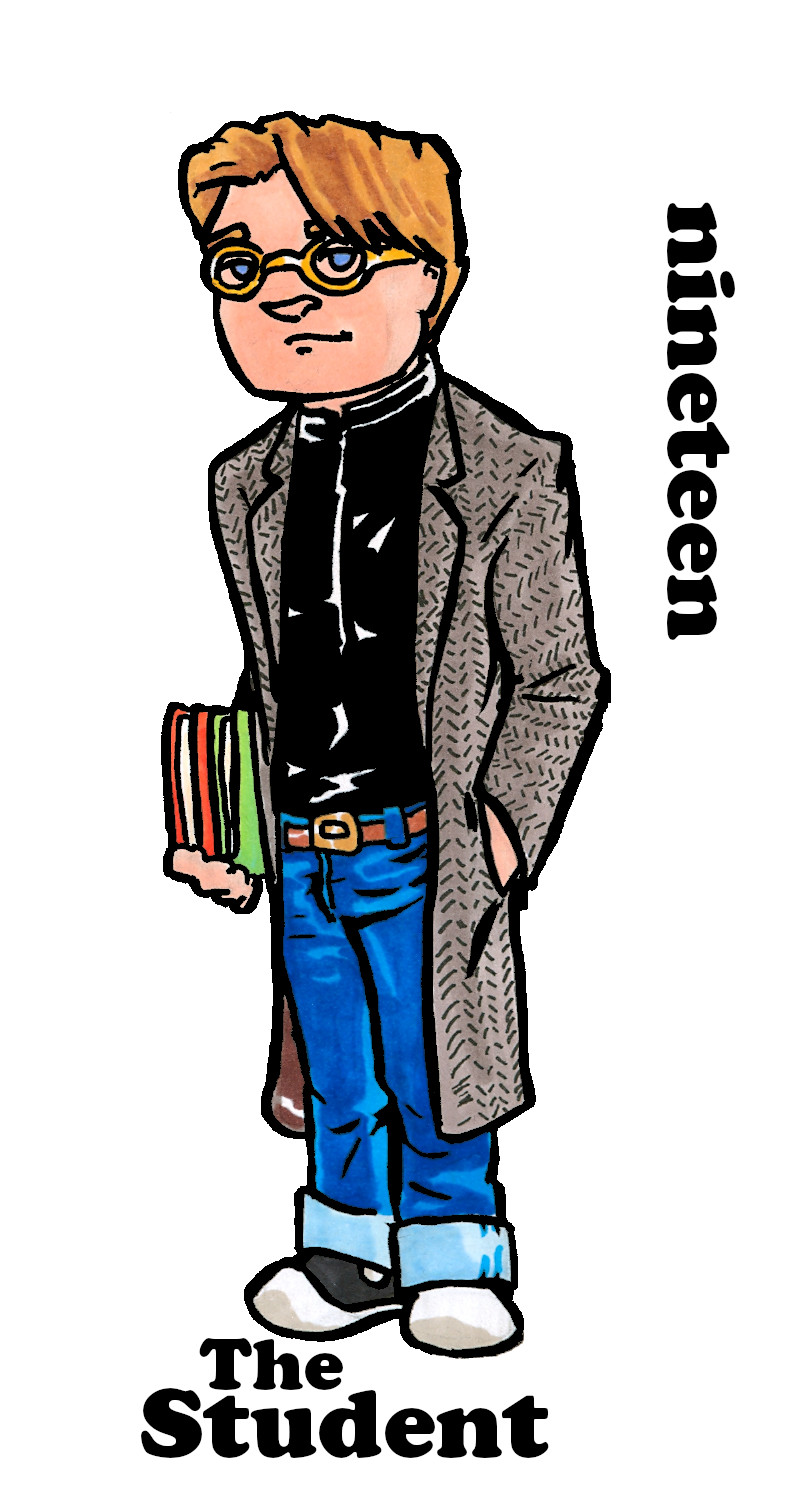
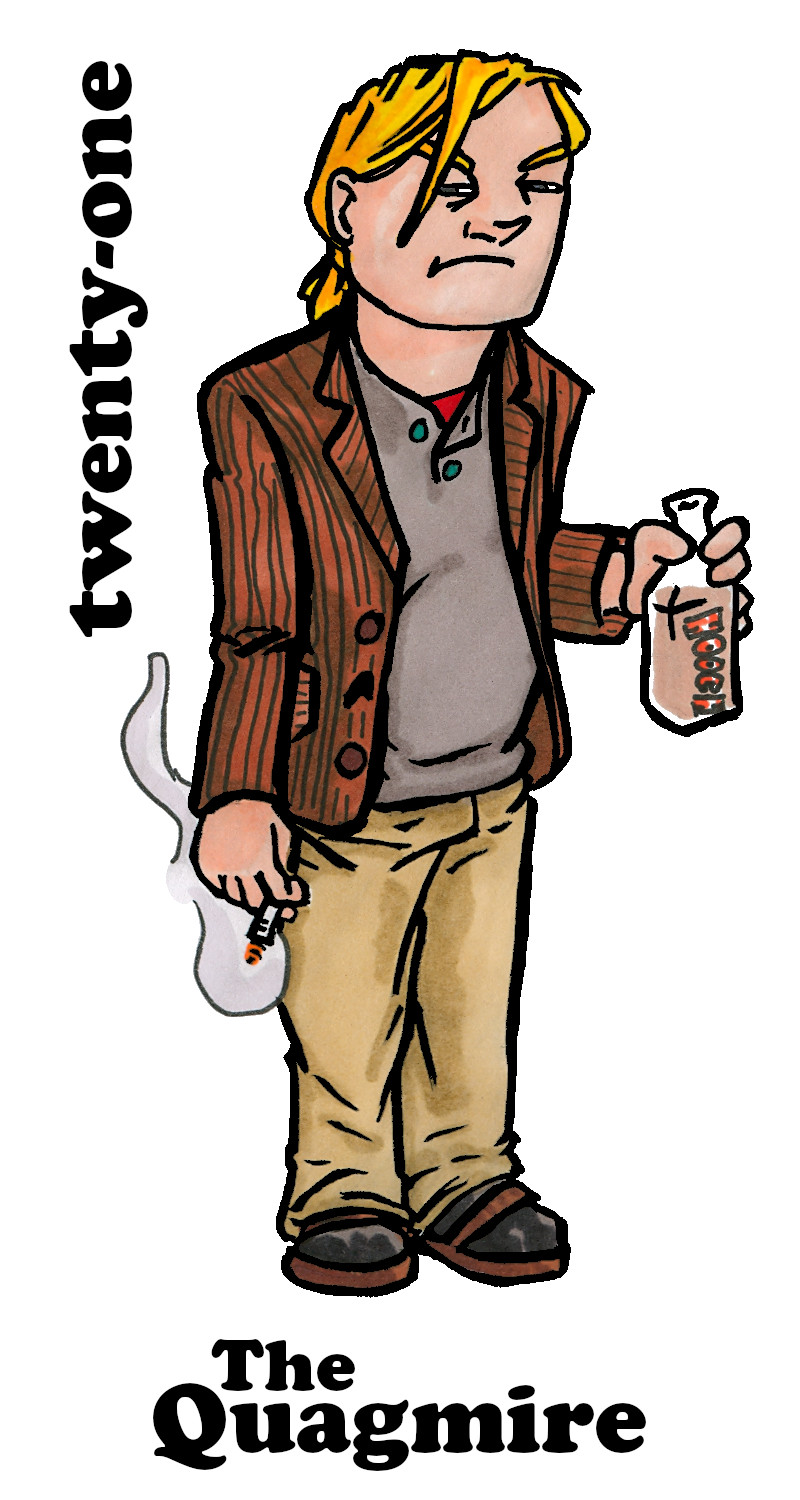
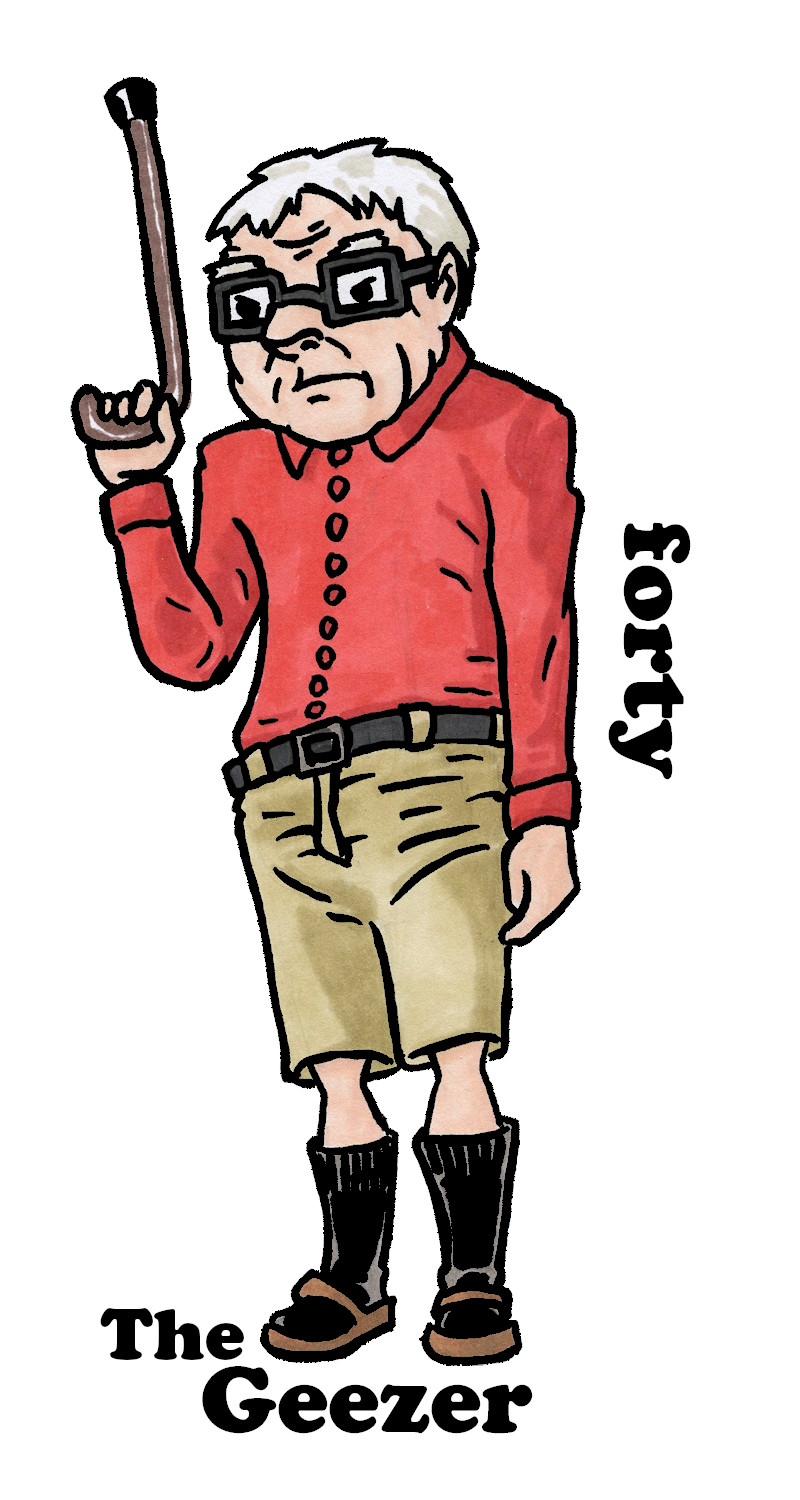
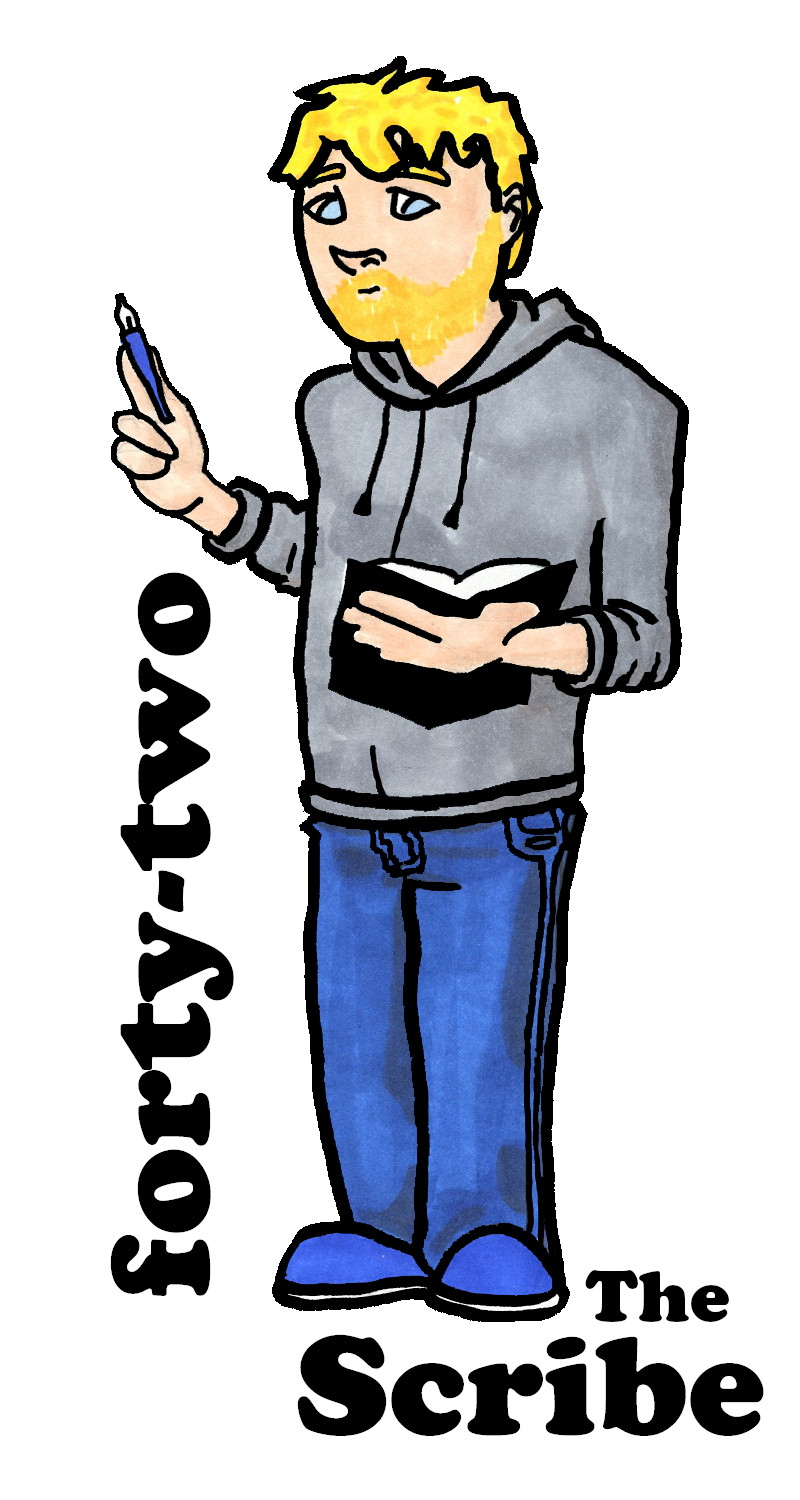
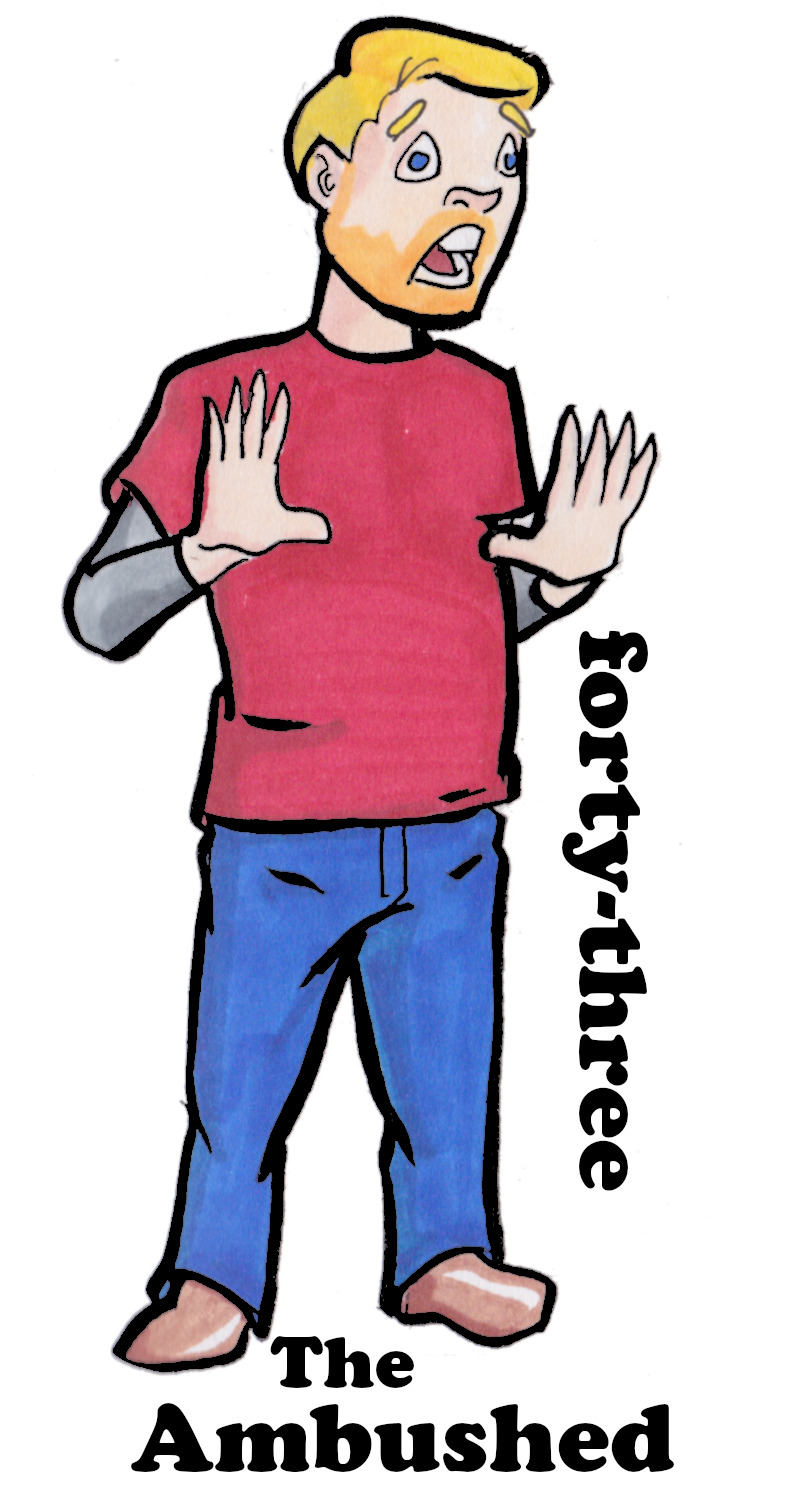
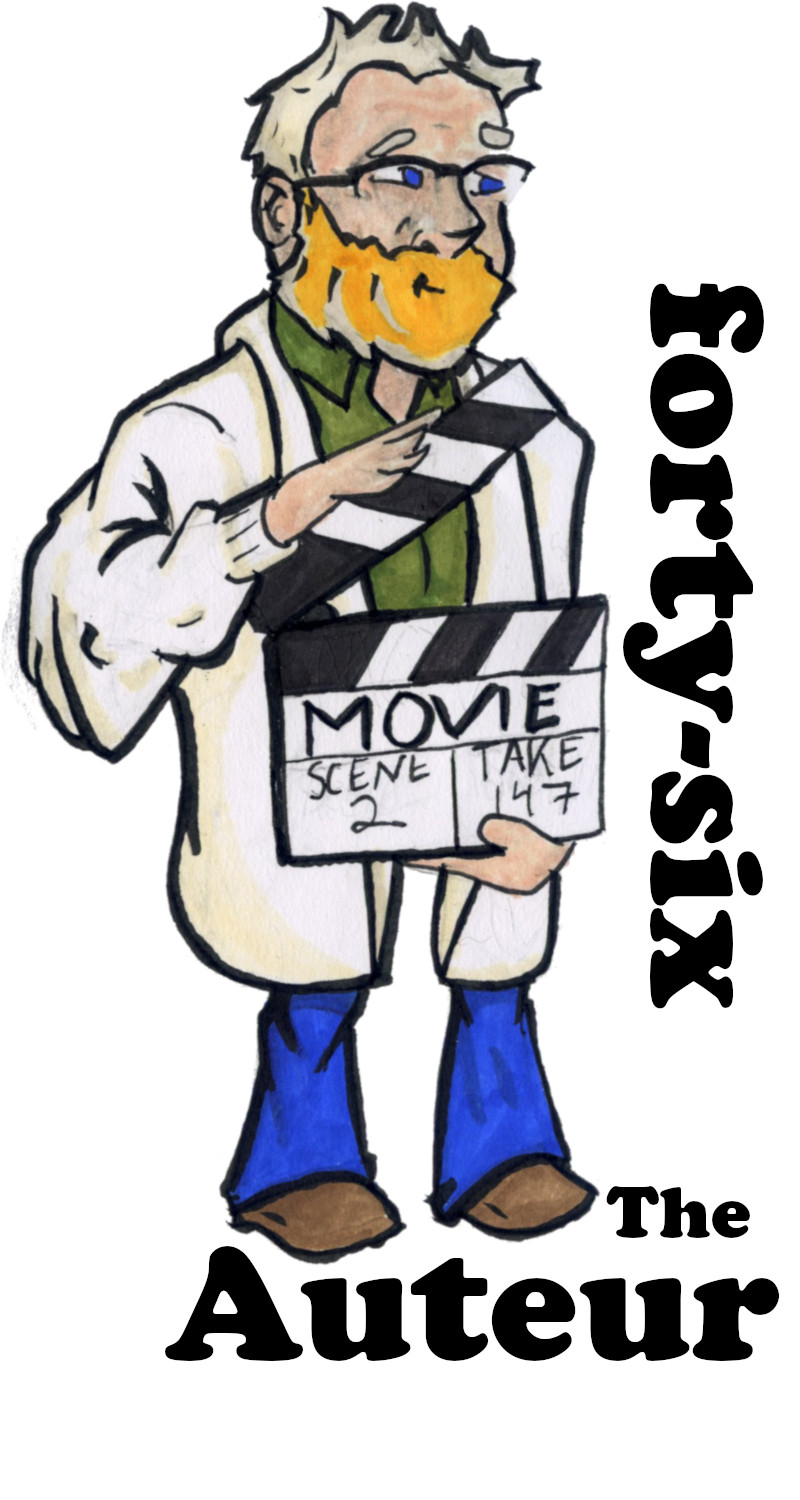
Later, I wrote a screenplay to challenge the question, in which a character based on me met up with four of his younger selves, going back to age nine, and I understood perfectly. Forty-eight-year-old me would not be able to stand a twenty-six-year-old me, and nine-year-old me was a monster. Without further ado, here are twenty-two incarnations of me.

And now, on my forty-eighth birthday, I’m taking care of a cat shortly after my last one passed away, so I guess that makes me a parent.

Enjoy your Sunday! I know I will.

That Crazy Witchcraft

My ex-wife is a card-carrying witch. She fancies herself a hedge witch, which means a solitary, standing between her village and the outside world like a hedge. She taught me a lot about magic, and while I don’t believe in it (though I made every effort to), I was fascinated by the lore.

When we were together, we had been working on a book. It was her idea, but I took the characters, added some more detail, and told the story. The novel has two interludes to tell you what happened while they attended a small, Midwestern, liberal arts college like no one I know.

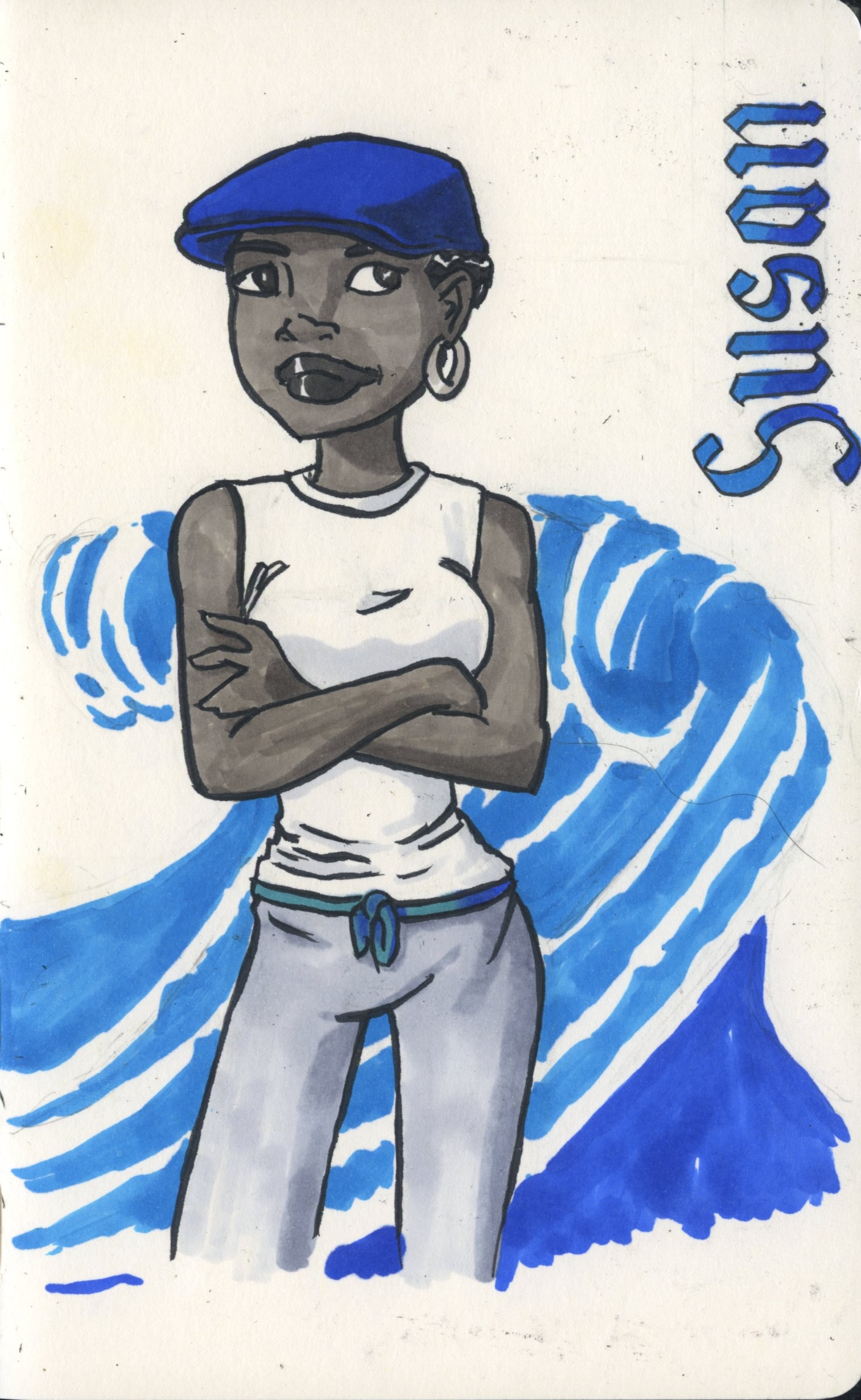
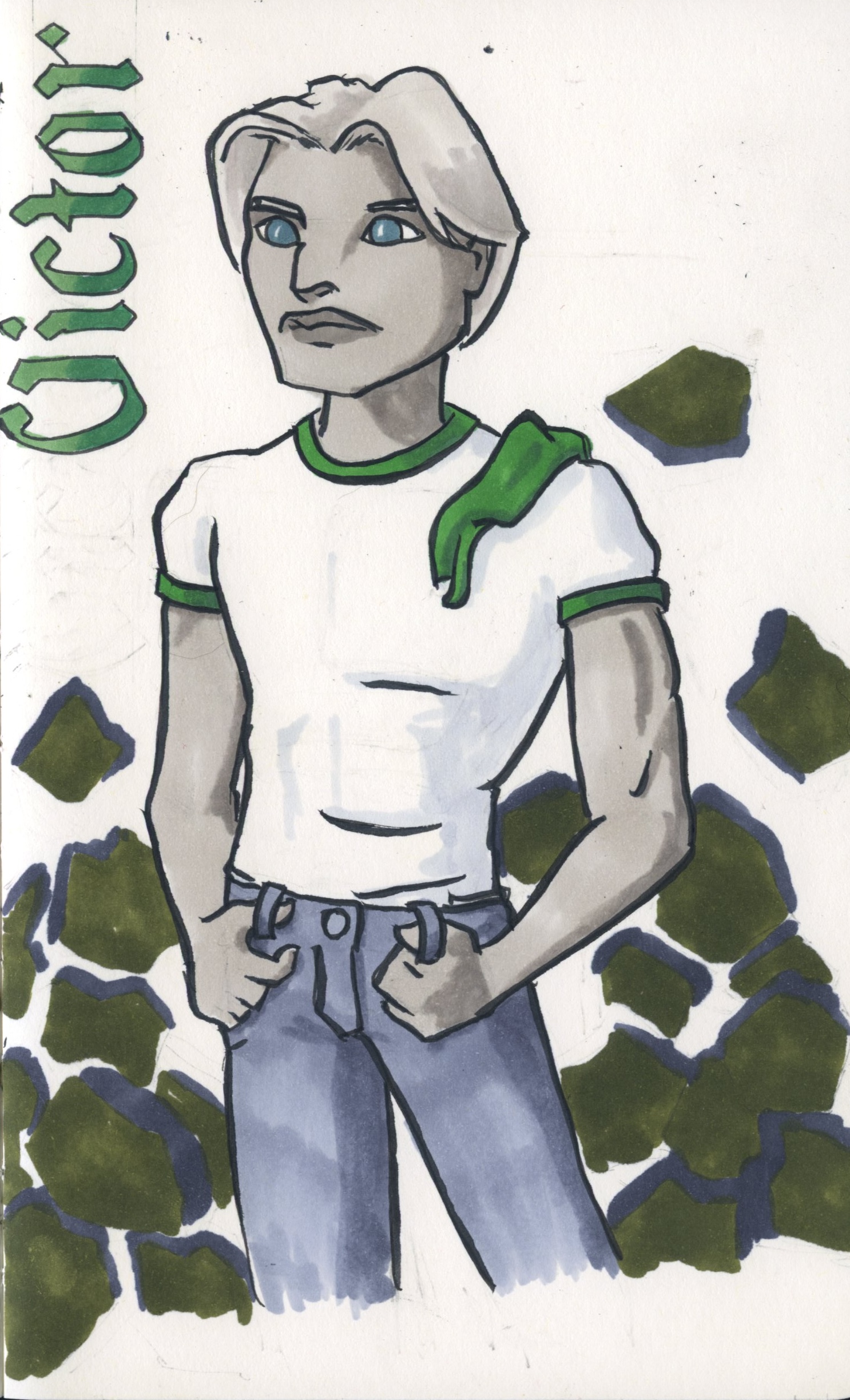
Something I learned about witchcraft or paganism from my ex was that witches had an affinity for one of the elements (air, fire, water, or earth), and that each of the elements has a corresponding color. I did drawings like these before ten years ago, and I wanted to update them for fun. This is most of the 2014 collection:

This is what I just did:

First, we have Jin Harima, a phonomancer, which means sound, preferably music, powers his magic.

This is Regina de Costa, the Secret Princess of the United States, run away from home.

Susan Young is a track star from Gary, Indiana. She’s not really into all this witchy stuff, but she is endlessly fascinated by Regina and will do anything she says.

And finally, Victor Huber, a farmboy and Regina’s protégé.

I haven’t really thought about them since I published their novel three years ago, but this was a nice trip down memory lane.

The Wrath of Gods

According to a philosopher named Giambattista Vico, there are three ages of mankind. In order, they are the age of gods, the age of heroes, and the age of men. I wanted to use this, in reverse order as a framework for three action comics that I would create. The first would be a grounded vigilante story, the second one a straight-up superhero epic, and the third one would bring the first two together in a unified vision of mythology (i.e. all the gods we know from legend are based on the same five beings).

This guy, the hero in the second book and one of the heroes of the third, is a demi-god. He has super-strength, so he wears a metal suit (and pants because he would look ridiculous in a onesie), and he gets around by leaping (the funky boots keep him from smashing the street when he lands).

When I developed him in the late nineties, early aughts, there were no gay superheroes, and that would have made him unique. His nationality is Mexican-American, which wasn’t necessarily unique back then, but it was definitely rare.

Unfortunately, all of the writing I did with the character was lost because Newcastle kept sitting on my laptop twenty years ago. The first image I did this week, using the black, white, and red style. The second I did in 2003, when I became more sure of my skill.

An All Hallows Eve That Will Live in Infamy

To explain to you what went wrong on Halloween night, 2003, I have to tell you about Satanicide.

If you’re an educated Satanicide fan, at some point you have had this conversation in your head: “Doesn’t –icide mean to kill? Killing Satan? They’re on God’s side? Or are they just that stupid?” You never learn the answer to that question because the band in question rocked your face off. Satanicide was a Spinal Tap style of band, i.e. comedy, but can actually rock out.

Front man, the voice, Devlin Mayhem, was played by Dale. Devlin represented hard, biker rock. His chaps even had flame-detailing on them because Dale’s girlfriend (now wife) is amazing at that kind of thing.

Aleister Cradley, played by Phil, is a glam rocker, complete with teased hair and spandex tights. Part of his joke is that he’s an f-word but doesn’t know it. In the Satanicide movie, Aleister moons over Devlin while their cover of “My Heart Will Go On” plays in the background. I thought it was funny. Other people might not. This will get me into trouble during the Halloween in question.

Satanicide goes through a lot of bassists, and their replacements are always relatives of the first one, Baron von Goaten. None of the von Goatens could speak English, and, mentally, they weren’t operating on the same world as the rest of us. Last I checked, they all wore masks to hide their Frankenstein hideousness from the world. I’m pretty sure the second Baron was my contemporary. He might have been the first. His name was Jake, and he was the sweetest guy. The von Goaten clan represents European metal, which is some weird, scary shit.

English punk was represented by Sloth Vader. One minute, he was tearing some shit up in London, and then he wakes up in a dumpster in New Jersey, so he joined a band. Griff, the English guy behind Sloth, was a big guy. He loped along like a bear. So when I tell you he routinely did stage dives on top of me, you won’t question my commitment to taking one for the band.

I first saw them because Beth invited me to a show. She did that within five minutes of meeting me, before she even asked me for my name, if I remember correctly. Since that initial concert, I don’t think I missed more than one show during my last two years in New York. Beth’s boyfriend was Dale, so we had the inside scoop. I even recommended a fragment of a song that Devlin sang at one of their concerts (“P is for pussy, that’s good enough for me!”)  

In 2003, Beth thought that it would be funny if, on Halloween, Steve and I dressed as Devlin and Aleister, respectively, and go to a Satanicide show. I thought it was a brilliant idea, but my execution was loathesome and half-assed. I wore a curly wig when Phil’s was straight. I couldn’t find exciting tights, so I wore these pants that looked like a cheetah-print pajama bottom. I wore makeup like a drag queen, thanks to Beth. Steve’s costume was on point. We were a terrible mismatch.

Right before we left Steve’s apartment to go to the bar, we had to decide if we were going to eat something for dinner or do vodka shots. We didn’t have time for both. We chose vodka shots. Later at the bar, before the concert, we did shots again, more than once. We watched the show with beers in our hands. After the show, I had a Jack and Coke.

It was in that state that I encountered Moby. That Moby. He went to high school with Beth and Steve. I called him a homophobic slur. The reason I did was because juvenile gay jokes were part of the Satanicide experience. However, this did not endear me to him. Next, I encountered Ed Helms, who was a very, very loosely defined neighbor of Dale. Ed Helms is a cool guy. On the street you will recognize him as Ed Helms, but he looks completely different than the dork that is his brand.

I sat down at the bar and ordered another drink. After I finished it, I swear there was an earthquake, and I fell off the stool. Immediately, I was escorted out of the bar. I ran into Beth and Steve outside, having a cigarette, and we all agreed to call it a night. Beth went off on her own adventure while Steve took me home and put me on his couch.

That’s where I proceeded to puke all night, like young Regan on The Exorcist. That was not the worst part. The worst part is that I tried to cover it up.

Steve missed this because he went out alone after he’d dropped me off. Later, he described himself as kind of a zombie, but one with a single-minded focus on eating a slice of Ray’s Pizza. When he arrived at the storefront, he lurched up to the counter and somehow ordered a slice, which they brought to him lickety split. As he was walking away, tasting victory in the mozzarella and sweet tomato sauce, he noticed the long line he had just cut in front of.

Beth went to sleep on the sidewalk somewhere.

I don’t know what happened to Moby.

Steve and I never spoke of how I befouled his couch.

While Beth agrees that the night was pretty horrible, she can’t stop talking about it. She treats it like it’s a warning tale for the youths.

I had a hangover for days. I didn’t quit drinking until 2007, but when I was coming up with reasons to stop, Halloween 2003 was Exhibit A.

The Book of Jobs

Here is the last of my work portfolio to share.

First is a job I did for the husband of a friend who wanted to bring photo booths back, in time for the holidays. It was back when I worked a lot in Photoshop.

Next is a day care/tutoring business (I think) called Sprouts that my friend Vicky was starting. I did a lot of different versions of this in several different colors, but this was the one I decided to go with.

The rest weren’t for money, just fun, like the gift I made for Vicky for teaching a cardiac kickboxing class that I loved and feared at the exact same time.

And finally, I made a birthday card for my friend Maryam about ten years ago, when she was terrified of cats. The ones stalking her belonged to our mutual friends, Samir and Sammy.

These are all at least ten years old because I kind of stopped drawing at around this time. I want to start doing birthday cards again, but I have no idea what to draw.

Chuck Norris, but with Kittens instead of Guns

I was chatting with my friend Lisa, and she said, “I want to see Chuck Norris, but with kittens instead of guns.” This was a trap, and I fell for it. Immediately, I started looking up Chuck Norris pictures, and when she Photoshopped what she had in mind (it was a terrible Photoshop), I said, “Thank you for bringing this to me instead of going to an AI.” She said, “I hate AI so much.” This was the ethical (and fun) way of entering a prompt and getting an image out of it. So here he is, Chuck Norris, but with kittens instead of guns, as well as proof I did it (thumbnail, pencils, backgrounds, paints).