
I love how, at this time of year, night kind of sneaks up on you. The first Friday of the month, I leave my apartment at about five o’clock for the Jubeh Bazar, with the sun hanging low, but not quite setting. When I arrive at five thirty, it’s full evening.
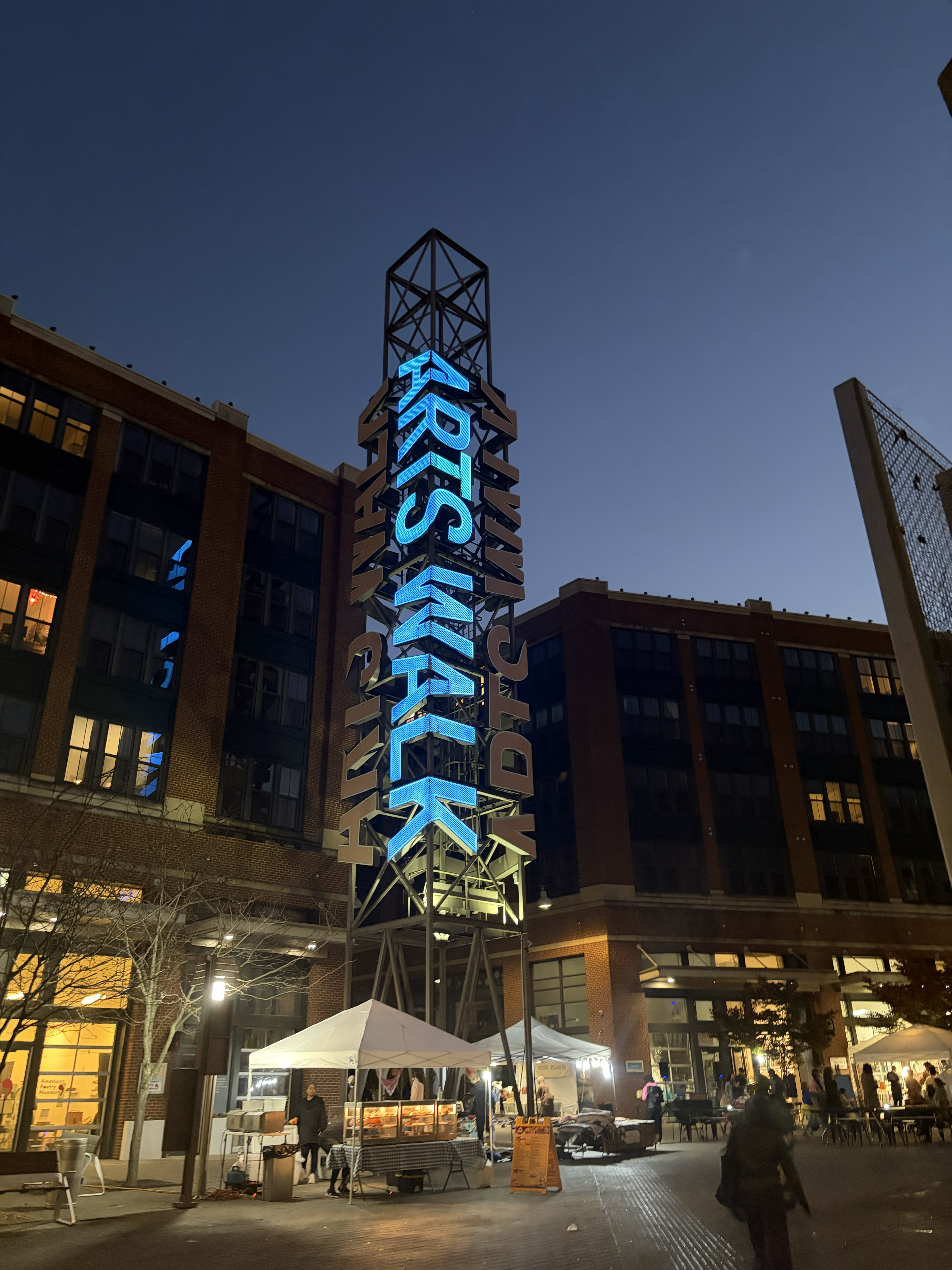
Pictured: a flame for a certain kind of moth
I’m greeted at once by Isa, who leaves the safety of his coffee-and-tea table and greets me with a handshake that transforms into a hug. The first time he did this, it alarmed me; this time, however, I go with it. He’s located next to the DJ booth’s giant speakers, so it’s a lot harder to talk, but I discover he is selling books in addition to his baklava and hot and cold drinks.
Pictured: Words, words, words
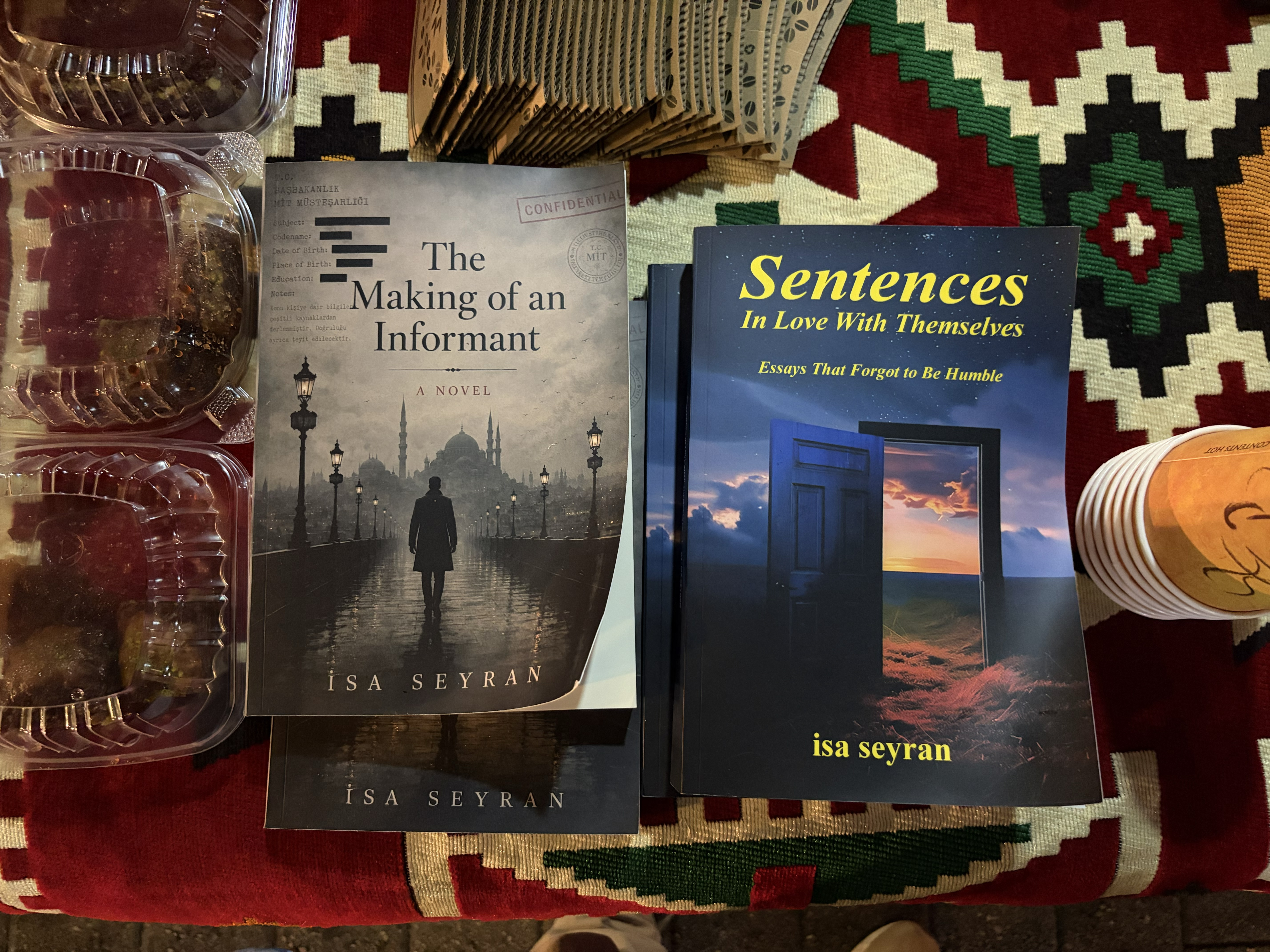
He has four books for sale: a spy thriller called The Making of an Informant; a bilingual poetry library called Kendi; his memoirs, Waiter; and Sentences in Love with Themselves, a collection of essays with a title so clever I have to buy one.
His slick website (https://isaseyran.com/index.html), unveils a vision. Whether he’s introducing you to the people he’s collected at the Ballstonian or introducing you to his world on the page, stage, and film, Isa is a consummate host. He yells out to passersby to introduce them to his beverages, and he has the nerve to call himself an introvert.
One of his customers is an elf with a raven pixie cut, a black bomber jacket, dark skinny jeans, and a camera slung onto her hip. She is overjoyed to talk to Isa for the first time, as are most people, but she’s as relaxed as a cat in a room full of mousetraps. We’ll get back to her.
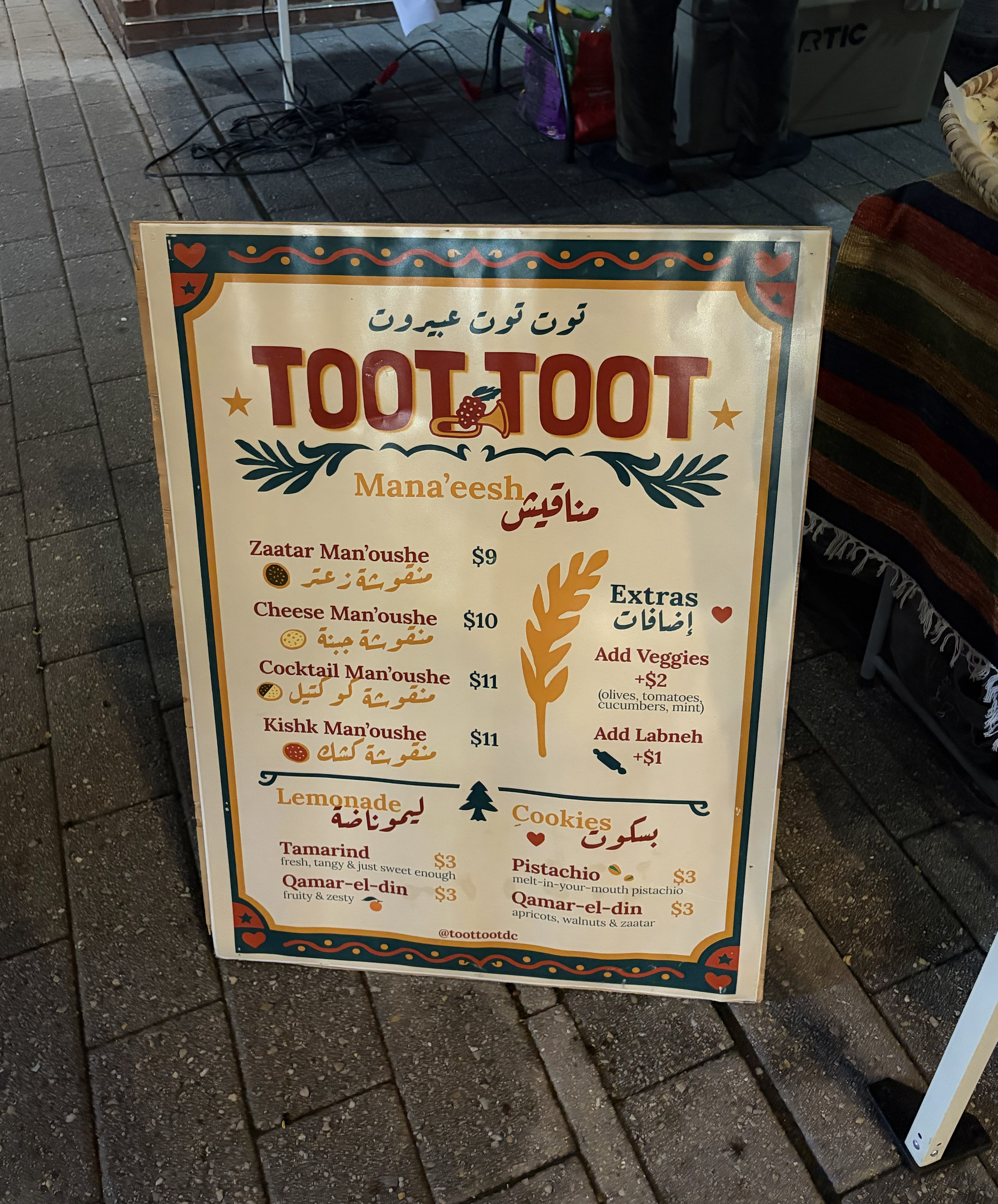
The second thing I do at the Bazar is find something to eat. This comes in the form of Toot Toot, a Lebanese popup. I’ve had a man’oushe with them before, and I remember loving it. This time, I ask for a recommendation, and they talk me into the either blue or goat cheese. I choose the latter and optional labneh. I can come back in ten to fifteen minutes to pick it up.
Pictured: Refreshment
With all this time to kill, I take my Turkish tea and find Zack, where I get the most baffling reading I’ve gotten so far.
Last month, two things Zack told me to watch out for a pair of trees and something snake-related, both of which have messages for me. I’ve spotted a pair of trees on the corner of my apartment building, but the only message they seem to be making is the Wing Stop behind them. I explain this to Zack, and he tells me to keep looking. They symbolize something, and it’s important I know what it is.
As he prophesized, I’ve been bombarded by serpent imagery in October because of something that’s hard to admit to: I’ve been swept up in the Malfoid craze. I suggest you look it up. It’s made up of something never been crazy about (Harry Potter, even before its creator turned into a monster) and it’s something I loathe (AI). It’s a deep-dive in the Slytherin House, represented by a snake, and features genderbending and flirting. Zack interprets this to mean I’m looking for some kind of a connection.
Pictured: the future
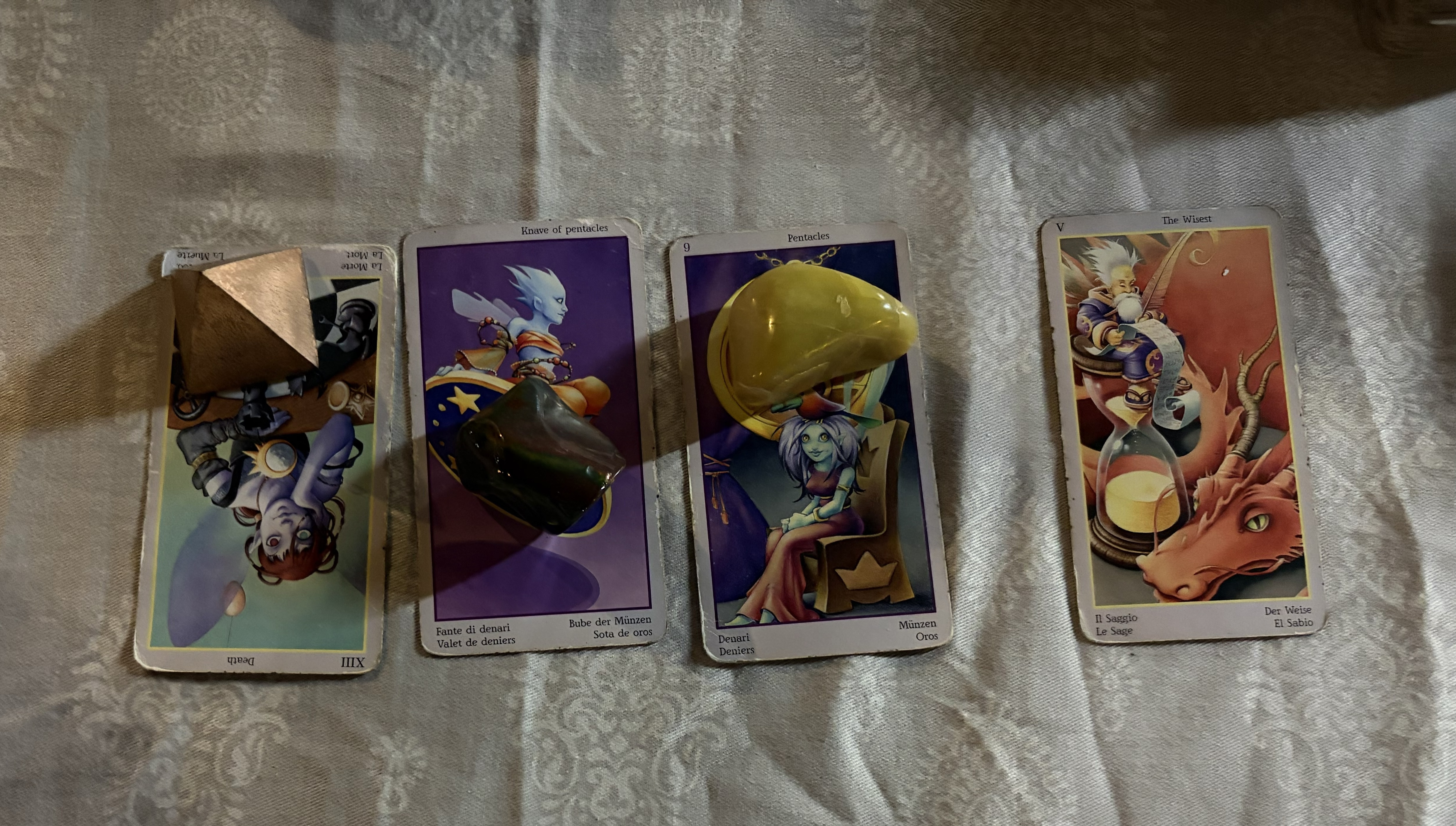
With this month’s spread, he draws the death card. He says, “There’s this meme that the death card only means a spiritual death, but it actually means a real death. Probably not yours.” He’s seeing something about keys, which I collect them; also, I have a set of Nicole’s so I can watch out for her cat, Henry. Recently, I had to take an emergency trip to her apartment to bring of my two set back to her. (“Yes,” Zack says.) Two hours later, her cat Henry has a heart attack. (“That’s it!”) But Henry made a full recovery. (“The cat’s gonna die, I hate to say it.”)
He also brings up a bird of prey, and I tell him I’m a big owl guy. I also go to ground from my birthday to late September, when I peek my head out. It’s interesting I put it like that, he says, because the summer as my journey into the underworld, as represented in the death card.
The underworld motif explains the thing I need to remember more than anything else. He asks how I feel about pomegranates. I tell him I’m agnostic. He acknowledges I’m happy living my little hobbit-hole life, but I still need someone to share it with. He tells me the pomegranates are the key. He doesn’t say why or how, just pomegranates.
A half-hour after my man’oushe is ready, I pick it up and wander, shooting off a quick, one-handed text to my closest friend. She asks me how my reading went. I tell her about the pomegranates. She tells me she just got back from the store, where she bought a fresh pomegranate.
I have to sit down for a moment.
I go back to Zack’s table and tell him. He high-fives me.
On my way to the Ballstonian, I peek my head into the Sewing Machine Petting Zoo. Even though I know nothing about sewing, I’m impressed with the age of everything.
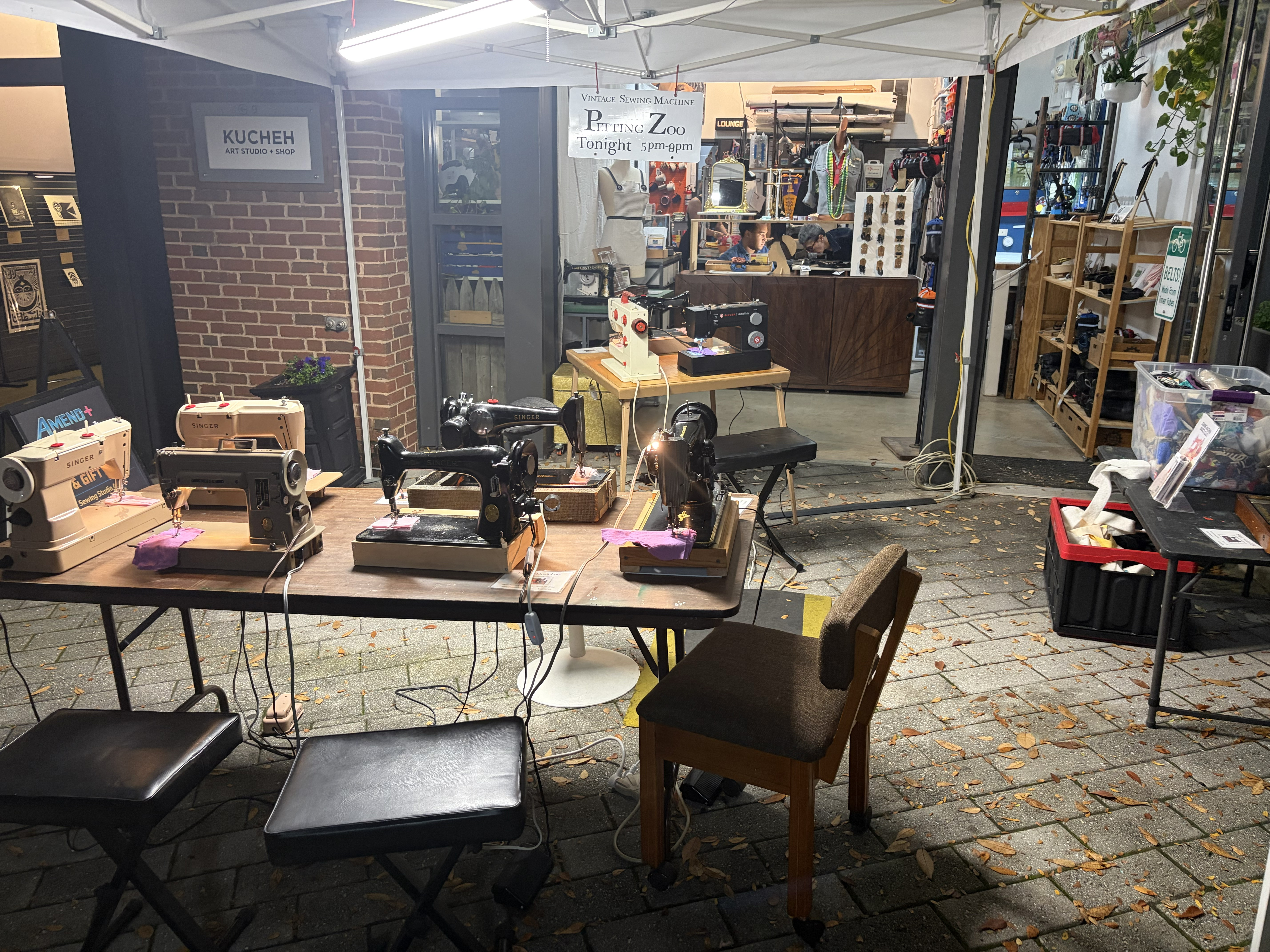
Pictured: natural habitat
I hang out with Isa a little more. He’s being a salesman, as per usual, and I get a chai and attempt to pay for my tea from earlier. He takes the money for the chai, and that’s it. I pass him my second credit card so I can buy Sentences, which comes with a spicy hot chocolate. He rattles off a list of ten ingredients, none of which are sugar. “Oh, and nutmeg.” Of all the writing he has done, the essay is his favorite. It’s the direct conduit from the mind to the page. You don’t have to persuade, you just have to be. I tell him I used to write a lot of essays in my blog, but now I mostly tell people what I’m doing, which seems to be what they want. He now has my website. He will probably be reading about my early impressions of himself soon.
It’s time to wrap things up, but I have a feeling it’s going to take a while. First, I see Saira, the master of the herbal concoction. I tell him that “De-stress” stressed my cat out, and he explained that valerian root smells like catnip. Mystery solved. He introduces me to his new blend, a mixture to get me through the winter months he calls “Warmth.” With my purchase, he gives me some “Warmth” tea, it takes the edge off the chai and Turkish tea. It feels good to be a regular.
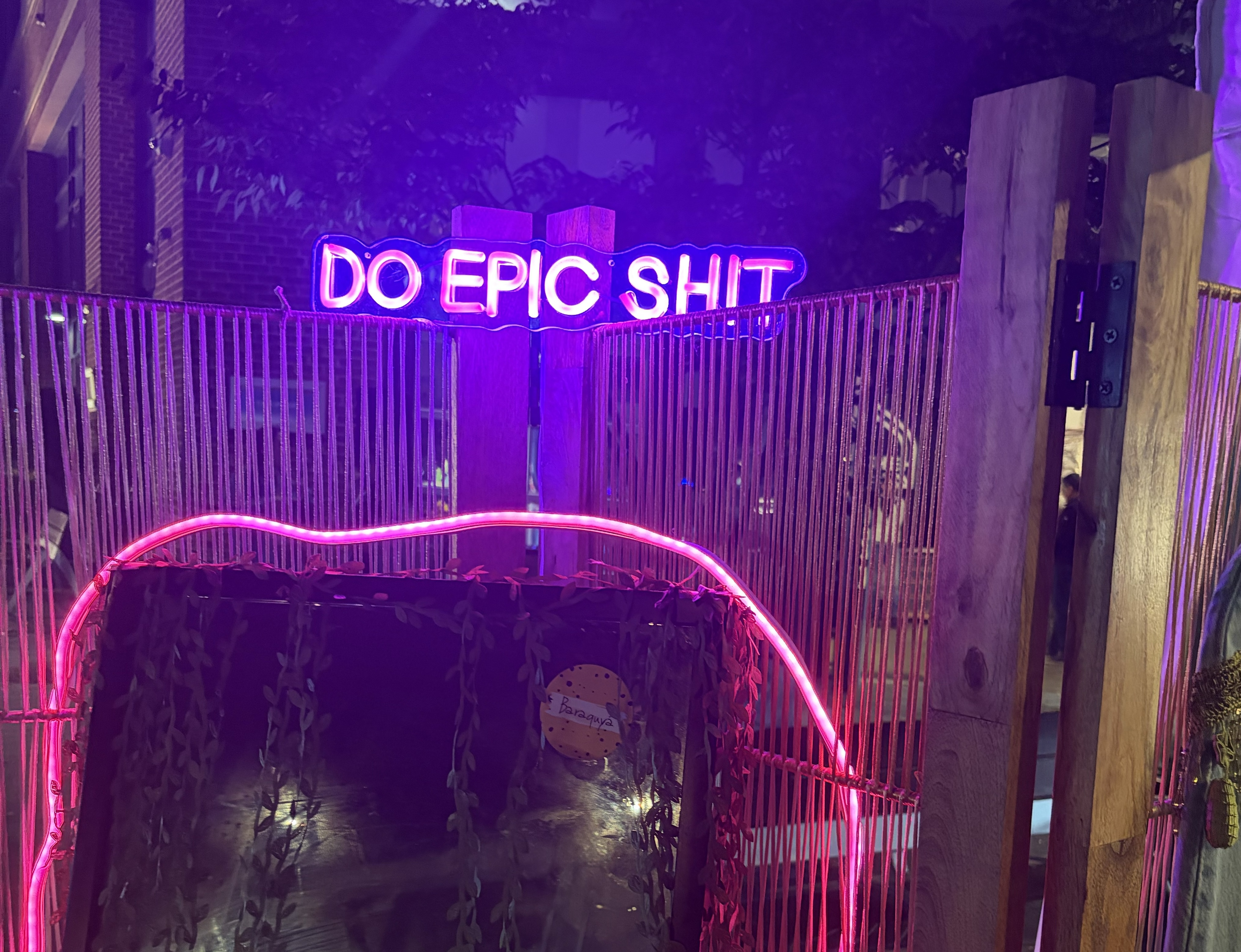
Pictured: epic shit
This time he’s sharing his tent with someone whose name I don’t catch, but I think of her as “The Designer.” I also don’t know the name of her shop, but I think “Do Epic Shit” is a perfectly good one. Her designs are aggressively artistic, Bohemian chic, with patches of color that match, but only barely. There’s a belly-dancer aesthetic to them too.
I have a nice conversation with her about her style, mentioning that fashion is the reason I draw mostly women. She’s always wanted to incorporate paint into her clothes, but it doesn’t stick well to the textiles. I recommend P.H. Marten, a paint with the texture and viscosity of ink.
What’s amazing to me is that it feels like these virtual strangers are really listening to me and trusting any expertise. From the designer frantically typing “TH Martin” into her phone to Isa looking up my blog as I talk to him, I’m not so much an extra as a part of their lives.
This is no more apparent than when Mina explodes with joy upon seeing me and tackles me in a hug. She has to do “marketing shit” for Instragram, so she can’t hang out and talk, but she needs to take a moment to tell me how much she loves my blog—I’d sent her the three Bazar entries I’ve written thus far. When she didn’t respond to the message I sent her with the links, I assumed she was just being nice, but she was just busy and forgetting, just like the artist she is.
I’m left alone with her partner, and I tell him about the pomegranate and my friend, and he’s as blown away as I am. I see a print of a pomegranate on the wall, and we’re blown away by that too.
As we’re chatting, the elf returns, and she continues a conversation with him about meels. She is paying no attention to me, so I wait patiently for her to leave, until she unexpectedly turns her whole body around to explain to me what meels are. She describes them as bowling pins that you twirl with your whole arm. She even shows me a video. “Bowling pins” is an inaccurate description. What the massive men are hefting are the size of butter churns.
I ask her about her camera, and she tells me she likes to do documentary photography, especially portraiture. She hasn’t found a subject that’s caught her attention in years, but she still brings the camera with her, just in case. A jane of all trades, she dabbles in all kinds of media, but her current true passion is a salt cellar done in the style of the Armenian goddess Anahit. She keeps producing them and would like to make a shrine out of them someday. She just can’t figure out why.
I ask her really good questions, which alarms me because I’m not very good at that that kind of thing. The whole point is to get her to tell me why. Does she identify with Anahit? Most importantly, is it okay if it’s just because she likes the process? With each answer, she laments her inability to answer her question while answering it with depth and insight. The last thing she wants is to be doing it because of her cultural heritage.
She’s jittery, but she seems to like talking. Her tangents are sure of themselves and don’t sound at all like nervous babbling. Her enormous, dark eyes hold mine as she brushes hair that isn’t there behind her ears. I don’t talk about myself at all, but I don’t want to. I’m not used to conversing with artists who love to discuss their craft, so I savor every moment. She shows me a picture of some of the cellars and tells me that cutting out their tummies is her favorite part, which is kind of sick.
The whole time we’re talking, I’m aware of the pomegranate print over her shoulder.
Even under the influence of the Ballstonian delights, my bed calls to me from a Metro stop and twelve-minute walk away. I excuse myself, and she falls apart subtly. She’s afraid she drove me off by talking to me for what may have been forty-five minutes. I assure her she’s a fascinating person, and I’ve enjoyed everything she had to say.
I shake her hand. “I’m Jeremiah.”
“I’m Aziz,” she replies. She gives me a second name. “Aziz is my pen name. The other on is my … I’m Aziz.”
There’s no reason I shouldn’t ask for her Instagram handle. It even crosses my mind to do so. But I don’t.

