Art to Art

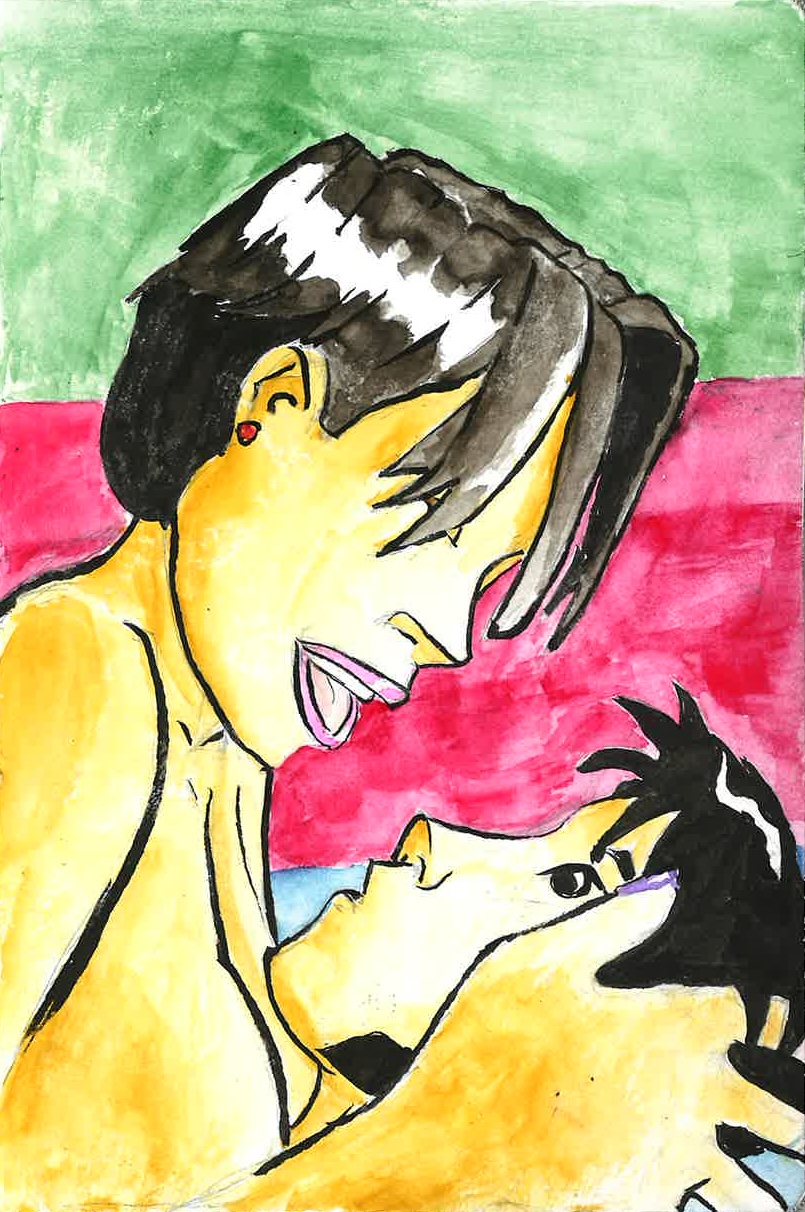
I’ve been feeling really self-conscious about my art lately`. I’m continuing to draw, almost compulsively, and paint or color, because I like the act of doing it. Unfortunately, I am not that crazy with the results.

I obsessively catalog and curate my art, going back almost as far as I’ve been drawing, which was 1998. I started out sketching in lined notebooks or whatever I could get my hands on, and I was so proud. I was drawing stick figures and bodies with no faces, and to me, they were as classic as a John Singer Sargent. Unfortunately, those notebooks are all lost to history. The first sketchbook where I started drawing faces was given away as a wedding gift to someone who would appreciate the symbolism of it. That’s the first six months of me making art.

The earliest drawings I have digitized are from 1999. They’re of Sean, Lisa, and Eugene, characters from a short story I wrote in college and the sequel I was working while I was figuring this out. I still write and illustrate these characters constantly.

Twenty-five years later, I continue to feel pride in these sketches. I can’t always say the same.

Recently, I skimmed through thousands of digitized drawings and picked only the ones that sparked joy, which turned out to be about six hundred. As I was paging through, I saw countless bad drawings that are making me ask myself who I’m fooling.

I’ve drawn pictures as recently as last week I would be mortified by if someone else saw it. Even as I’m getting better with basics like hands and anatomy (I’m still trying to get the hang of hips), I draw mostly stinkers. There are dozens of pictures of Lisa crosshatched with red, blue, green, and black pens, and only four of them are worth looking at. (Almost) everything I drew between 2015 and 2020 was so bad, I quit drawing altogether.

I didn’t start drawing again until the end of 2022, when my coworker saw a self-portrait I did in 2020 (one of the few good ones I did) and would not let me say no to her request for a portrait of her own. This time, I bought a cheap sketchbook and a mechanical pencil and started from scratch.

Look, I have no idea what the hell I’m doing. I have no training. I have two anatomy books that are useless to me because that is not how I learn. I read How to Draw Comics the Marvel Way. Every breakthrough I’ve made is met with a backslide, and I can’t seem to stop that from happening. I’m self-taught, and it shows.

I look at the comic book artists I take inspiration from, and they don’t make mistakes. The penciller doesn’t make one hand bigger than the other. The inker doesn’t lean too hard on their brush and make one line really thick. The exception to this is my idol, Matt Wagner. In his 1983 series, Mage, you can witness his evolution, issue by issue, as he gets better by doing it.

This inspired me to start drawing comics in 2002. I figured out how to do it by doing it. It’s how I learned to draw in the first place, and it’s the most satisfying way for me.  

I’m not going to share as much art as before. A lot of what I’ve already shared is a huge mess, and I’m really embarrassed about it. I’m also not getting as much engagement over social media, so I’m seeing that as a less and less productive way to spend my time. If there’s one that really knocks me out, I’ll share it. Otherwise, I’ll turn the page and try again.

Noir Favorite Things

A while ago, I started listening to podcasts, and I soon learned that some really talented people were doing old-timey radio shows. I quickly zeroed in on writer and voice actor, Gregg Taylor and his baby, Decoder Ring Theatre, home of the superhero adventures of Toronto’s Greatest Champion, the Red Panda and my favorite, Black Jack Justice. Set in the fifties, the show is about a Private Detective and coffee snob, Jack Justice, and his partner, Trixie Dixon, two-fisted Girl Detective.

Taylor is an enormously talented writer. The styles of Red Panda Adventures and Black Jack Justice, as well as the anthology plays he does are wildly different. The tone between episodes of a single show will veer out of control. Black Jack Justice has had episodes that leave me laughing aloud on the train or episodes that break my heart with the injustice of it all. His dialogue is spot on, and I wish I could pull out a few quotes to share.

I picked up a couple of his novels when I was a reader, and his conversational style in the shows translates perfectly to paper. He’s been a big inspiration to me, as a writer and as an artist, so I did this little piece a while ago.

Tooting my own Horn

Evidently, farting is funny. There are fart jokes in ancient Roman murals. We all know who Shakespeare is because 60 percent of his writing was baffling language, and the other 40 percent were fart jokes your English teacher had to explain to you. Fart jokes are mighty.

I don’t understand the appeal, to be honest, though I think it may be the taboo nature of farts, mixed in with “there but for the grace of God go I.” Farts smell really bad, and there’s something funny about being people being disgusted.

Some people are really proud of their farts, and some people don’t ever admit to having them. But the fact is, we all fart. Kim Kardashian farts. And since it’s a shared experience over the world, a vocabulary is going to be built around them. And that brings me to my question.

You know how some farts just explode, real attention-grabbers? Other farts are the opposite, hissing out of your anus with nobody the wiser. The problem is, these are also the most fragrant, so what do you call them? Silent-but-deadly? This is the one I hear the most. I understand the appeal of the gag, where it’s like a ninja of discomfort, but it’s not as good as the other one. I learned of this one in middle school, and I loved it for its sheer poetry: silent-but-violent.

I never hear it anymore, even though it is the superior of the two by every means. Silent-but-deadly describes poison gas, but silent-but-violent knocks you around a bit, gives you a bloody nose. And it rhymes.

When you were a kid and the scent of a microwaved dead skunk marinated in used gym socks comes from the bowels of someone in this room or elevator car, what do you call it?

Silent-but-deadly?

Or silent-but-violent?

Meet Gretchen

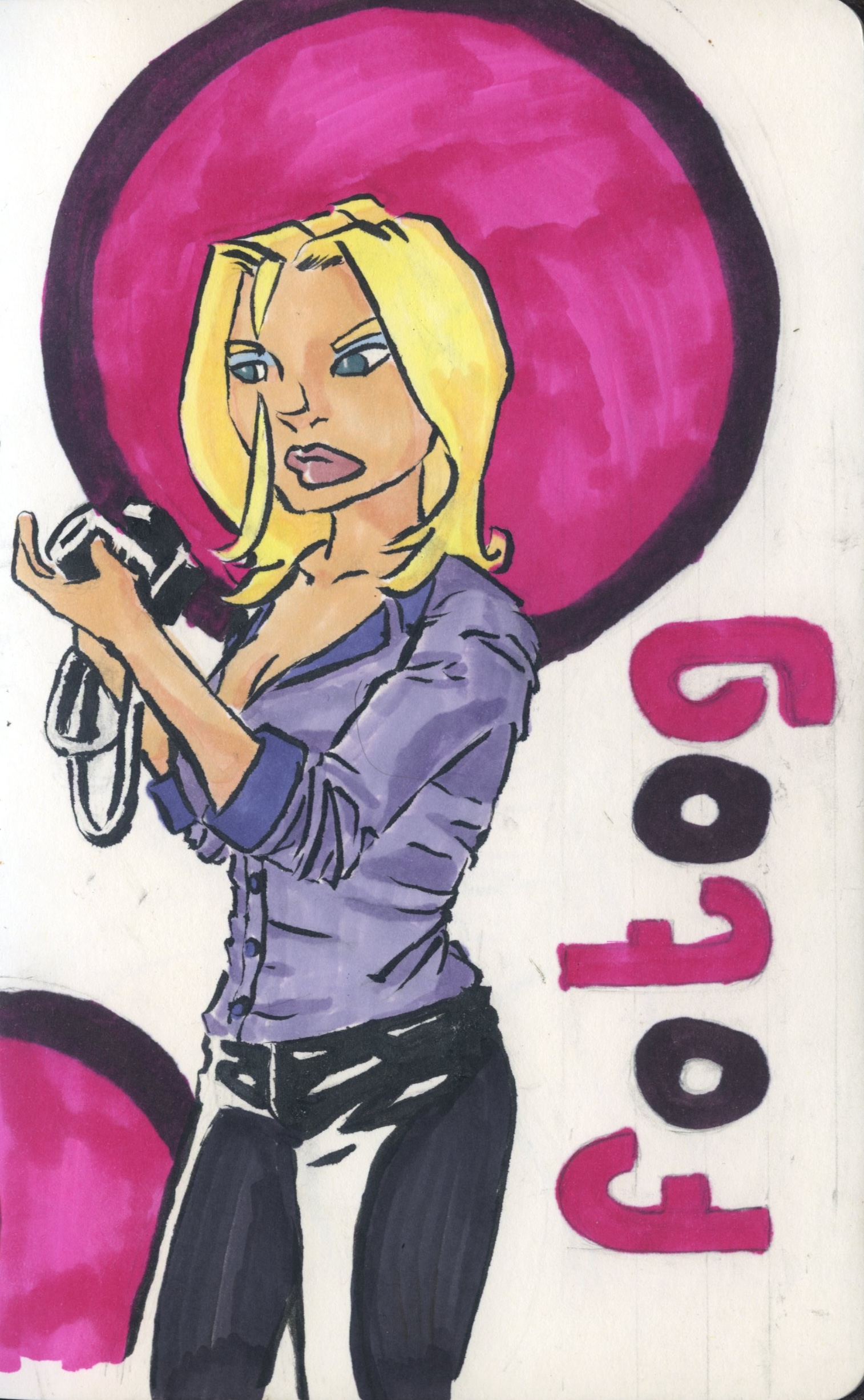
Gretchen West is a former intern at a sleazy New York City tabloid who graduated to fotog. She’s a bombshell, she doesn’t have an insincere bone in her body, and she’s actually a really good photographer. She balances out her good points by being really obnoxious. She is a gum-chewer, a belcher, and a knuckle-cracker. She can unleash a silent-but-violent at will. And her laugh. Oh, God, her laugh.

Parenting in the 70s

I would like to start working on comics again, but it’s been so long, between Newcastle’s final days in February and Oscar moving in in April, that I’m concerned I won’t be able to restart. I’ve been spending my weekends at the coffee shop, drawing little lots of little fully rendered sketches, hanging out with Oscar, etc., that I can’t bring myself to return to my half-penciled page.

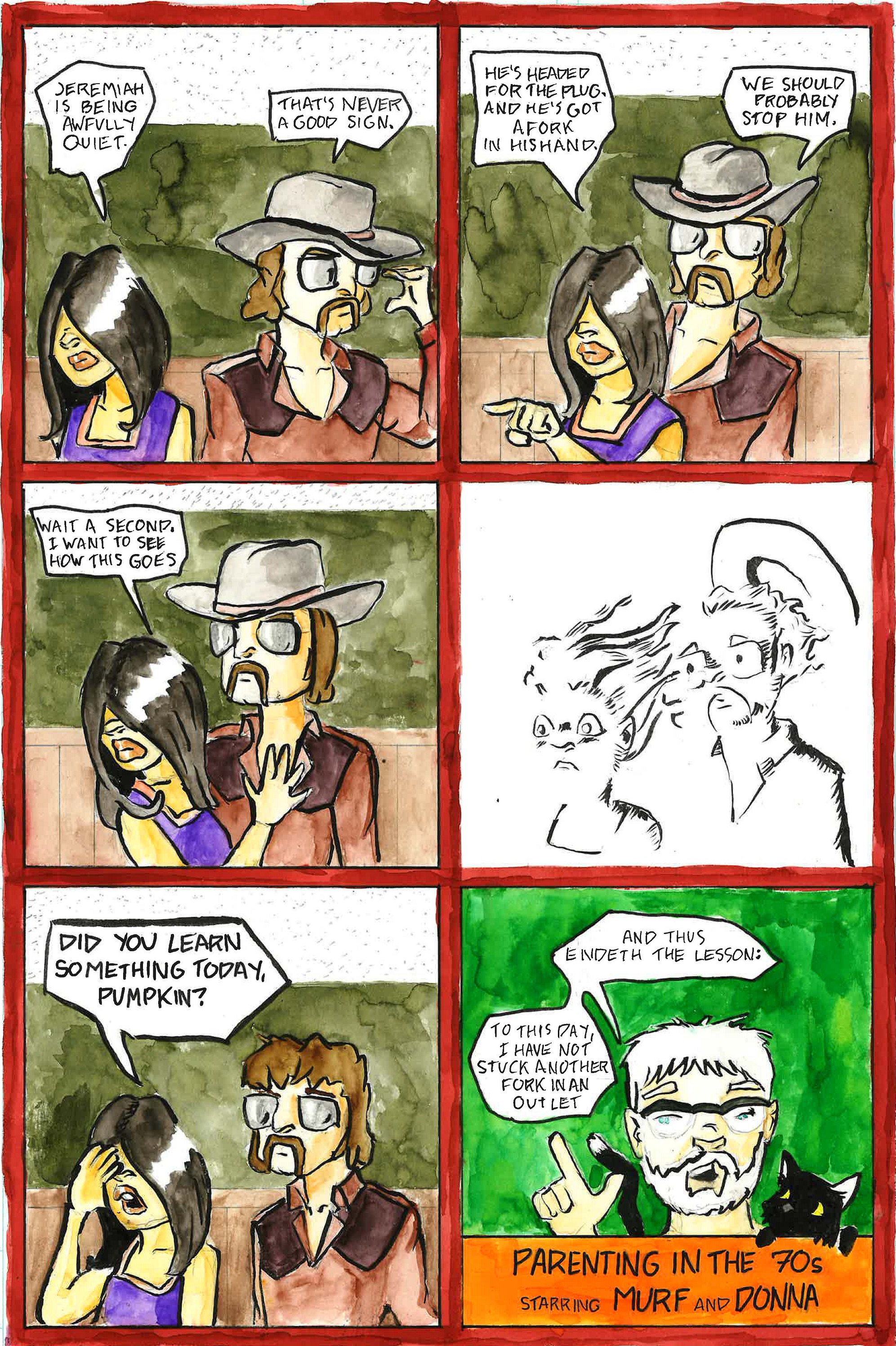
So I did a one-page short, set in 1977, starring my parents and their kid, who only likes to play with toys if they can kill him.

I Ink, I Can

Last week was a terrible week at work (this one’s not looking much better). I was just basically buried in work, but I fell sick for half of Tuesday and all of Wednesday, and no matter how efficient I was, no matter how much Adderall I took, I could not catch up.

Some of this momentum must have carried over to the weekend because I chose to work on a project I needed to finish by this morning at the latest, but I also wanted to finish some art I’d worked on during my busy week.

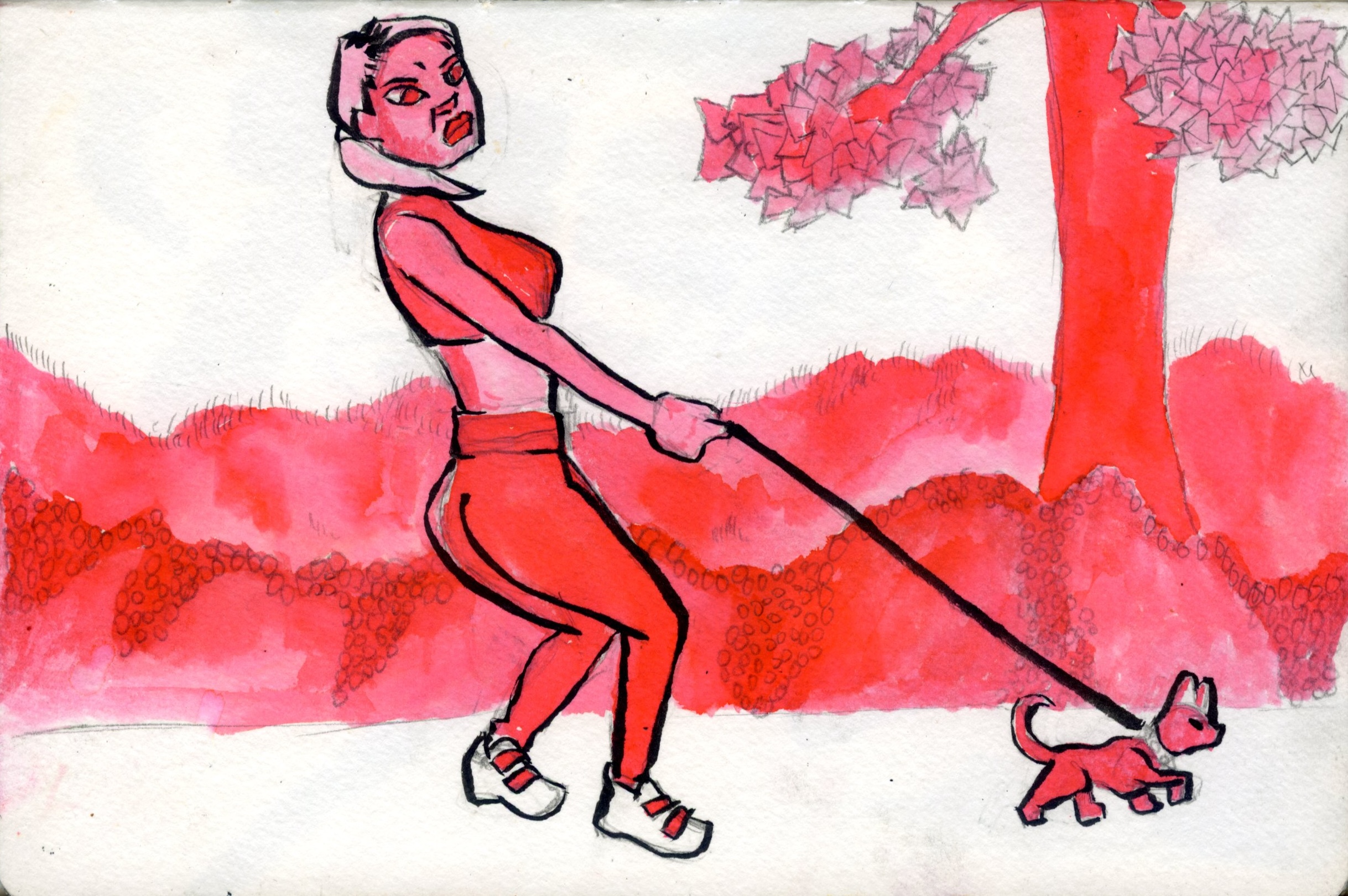
In addition, I was thinking about ink-washes and the fact that I had several bottles of ink left over from when I was writing my books by hand. I rushed through these drawings, so they are not great drawings. I’m not sure I really enjoyed them very much, but I’m also not sure I did them right.

Words, Words, Words

If there’s one thing people know about me, it’s that I’m a writer. This goes all the way back to the fifth grade when I wrote my first short story, a Top Gun fan fiction. I showed it to my dad, and he had notes. Everyone’s a critic.

I have over thirty novels to my name, as well as countless short stories, a well-curated folder of most of my essays and blog entries, as well as a memoir and whatever the fuck “Three Stories in One” is supposed to be. Between “Three Stories in One” and my school newspaper column, writing made me a celebrity in high school. I went to college to learn to write. I moved to New York to become a writer, and while I didn’t become published, I certainly enjoyed the craft.

My marriage was great for me as a writer because she had an idea for a novel (I’d only written short stories so far), she got a lead on a contest I ultimately did pretty well in, and she bullied me into submitting my work. Ten short stories were published in various anthologies, but I got over sixty rejections on a novel I wrote by accident while she was in Namibia.

That basically stopped me from writing until seven years ago, when I entered another season of the contest and decided that I was going to write a novel. I did. And then I wrote the next one. I wrote the novels to write them, and I wasn’t going to kill my self-esteem with dozens more rejection letters. I tried again, though, submitting my best novel so far, but after thirty-plus rejections and Covid, I gave up.

Years later, I saw an ad for a writing service. Among the their many offerings is help (from agents and editors) with writing your query letters and synopses, copyediting your samples, and helping find the agents and publishers your work is the best match for. I purchased all of these. They found me five agents and five publishers because I didn’t want more than ten rejections. I got nine. The tenth should be publishing me in a few months.

If there’s two things about me that people know, it’s that I’m a writer and a Doctor Who fan from way back. I grew up with Classic Who, where the effects were cheap (but very imaginative), the acting was not Method, and the serials were always one or two episodes too long. Then it got cancelled, and seven years later, there was a movie with flashy effects and motorcycle chases. When that went over like a fart in a car, they rebooted the series nine years later, and it runs to this very day.

I’ve loyally watched all of NuWho (or Who Redux) as they have gone from Doctor to Doctor and showrunner to showrunner. Prior to last year, the latter was Chris Chibnall. It did not go over well. It started going badly before his era even began because the Doctor was going to be played by an icky girl. I defended Chris Chibnall from the Doctor-Who-not-Nurse-Who/Go-Woke-go-broke contingent who were complaining about the writing so they could mask their sexism. However, I wasn’t enjoying the show anymore. When it wasn’t completely forgettable, the mythos was being torn down, and the character was being stripped of everything I loved about them. The problem was indeed the writing. As a writer, I’m not happy to say this.

When a project goes wrong, especially on TV, it’s almost always the writers. And considering how much people complain about the writing, it’s no wonder the studios want to use AIs to do it.

Movie and TV writing are not art; they’re science. In a movie, you must, by around page 55, have some kind of major conflict. And the audience is so trained to expect this that The Avengers dragged a little in the middle because the epic fight on the Helicarrier took place on page 70. If characters don’t hit their beats like they’re supposed to, people can’t handle it. Look at the reaction to The Last Jedi. I tried writing a pilot, but I couldn’t make it fit into five acts.

Movies have endless script doctors fine-tuning every little thing. A sitcom will have rooms full of writers, fine-tuning every single joke. Producers and studios give their input. Actors love to give their input too, sometimes rewriting their lines. A producer (or a comic book editor) will have an idea, and they’ll make a writer make it happen. The writers everyone is complaining about are a committee, about as far from the process of writing I enjoy.

Don’t get me wrong—I love a good collaboration. Some of my favorite memories are sitting in Shane’s studio, bouncing ideas off of each other and creating a screenplay and a lost screenplay. But that’s not what happens. In movie and TV writing, someone is always reading over your shoulder and telling you they can do it better, unless you’re Neil Gaiman.

I used to want to be Joss Whedon (before we found out he was a violent creep) because he had made a brand for himself. He had fans who would watch anything he wrote, even Dollhouse. They picked apart his mythology, they obsessively watched for Easter eggs. I wish someone would do that to my stuff. Yeah, it would be great to have fans. I wish my other twenty-nine novels had readers.

On the other hand, I sit here in my cozy apartment with my swiftly growing cat, living my life with (mostly) peace and contentment. How miserable would I be if I were a professional writer?

If I were a novelist, I would still need a job because authors get paid shit (there’s a finite amount of money for authors, and it’s all going to JK Rowling). If I were a TV writer, I’d have to hustle just to make minimum wage while the studios figured out ways not to pay me, and I’d have to share my inspiration with a crowd and a belligerent showrunner. If I were a movie writer, the screenplay I poured my life into is going to be ripped up and reassembled, so I won’t recognize it.

The Princess Bride is a classic because of the performances and the art direction and costuming and sets, all brought together by Ron Howard, but every single quirk, every single quotable line came from William Goldman. You can’t have a movie, TV show, or comic book without the writing (though the founders of Image Comics gave it their best shot), but people don’t notice unless it’s bad.

I’m living my best life right now. I’m not famous, and maybe that’s okay. I used to feel like I was supposed to have a bestseller for my twentieth high school reunion, but I don’t want to hand over parts of my soul to people who have no respect for me. I’m a writer. I write. And that’s good enough for me.

The Oscar for Best Kitty

As anti-Woke comedian Jerry Seinfeld would say, “What is the deal with Oscar?” Since I think a few people might be interested, I decided to fill you in.

I used to have a cat named Magik. When Magik was a kitten, there was a mishap, and he didn’t get fed for two days. Magik, as a result, was food insecure. He ate each meal like he was preparing for a famine. Since Oscar was starving when Nicole rescued him, I was concerned that he was going to overeat and be a roly-poly like Magik was.

Luckily, he has different ideas. He used to try to steal the food out of my hand, no matter the cuisine. Now he has no interest in human food, except for meat sticks, and even then, he spits out the teriyaki. Original flavor only. That, the wet food, and a little bit of dry food are the only things he eats now, which is a huge relief. If he started getting chubby, I was going to have to start saying no.

Oscar has grown. Again, when Nicole found him, he was starving. The vet couldn’t give me an estimate of his age because of the damage. But he’s all repaired, and now he’s starting to become a cat. I mean, I knew he was a cat this whole time, but he had the build of a ferret and an unnaturally long tale. Now he’s starting to fill out, and his coat’s growing in.  

His favorite perch is my shoulders. Despite having claw marks (through clothes) all over my back and arms from him making himself comfortable, I really love having him there. Of course, that means I have to stand until he gets bored. Also, he’ll hop up on the bathroom counter while I’m getting ready for a shower, and his eyes will start to focus on my deltoid muscle, and I have to intervene before I pass out from the blood loss. He bit my shoulder as he settled in, but he suddenly stopped, as cats are wont to do.

I still haven’t told management I have a cat.

Even though there’s a heat wave (otherwise known as An Average Summer in DC) right now, I’ve been opening the window so he can experience the outdoors. I’m pretty concerned that he’s going to get bored. I have a very small studio, and he’s already explored every corner. He becomes a fuzz-saw when I put him into his harness, and when it’s on, his legs don’t work. So no walks.

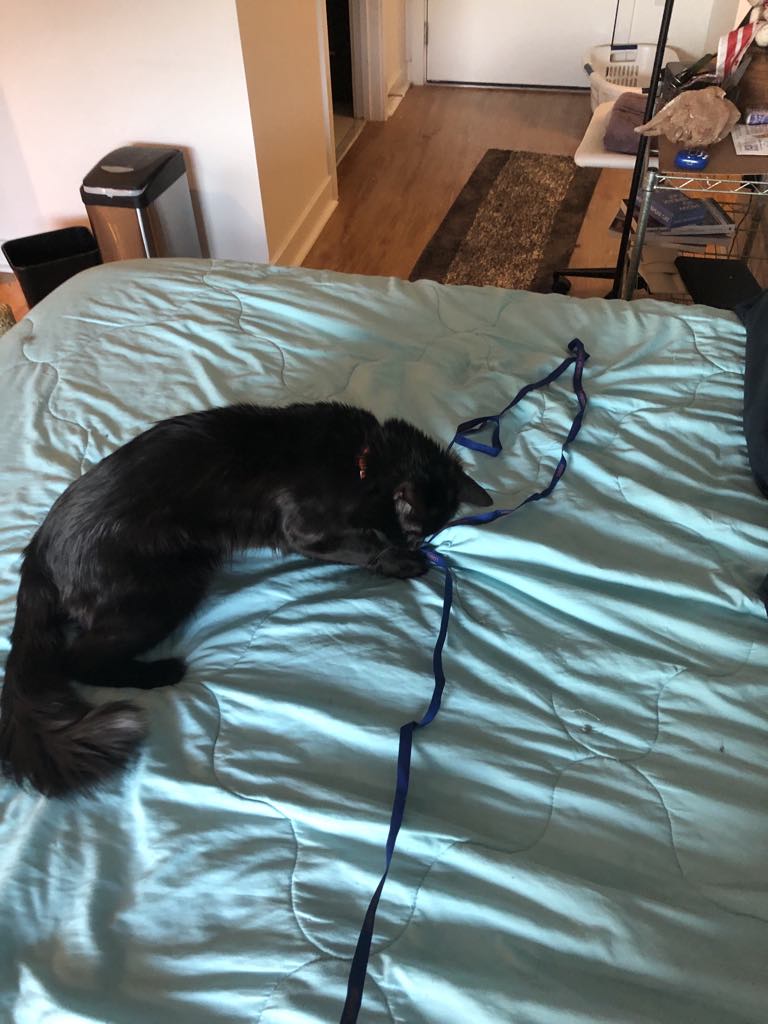
He is constantly begging me to play, and I try to keep up with him, but that kid’s got a lot of energy. I have to tell him, Dad is very old, and his elbow has been giving him problems. His favorite toy is the long, skinny ribbon someone left in the hallway (Exhibit A). As you can see from Exhibit B, it’s the most stylish toy any cat has.

I still miss Newcastle. I’ll remember how happy he was exploring the backyard, and it doesn’t make me sad, for the most part. Sometimes a memory will drag me to tears, though. It’s not because Oscar isn’t a good cat. Oscar is a great, well-behaved cat. But he can’t replace Newcastle.

I love having the little guy around. He’s a great lap cat, and he’s always so excited to see me when I get home. He’s a talker, but at his high pitch, it sounds more like singing. He tends to stick close to me, even if he’s mad about something. His favorite place to play is on my bed, so he’s starting to shred my comforter. He hasn’t settled into routines, so he’s unpredictable, and that is exciting.

I could go on for pages, just rest assured that Oscar is getting spoiled, and so is his dad.

I Want to Take his Face … Off

We all know who Nic Cage is. He’s a dangerously unhinged actor who had a pyramid constructed to house his remains. When you see him screaming, “Not the bees! Not the bees!”; it’s easy to forget that this guy won an Oscar. He is a genuinely good actor, but he owes a lot of money to the IRS, and will take any job he can get.

Nicolas Cage is weird. He named his son Kal-El. He’s plenty weird onscreen too, delivering some of the most bipolar performances in movie history. You can see the same histrionics in the role that won him an Oscar on display when he dresses as a bear and cold-cocks a woman.

In Face/Off, one of his bigger roles, Cage plays a terrorist who switches faces with the FBI agent vowing to bring him to justice. He costars with John Travolta, who plays the FBI agent who switch faces with the terrorist he vows to bring to justice. And then the doves come out.

Face/Off starts out with a little boy, no older than five, getting shot in the head. It’s a John Woo movie, so no punches are going to be pulled. The next scene ends with a plane crash and gun ballet and someone getting flattened in a wind tunnel. This is the first eighteen minutes of this film.

John Woo had a long career in Hong Kong before coming to the US. The first time I saw Hard Boiled, I couldn’t get clips from it out of my head. The grace of the dives, the flash and crack of the guns. A baby urinating on the hero to put out a fire. Hard Boiled was a bloodbath, but sentimental, like all John Woo movies.

I haven’t seen all of his movies, but I have to say that Face/Off is in his top three (that I know about). With a Hollywood budget and stars, he shot a bloody gunfight around a five-year-old boy listening to “Somewhere over the Rainbow.” He ends the movie with a brutal gunfight in a church, followed by a high-speed boat chase that ends when their stunt men are thrown onto the beach. This was a bay seemingly made of napalm because everything blew up.

Face/Off seemed like the last few episodes of a long-running show. Agent Sean Archer and Castor Troy have a long history of failing to kill each other, and it shows. There are so many stories between them, I’m surprised a comic book company never got the licensing rights to do prequels. There are so many characters who have names and are given a personality who are in maybe two scenes, from Archer’s best friend, Tito to the agents at the FBI office, to Castor’s brother Pollax, to the vaguely incestuous Demetri and Sasha, who work with Troy.

Even though Nicolas Cage danced, grinned, and got a little pedo as Castor Troy, the movie is never more entertaining as when he’s John Travolta. When Travolta is Sean Archer, he has all the charisma of a sack of mashed potatoes in a toupee, but if there’s one thing he’s good at, it’s mischief. He plays Castor Troy like a sociopathic thirteen-year-old boy.

With John Travolta as the bad guy, Nicolas Cage gets to be the good guy. Where Travolta’s performance ranges from annoyed to angry, Cage brings in some real pathos. This war is weighing on both of them, and it shows.

John Woo’s career didn’t get any better than this. He made some more movies in America, to diminishing returns, including Mission Impossible 2, as well as Windtalkers, the movie about a Navajo Code Talker where the main character is a white guy. Eventually he went back to Hong Kong and has been making the kinds of movies he wants to make.

This was my favorite movie until it got dethroned two years later. I bonded to the moral grayness—when Travolta is Troy, he becomes a father and a husband, and when Cage is Archer, he steals and lies and commits great acts of violence. I was pretty convinced I was a bad guy back then, and it was good to see that you could be bad and do good things.

I also really dug the gun ballet, as well as the mythos, and the finest, as Jason Mantzoukas calls it, “kabuki acting.” I could talk about this movie forever, like how the Troy brothers are named after the Gemini brothers, but I won’t. I’m not qualified to say if this is his magnum opus. What I will say is that this movie was the work of a mad genius, and I salute you. If there’s one word you can use to describe John Woo, it’s sincerity. I think this is how he sees the world. I think that, most of all, is what I connected with.

Life in Plastic is Fantastic

Fort Totten is a border neighborhood with Maryland, and from 1 June until 29 June, all four of the Maryland Metro stops are closed. People are getting shuttled in, but the same number of people are riding. Why do all the cars feel more crowded than usual?

We’re all exhausted. We’re all in drab colors, as if our souls had been drained. On one side are the manual laborers. On the other side are federal workers, along with non-federal office workers. There are even tourists. There’s seats, but I’d have to sit next to someone, so I stand.

For a moment, the mob of students with their backpacks and white-guy afros parts and I get a glimpse of someone I can only call Barbie. The blonde sat down, her back straight, her legs demurely crossed. Her sundress went all the way to the floor, and it appeared blinding pink, but was really white with small red flowers. She looked pleased with herself.

The train pulled into Judiciary Square, and she jumped out and cat-walked out of the station and out of my life, taking the color with her.

That felt like magic.