Fit for a Straightjacket

In June of 2010, I weighed two hundred and fifty-four pounds. I couldn’t do ten pushups, and a walk up a flight of stairs winded me. I got that big for a number of reasons. For starters, after leaving the New Jersey/New York area, I went from walking a minimum of two miles a day (usually super-fast, because I was often running late) to driving and sitting at a desk. Later, when I got really depressed, I began eating for comfort. When I was on anti-depressants, I ate too much because that’s what anti-depressants do. I literally embezzled money from grocery-shopping trips (i.e. getting cash back from my debit card at the registers) to buy donuts in secret. I was, and still am a little, totally ashamed. 

I seem to have swung in the opposite direction. I now weigh one hundred and ninety-one pounds, have 20 percent body fat (which I’m assured is pretty good, but the Internet tells me that it’s either average, borderline ideal, or really bad; that’s the Internet for you), and do fairly intense cardio four or five days a week. My wife and I have splurged on a personal trainer, and, about half the time, I bike to my appointments, which is about six-and-a-half miles one way, mostly uphill. For the most part, I eat better and less. And I’ve realized lately that I’m skipping lunches in secret. 

And that brings me to today. At my training session, I almost passed out. That’s not the bad part. The bad part is, I tried to pretend that it wasn’t happening. My trainer isn’t dumb, so he called it off before I could hurt myself. It didn’t have to go that way. During my morning ride, before which I had a banana to eat, I felt lightheaded a few times, but I didn’t stop. 

Why not? 

Because I look in the mirror everyday and see the fat guy from over two years ago. Apparently I’m the only one who sees it. However, my friends and family told me, even at my biggest, that I wasn’t fat, because they were trying to spare my feelings. How am I supposed to believe them when they tell me that today? 

On top of that, I have newly developed, low-grade asthma that winds me whenever I work out. I also have a lot of friends who are really, really, really fit, including marathon-runners, long-distance cyclists, and swimmers who make Aquaman say, “Take it down a notch, dude.” I don’t want to run a marathon. I’m perfectly fine running twenty to twenty-five kilometers over the course of a whole week. I just want to be healthy. And I am healthy. 

But that’s not what the guy in the mirror tells me. He uses as a weapon the fact that I had a (delicious) cheeseburger and a chocolate shake (also delicious) for lunch yesterday. He blames my difficulty breathing on my laziness. He says that the weight I’ve put on since I’ve started swimming a lot is me being irresponsible. That the fact that I have a naturally large frame is only an excuse. He’s a lot louder when I’m under a lot of stress, and there has been a great deal of that in my life. So whenever he talks to me like that, I respond by exercising. 

But today, when I got really dizzy and began seeing spots during a routine workout, I put myself in danger. I think have a problem. I can’t stop exercising, because it’s good for me. And yet, I need to know when it’s enough, that I don’t need to push myself quite so hard. 

But the guy in the mirror doesn’t believe that. 

Sister Act

I haven’t had any contact with one of my sisters for a year to the day. What weirds me out is that I don’t feel all that bad about it. I’m not sure what kind of person that makes me. 

You have a friend or relative like this. They’re the ones who say political opinions you find objectionable, and then defend their point-of-view in the nastiest way possible, using every fallacy in the book, and then pouncing on any admissions you make on the occasions they have a point and using this as a means of negating your entire argument. When you fight back against what they’re saying, they accuse you of trying to silence their opinions. In short, they are bullies. 

I hate bullies. My Evil Sister is a bully. She is the kind of person who imagines herself telling “the truth to power” or some self-aggrandizing bullshit like that. I don’t even know if she believes what she says; it’s almost as if she is daring people to argue with her. Every time I would see a status update or a comment on one of mine, I would clench up a little. There came a point, however, when I decided that I needed to stop. 

You see, thanks to the bravery and encouragement of my wife, I’ve learned to break off contact with people who make me uncomfortable. In the Facebook era of being “friends” with even with that lab partner from junior high, this is kind of difficult. But the fact is, it doesn’t matter your history—if you don’t like a person anymore, they’re not your friend. I cannot tell you how utterly liberating this is.  

When I began doing this back in 2005, it was extremely difficult, so much so that I had to justify to myself why. The guy in question was my best friend throughout high school. In the past when I behaved like a drunk as a bipolar, going to highs, wherein I was a selfish-but-charming douchebag, to lows, where I was a self-pitying Eeyore, he stuck around because he knew I’d even out and be the person he enjoyed. And yet, as I got older, I couldn’t stand to be around him anymore. And then I was advised, by my wife and by my therapist that I didnt have to

My usual method on Facebook is this: I block offensive status updates in an attempt to ignore them. When the offender rudely attacks me for something I say on my wall, I defriend them. Evil Sister had hit the first stage, which is where I had intended to keep her (she is my immediate family and shouldn’t be disowned). However, thanks to the miracle of that wonderful Facebook sidebar that allows you to see who comments on stuff, I discovered something she said that was too much. 

On September 11, 2001, a band of terrorists bombed the World Trade Center and the Pentagon, using an otherwise innocuous device—i.e. the passenger airplane—as a weapon. Most Americans are still processing what this has meant to us and to our world. 

Yes, I was there. But that doesn’t make my memories superior to others. On September 11, 2011, a friend in Albuquerque reflected movingly on his first trip to the USS Arizona in Hawaii, when he discovered that it was more than just a tourist destination—it was a tomb—and how that paralleled a reaming he received from a friend for requesting a jar of WTC ashes as a memorial. Another friend wrote an essay, entitled “My Narrative,” about the fear and isolation she’d felt in Colorado as the news barely trickled in over the sound of evacuations. I wrote a piece about how something as ordinary as a statue had been taken from me, using it as a metaphor for how my day-to-day life had been changed. 

Evil Sister for her part, accused everyone—everyone—who shared their “narratives,” (she used the word narratives very specifically) of trying to exploit the occasion to make it all about them—“it doesn’t matter how close you were.” This was a pretty direct, passive-aggressive swipe at me. It was a passive-aggressive swipe against her friend who wrote “My Narrative*.” It was an indirect swipe against my wife, who frequently spends months in Afghanistan, her job being to prevent this from ever happening again. It’s a swipe against the friend I was visiting that very day, a New York firefighter who lost literally dozens of the colleagues who ran into a burning skyscraper when the rest of us ran away from it. When I responded, in the gentlest terms possible (“I am disappointed and saddened that you feel this way, and that this is how you chose to express it.”), her response to me was predictable, but infuriating (“Oh, I forgot, you’re the only one who’s allowed to have an opinion.”). I informed her privately that I would not speak to her unless she apologizes, and that I don’t anticipate this ever happening. She (as I was told later) cussed me out behind my back and told me that I “always had to be right,” and told me that she didn’t care if she never heard from me again**. 

And so, after a year of stubborn silence, I’ve concluded that the only thing I’m pissed off about is how my family, who understandably don’t want to take sides, talks about the incident as if both of us are at fault. We are not equal here. I’m not perfect, but I am not an asshole. I do not treat people with disrespect and venom, nor do I expect my negativity to go unchallenged.  

I don’t miss my sister. I miss what she used to be—my favorite play partner when I was a child. I also miss the teenage version of the friend I mentioned earlier who now thinks that women who use birth control are sluts. Time has marched on, and so have I. 

But I still feel uneasy. I feel like I could have handled this differently. I wonder if maybe I am the asshole. I won’t discuss this with the people who witnessed this, because I don’t want to put them in an awkward position, so I feel alone. And yet, as I said, I don’t like bullies. I’ve dismissed at least five old friends, including my one-time best friend, for saying less. 

My life, as a result, has much less negativity than it used to. It’s also missing my sister. I’m very confused. And I will be for a long, long time. 

* On this particular friend’s birthday, Evil Sister complained in her status about how she hates it when, on friends’ birthdays, her feed gets clogged up by birthday wishes. As maid of honor at this friend’s wedding, Evil Sister accused her of being a “bridezilla,” because this friend wanted to go to a tanning booth to get rid of some of those lines that had built up over the summer, which would have ruined the aesthetic of her strapless dress. Evil Sister is not a very good person, is what I’m trying to say. 

** There are a lot of complications, of course, regarding the parallel and perpendicular relationships my parents have with their siblings, as well as my relationship with my niece. I won’t go into these, because I have rambled long enough. 

Random Accessed Memory

I used to be a high-school student. Time has marched on since then, as has been known to happen. 

During that time, around my sophomore year, roughly twenty-one years ago, my communications teacher introduced his students to an allegedly foolproof method of memorizing passages of text, which goes like this: 1) Say the first line out loud. 2) Repeat the first line, and then say the second line. 3) Repeat the first line, and then repeat the second line, and say the third line out loud. 4) Keep doing this until you run out of lines. 

To demonstrate, he led the classroom in the recitation, using his tedious method, of a strange little poem, that goes a little like this: 

A big fat hen; 

A couple of ducks; 

Three brown bears; 

Four running hares; 

Five fit fiddlers; 

Six simple Simons, sitting on a stump; 

Seven Sicilian sailors, sailing the Seven Seas; 

Eight egotistical egotists, egotistically echoing egotistical ecstasies; 

Nine Nubian nudes, nimbly nibbling gnats, knuckles, and nicotine; 

I slit the sheet, and on the slitted sheet I slit I slit. 

I’ll be damned if maybe he wasn’t just a little bit right. 

Yesterday Never Knows

Long ago, I was cleaning out the rain gutter crowning my old home back in New Mexico. Because I was a teenager, I was really fucking stupid. Rather than employing a ladder or a solid surface of any kind, I chose to stand on one of those green, wide-lidded mini-dumpster things we called a herbie because beats the hell out of me. Naturally, every part of it that could collapse or roll waited just long enough for me to get comfortable before pitching me backward onto the dirt of my backyard. 

I wish I could say that I was lucky I didn’t land on concrete, but I can’t. This was desert clay, which, when dry, resembles dust-covered iron. This is the kind of firm that young concrete dreams of growing up to be. Because that didn’t suck enough, random chunks of sandstone jutted out of the surface here and there. You know, for garnish. 

And so, one moment, I was performing one of those tedious chores that are a consequence of living under your parents’ house, your parents’ rules; and the next, every single molecule of oxygen that wasn’t already tied up in hemoglobin fled my body. Blunt pain rattled my spine, and my heart stopped doing what it was it did out of confusion, as my lungs had evidently forgotten to breathe properly. I couldn’t move—less because of said pain and more because of the very tangible fear that I wouldn’t be able to. 

And that, dear readers, is exactly how I felt when I saw her picture last week. 

Her eyes were still mocha and enormous, with thick, dark lashes. Her hair was still an impossible blend of gold and platinum. And the way she smiled still inspired me to do the same. It reminded me how inhumanly gorgeous she was, making even overalls look sexy. And how she was confident enough to be visibly bored every time some boy came over to feign interest in her conversation, a fist clenched around a beer and a thumb hooked on a belt loop—yet only those who were really paying attention could make out the mournfulness hiding there. 

I remembered my reaction upon seeing her for the first time on the other side of a spirited party. (“That girl is way out of my league.”) I remembered my reaction when she waded through that crowd for the sole purpose of finding out who I was. (“Wait. Me?”) I remembered my reaction when she and her sister sought me out at a different, equally spirited party the next night. (“Seriously. Me?”) And I remembered my reaction to the fact that I had started to flirt with her. (“Okay. Clearly not me.”) 

But that’s not what knocked the wind out of me when I saw that picture last week. What did was the fact that I’d forgotten how deeply we were in love with each other. 

It’s been nearly fourteen years since I learned her name, and about thirteen since we last communicated. Over that time, I’ve convinced myself that I made all of these feelings up. We were simply two people with nothing in common, whose hunger for any kind of attention led us to comfort each other during the intense transitions we were subjecting ourselves to. Hell, we’d never even kissed; we were afraid to, because we couldn’t possibly be falling for someone we’d known for a handful of days. 

Except we were fooling ourselves. And for too long, I’ve been fooling myself. The intimacy of our letters and phone calls was real, and it was exquisite. It really was love. Eventually, I found my footing in New York City, she found her footing where she was, and we didn’t need each other anymore. 

And time passed. 

I don’t know how she remembers me. Was I a fling? An overreaction? A friend? A mistake? A pen-pal? An ex-boyfriend, even? I doubt I’ll ever know. That doesn’t matter, though, because somewhere, she is smiling. 

Inconceivable

The events of which I speak transpired in the year of Our Lord, two thousand and four, in the final week of the eleventh month, in the city of Bloomington, Indiana. Bloomington isn’t much of a metropolis, but the vast number of students at Indiana University certainly try to make it one. The side-effect of this is the sudden decline in the town’s population during holiday breaks. 

And so, during Thanksgiving week, peace reigns. That night, so long ago, the air was brisk enough to require a light jacket, but not so cold as to prohibit cycling. The hour was late, in that I had finished a long shift at the copy shop whose name I will not mention (it rhymes with “Pinkos”), and the quiet inspired me to push my bike home and relax.  

On my right loomed the vast parking lot for the IU Stadium, on my left sat the houses unfortunate enough to be across the street from the stadium, and on my cell phone spoke the man who, unbeknownst to either of us, would one become known as “Best.”  

We’d been trading vulgar jabs, as usual, through most of the journey, until a police car whispered up behind me and continued on. Given my history, I still flinch whenever I see a representative of the law, but tonight, I tried not to show it. I don’t have a firm grasp on the statutes of limitation on said history, so it was best I not draw attention to myself.  

“Be cool,” I told my friend.  

“Why should I be cool?” he replied.  

 “Heat.”  

He laughed. “You know I’m not actually there, right?”  

“Be,” I repeated. “Cool.” 

“Okay, okay.”  

“Oh, shit,” I muttered, because even the most law-abiding of citizens tenses up when a representative of the law flashes its lights and performs an action-movie U-turn in his or her direction, which this one just did.  

It took only a second for it to occur to me that the officer in that car was not after me. It’s not like I was carrying around a trunk-load of cocaine; I didn’t even have a trunk. The inspiration for this act of vehicular drama must have been quite spectacular, and I was sorry I had to miss it. I mean, this town was dead.  

As the cruiser sped away, reflections of its lights receded behind me … except … except they weren’t actually receding. My heart leapt.  

“Okay,” I said, “I think something really entertaining is about to happen nearby.”  

“You’re going to have sex with a bunch of goat farmers?”  

 “I’ve been doing that the whole time we’ve been on the phone,” I replied as I looked over my shoulder, just in time to witness the same cruiser executing another U-turn in my direction.  

This time, it took almost three whole seconds for it to occur to me that the officer in the car was not after me, even when the siren whooped that singular whoop that heralded an upcoming punishment for a traffic violation. Because that would be ridiculous—so ridiculous in fact, that the officer had to stop his car, jump out, and trot over to my side to get my attention.  

“I’ll have to call you back,” I told my phone. “I just got pulled over.”  

“What?” he replied. “I thought you were walk—” 

I flipped the phone closed and faced the civil servant who was only a little bit out of breath. He asked, “Do you know why I stopped you?”  

There are so many things I wanted to say at this moment. The first was, “Speeding?”; the second was, “That may be the dumbest question I’ve been asked in some time.” However, the police packed pepper-spray in this town, so I went with number three: “No.”  

Before he could respond, a second cruiser came up from behind, passed by, flipped on its lights, turned with even more urgency and panache than the officer who currently held my attention, and came to a screeching halt directly in front of me. The driver swung open the door and stepped out, one boot at a time. The time of night forbade the use of the mirrored sunglasses clipped to his shirt, but in his heart, he was whipping them off with cocky menace. He swaggered up to the other cop, looked me up and down, and muttered something in his ear. Officer One muttered something back, which caused Officer Two to study me more intently.  

I would have been more self-conscious, were I not more clean-cut at that moment than I had been at any other point in my life—up to and including my First Communion twenty years before. This left my current state of being squarely between “What” and “The fuck”—so much so that I was completely numb to the third cruiser that whipped around the corner. The fact that its siren was already wailing and its lights were already strobing ferociously meant that someone had dispatched it. For me.  

The third cop’s assessment of me was much more appropriate given the situation. Frowning, he muttered to the other two, and they muttered right back.  

After some intense chatter, Officer One stepped away from the group and asked me, “Do you have any idea—” 

“No,” I replied. 

“Well,” he explained, “this time of year, there is a rash of bike thefts while all the students are on vacation.”  

Officer Two watched my reaction before adding, “And walkin’ on the side of the road like that, you look awful suspicious.”  

“Can we see your ID?” asked Officer One. I complied, and he took it back to his car for further scrutiny.  

Officer Two folded his arms. “That really yours?”  

“Yes, it is.”  

“Prove it.”  

This was a challenge, inasmuch as there was no registration I could pull out of my glove compartment, inasmuch as I had no glove compartment. And yet, somehow, a clear thought jumped into my head just as Officer One returned, license in hand. “If I unlocked this chain,” I asked, “would that do it?”  

Officer One frowned at Officer Three while Officer Two unfolded his arms so he could fold them again. “Sure,” Officer One replied with a shrug.  

It took only a moment for them to witness my demonstration, return my ID, thank me for my cooperation, and drive off. The blue and red flashing from their roofs gradually faded into the amber of the streetlights above my head. That night, I learned very important lesson: if I ever want to steal a bicycle in Bloomington, Indiana, I should bring my own lock and chain. 

Movin’ on up to the Osten Seite

Unless I can weave a narrative idea around the random bits and pieces of misfiring neurons (as in the case of my unpublished-because-I-have-no-idea-how-to-go-about-publishing-it novel, The Long Trip), I usually don’t spend a lot time dwelling on dreams in my journal. However, sometimes, you kind of have to. 

Early, early this morning, the move that Kate and I will be making late winter floated to the forefront of my mind in the idea of a dream apartment. She and I had been looking around for a long time, and we had finally stumbled on a place that looked kind of beautiful. It was old, and so there were problems—for example, the thermostat was kind of beaten-up and unreliable, and the floors were freezing cold. Also, we’d be sharing the place with another couple. 

But that was also one of the draws, because they were good cooks, they were charming (the husband was a shorter version of Stanley Tucci’s character from Easy A), and their furniture was comfortable, tasteful, and extravagant. The place was also really huge. The kitchen was open, and could actually fit four people into it (as opposed to the one and a half in our real-world kitchen). Behind the bedrooms loomed a mini-auditorium/ballroom (Dream logic. Just go with it) with floor-to-ceiling windows that made great loading bays for the move. And—this is my favorite part—in said auditorium say a wood-burning stove for a bit of extra warmth in the winter, and maybe some hot apple cider. 

They asked us what we did for a living, and we told them, quite accurately. They told us what they did: they bought and sold authentic Nazi antiques, including posters, appliances, clothing, and the queen-sized bed that Adolf Hitler shared with Eva Braun before they moved to their bunker. With an excited squeal, the wife led us to the basement where she hid their prize acquisition: the basin that little Dolfy took baths in when he was just a baby. As you can imagine, we were horrified, but really, really classy about it. 

The worst part was we continued the dream trying to convince ourselves to look past their business*. I mean, I once convinced a potential roommate I was an Evangelical Christian to get a spot in his apartment (this is 100 percent true in the real world, FYI). Maybe this was just a job to them … That also meant ignoring the sheet music for “Deutschland Über Alles” sitting on their baby grand piano. The place had a basement

* This should probably go without saying, but, in non-dream world, Kate and I would have boogied the hell out of there, without even bothering to be classy, for reasons I shouldn’t even have to elaborate upon. 

It’s Funny How We Never Look Up

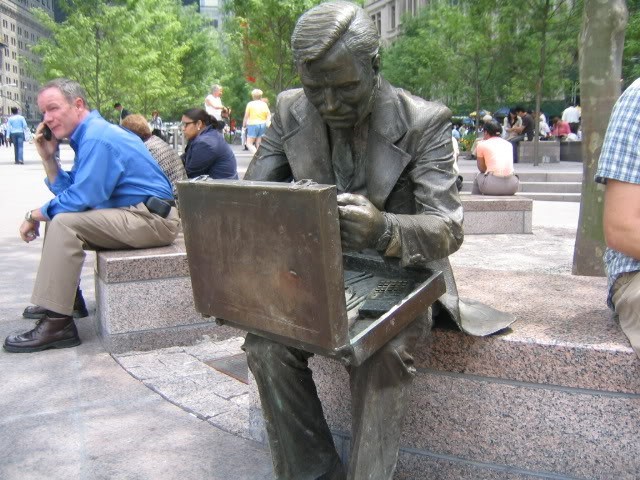
I first met him that August. He sat in a park at One Liberty Plaza, New York, New York, tucked in a corner, glancing into his briefcase. He lived in harmony with the workers and tourists meandering through the area; he paid them no mind, nor they him. 

At that time, autumn was creeping up on me like it always did, promising cooler air and brighter colors. Autumn was always good to me. I met my girlfriend at the time in the autumn. And years before, I’d met the woman I would eventually marry, also in the autumn. 

This fall was especially welcome, especially after a summer of unemployment and unhappiness. I’d finally been granted temporary work throughout the file vaults of various banks in the financial district. I spent my lunch breaks in the park at One Liberty Plaza, smoking cigarettes and trying to draw; the latter was particularly galling, inasmuch as I seemed to have forgotten how.  

One day I glanced around the park, looking for inspiration that wasn’t in this anatomy book that seemed to be the source of my frustration, and there he was, sitting on a marble step in the shade. I wondered who he was. I wondered what he was thinking. Was he relaxing, or was he about to stand up? And what was in his briefcase? Was it his lunch? 

As the days of tedious filing stretched into weeks, I crept ever-so-closer and peeked over his shoulder—subtly, so as not to offend him. I remember seeing an adding machine, and a few other items. But for the life of me, I don’t recall what these other items were, only that they were archaic. 

The last time I saw him, I stood up from the bench, tossed my sketchbook (weakened from the stress of erasers and my dissatisfaction) into my satchel, and dropped a quarter into a payphone. My girlfriend’s thirtieth birthday was that Thursday, and I was trying to arrange something fun; she hadn’t been my biggest fan over the past several months, and I needed to do something to fix that. 

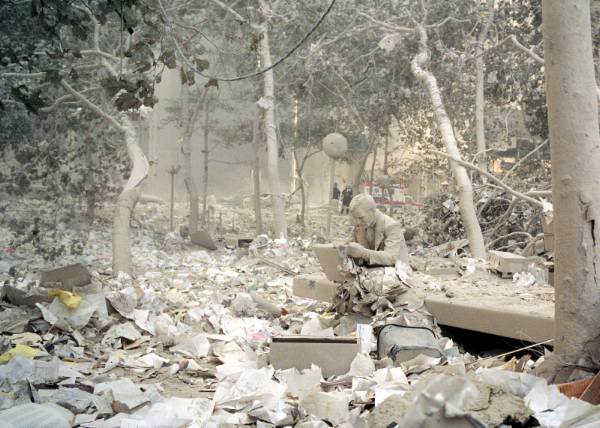
The last time I saw him was on a Monday, because on Tuesday, this happened: 

I’d originally wanted to write an essay about how much this country has changed in the past ten years—about how we’ve lost our way; about the silly phrases I used to love (i.e. “Bring ’em on” and “Dodged a bullet”) but no longer feel comfortable employing, as they have been soiled by those who have no concept of the value of a human life; about the collective, parasitic rage from that day that has turned us against cultures we don’t understand, against our own freedom, against our government, and against ourselves; about lost hope; about fear … 

And then I began running across never-before-seen photos from that day, begging the question: has somebody been sitting on them for ten years so they could release them for a big anniversary? And TV specials and stories and interviews on NPR and essays about what we’ve been up to over the past ten years … and stories from celebrities about what they were doing that morning. And I know that by noon on Sunday, we will have moved on to whatever it is we’re going to be saturating the media with this next cycle. It’s like the anti-Christmas. 

So I wasn’t going to participate. Regardless of everything I went through that day, I wasn’t going to participate. And then I remembered him. 

He’s since been moved around to museums and other parks. Now he’s been returned to where he once was, but in a prominent spot. I could go see him again, but it wouldn’t be the same. Nothing has been the same.  

I prefer to remember him from that late summer, when he and I were both alone, and we liked it that way. 

Somebody I Know Died on Thursday

I wasn’t close enough to call him a friend. I wasn’t distant enough to call him an acquaintance. I don’t know what I should call him. I have always wanted to know him better, but our lives didn’t sync up enough, as sometimes happens. He has existed almost exclusively through Facebook posts and my friends. I can tell you this for sure: I liked him a lot. 

Back in the nineties, we served time together as copy kids at The New York Post. A copy kid is, if you don’t know, is an intern. Actually it’s a step below an intern. And, like it says on the label, you make and deliver copies. Sometimes you went out for coffee. Sometimes you delivered fresh copies of the paper to editors and departments around the office. On very rare occasions, you are sent out to cover a story—usually ones that there are no reporters available to do, or the boring hot potatoes that reporters would like to avoid. There’s not a lot of dignity to being a copy kid, but it was kind of an honor. 

The men and women I worked with at the desk were an interesting bunch. Some were changing careers—not for the money, but to be journalists. For all its bluster and front-page comedy and right-wing agenda, The New York Post was and still is to an extent a very old-fashioned paper, and there was something to be said about running out in the night with a Bic pen and one of those small notebooks with logo stamped on it. 

I think he’d intended to start out as a reporter, but it wasn’t really his thing. Instead he became a copy editor. Just like me. Also like me, he was making things up as he went along, and that meant a lot of mistakes and frustration. We were both simultaneously kind and weary and devastatingly clever. We sometimes had a beard and sometimes didn’t. 

Once I asked him why he was there, and he told me that he’d worked for years as a doorman at a fancy apartment building. The job was incredibly easy, and the money was good. “I went and spent it all on drinks and cab rides. I don’t have anything to show for it.” Well over a decade later he is married with children. 

At the age of forty-three, while his family was out of town on vacation, he suffered a sudden, unexpected stroke, possibly a seizure. It’s not entirely clear what happened, but it appears that he fell while walking, sustaining physical injuries. Police were called, and he was taken to the hospital. For weeks, things were hopeful. He recoiled slightly from physical discomfort. He opened his eyes. He responded to humor. He began to squeeze his wife’s hand. He moved his foot. Soon after that, he raised his hand. And then he took a turn for the worse. On Thursday, his breathing tube was disconnected, and he died. His touching obituary ran in The Post—even in The Wall Street Journal

I don’t know if he had a DNR. All I know is that, at some point, his wife had to be told that somebody was going to be responsible for performing an action that was going to be responsible for his death. Never mind the seizure or stroke—his heart and a lot of his organs were still working. By now they’ve cut him open and removed parts of him and put them into the bodies of others. 

How do you cope with that? How would my wife cope with that? How would I cope with that? 

I’m reminded of the days and nights I sat in an uncomfortable chair after my wife broke her ankle, only to have it reconstructed. Her pain was something I couldn’t comprehend, and throughout the hours of the morning, she held my hand, crushing it. She asked me to tell her a story. She asked me to read for her the comics I had with me for when she slept. She asked me for more meds. I’ve had a loaded gun held to my head; I survived the attacks on the World Trade Center by virtue of showing up to work a little early; last month I almost drowned; I’ve ridden the Cyclone at Coney Island; I can’t remembering being as scared as I was then. And she was fine. It was only her ankle. But she was so helpless. 

I’m reminded of the night my aunt died of lung cancer, only a few hours after I had seen her last. I’d been asked by my uncle or one of my cousins—I don’t remember who—to sit with her alone for a few minutes while they took a break. I didn’t want to. My lively, hilarious, child-like aunt was in so much pain I don’t think she knew who she was. I wish I could say that this pale, shriveled-up person in bed didn’t look a thing like her, but I’d be lying. I don’t know what she saw when she stared into the distances. Sometimes, when I’m not careful, I remember the breaths she took in—about two or three times a second, for days. The effort it took was loud and gasping. They told me I needed to hold her hand and talk to her. Her fingers were cold, and I couldn’t think of a thing to say, and so I sang the first song that came to my head: “Yellow Submarine,” by the Beatles.  

What did he look like on the hospital bed, bandaged from surgery, IVs in his arms, a tube in his throat, his eyes sometimes closed, sometimes open and glassy? I can’t get the question out of my head. I’m drowning in work—both editing and art; I’m going to New York to see one of the people dearest to me and to re-explore the city I consider a lover; immediately after that, I have a visitor I’ve never met in person, but I am really dying to. I can’t close my eyes without seeing him, or my aunt, or my wife. 

I wasn’t close enough to call him a friend. I wasn’t distant enough to call him an acquaintance. I don’t know what I should call him. I have always wanted to know him better, but our lives didn’t sync up enough, as sometimes happens. He has existed almost exclusively through Facebook posts and my friends. I can tell you this for sure: I liked him a lot. 

Insane in the Membrane

My therapist advises me against me using the term “mentally ill” to describe myself. He prefers that I say “I have a mental illness.” I understand his logic and intentions—he doesn’t want my identity to be defined by something about me that is broken. However, I can’t disagree more.  

Your teenage years are when you start to forge your identity and become the person you’ll be*. And it was then that I became two people. On one hand, I was a quirky, soulful, artistic, sensitive, and intense guy named Jeremiah. On the other hand, I was a creative, energetic, charming, and very, very confident guy named Jeremiah. The first Jeremiah hated himself with a searing passion, while the second Jeremiah didn’t give a shit about anybody other himself. I was the angel and the devil on my own shoulders, wondering how the other could be so pathetic/such a douchebag. 

And that begged the question, what the hell is wrong with me?  

Lately, I’ve been a big fan of a (mostly) weekly podcast called “Sex and Other Human Activities.” One of the hosts, Marcus Parks, said this about being how bipolar disorder works: “Whenever you’re depressive, you let your life fall apart. Whenever you’re manic, you actively destroy it. It’s a dangerous thing to fuck with.” 

Lots of people talk about the stigma of mental illness. When I hear it described that way, I imagine frightened crowds with pitchforks, torches, and legislation who want to lock up the crazies, or at the very least, not invite them to parties. Maybe it’s because I’ve lived a third of my life in the twenty-first century, but I’ve never seen this. What I’ve seen is a lot of confusion. 

For starters, there aren’t a whole lot of actual “crazy” people. The mentally ill that most expect to see are muttering to themselves about government conspiracies, telling the voices in their heads to shut up, murdering people in cold blood (maybe with a giggle), or—if Hollywood can be believed—helping the normal folks see the world through exciting new eyes.  

That’s the biggest reason those like me can feel isolated. We look just like everyone else. We act just like everyone else. It’s assumed, then, that we function just like everybody else. After all, everyone feels down sometimes, so why can’t I cope? Everybody has mood swings, so what’s the big deal about mine? I seemed fine yesterday, so why not remember that? Life is hard; everybody knows that. Depression, Attention-Deficit Disorder, Bipolar Disorder, Borderline Personality Disorder, and even Asperger’s Syndrome are just words coined by those don’t want to own up to being assholes; they’re excuses people make because they’re too lazy to suck it up. 

I’ve spent a lot of my life believing all of this. In fact, I can’t shake the residual feeling that maybe I am just a lazy asshole. This is easy thought to have, both for me and for those around me, especially because I’m doing really well right now. I didn’t just “snap out of it,” though. I invest a lot of time and money and effort to be this way, and if I want to stay here, I can’t forget that, not even for a minute. 

As far as being an asshole is concerned, manic-depression is an explanation, not an excuse. What’s the difference? Perhaps getting drunk will give us some perspective. A lot of alcohol can give us a lot of confidence, but it can also take away some of our empathy. We do and say a lot of things that would not be said and done otherwise. Some of it is pretty shitty. And if we drink enough, we may not even remember it. These things, however, get done and said by us, and there’s no making them go away. If we get into a fight, or worse, run someone over with our car, it’s our sober ass going to jail. No one ever argues otherwise. Some people can hold their liquor, and some people can’t. Those of us that can’t have a responsibility to control ourselves, even though it can be incredibly difficult. 

So there’s that. As far as coping with life, I know full well that we all have it tough. Maybe I would be happier if I just counted my blessings. I want to. God, I want to. But I can’t. I am physically unable to … Well, that’s not entirely accurate. Sometimes I’m able to. Sometimes I’m not. Day to day, I don’t know what to expect. 

For example, I got mugged at gunpoint once, and for the duration, I thought I was going to die. When it was over, I walked home, called the police, called my girlfriend, had a cigarette, and shrugged off the money I’d lost as a small price to pay for not getting shot. On the other hand, I once watched a braindead-but-awesome action movie I’d seen a thousand times wherein a peripheral character loses his job and his home and dies alone on the streets. I spent weeks full of dread, convinced that this was my ultimate fate. I don’t really have any say in what it’s going to be. 

It goes like this: imagine you’re walking on a patch of ice. Strolling along at an even keel, there are no problems. Folks around you are walking at their own pace. The sun is shining and the birds are singing (shivering, but singing). Unexpectedly, you slip. You’re not sure why—maybe your mind wandered, maybe you caught your foot on a twig or a rock or something, or maybe the wind knocked you off balance. Regardless, you’re lying on your ass on the slick ice, bruised, and every attempt you make at getting back to your feet results in you falling down again. When you finally do get up, the panic fades, and you’re left with embarrassment, wondering why it is that you’re the only one who fell while everyone else can stumble without toppling over. (Answer: everyone is wearing cleats, and yours came out of the box defective.) 

And so now, even though I’m on a mood stabilizer and am exercising like a fiend and keeping up with regular counseling, and even though I feel better and younger than I ever have in my life, I am utterly terrified of feeling. I can’t trust my heart, because it has, in the past, knocked me down onto the ice. It doesn’t look like it, but trust me, it’s a handicap. Like a diabetic, I need take medicine and closely monitor myself if I want to function. Does that make me superior to those who dont have to work as hard to get out of bed some days? Hell no.  

I can tell you this, though, I got off better than some. Some don’t respond to treatment at all. Some don’t even have the option to get help. Some people spend their whole lives (or, like me, most of it) not knowing that this is a problem with chemistry, not character. I’m lucky; I have insurance, a stubborn wife, and (after a fashion) a good, personally invested psychiatrist who wants to see me working properly. 

It’s not fair that I’m this way—in fact, it really sucks. I don’t know any other way to be. I just am. I’m mentally ill, with all that entails.  

And I’m doing okay. 

*I used the word start for a reason, Argumenty Pants (you know who you are) 

All-American Gallic

What I am about to tell you is absolutely true. I have changed only the names of those involved. The events depicted occurred in the Year of Our Lord 2011, during the month of April. But the road that led me here had been paved six months earlier, in the lobby of a hair salon. 

“That’s an awesome jacket!” the receptionist said as she carried my battered, vintage, leather pea coat to the closet. “Where’d you get it?” 

“A place on Broadway and Houston in New York City,” I told her. As I waited for my designated appointment time to roll around, I poured myself a cup of coffee and added, “What was really cool was that I walked in the door to buy a black blazer like all the men in New York are required to wear, but the guy at the register wouldn’t sell it to me. He told me to go with brown, and even picked out a shape that matched with my body.” 

“Those places are really cool,” she agreed. “You know the one down the street called ‘An American in Paris’?” I shook my head. She prodded, “Just down the street?” I shook my head again. She asked, “An American in Paris?” I shrugged. 

“Anyways,” she continued on, regardless, “they’re a high-end boutique, so you don’t really get to pick anything out for yourself. I went in there for a dress, and the woman who owns it—she’s French …” 

“Imagine that.” 

“… and you tell her a ballpark of what you’re looking for, and she finds exactly what you need. Only for girls, though.” 

“That sounds really nice,” I said sincerely. I love women’s clothes. Part of that is my artist’s sensibility; I love color, shape, personality, and the mixture of all three. Yes, you can find these in the men’s department—and yes, the artist in me appreciates the smooth, masculine subtlety therein. However, men’s fashion is missing one important detail: women. I just love looking at women. It’s biological. 

And so, the following spring, I pointed to a gentle, hand-painted, pastel sign and said to my walking companion, “We should go here.” 

My friend Noel had never been to the DC area before. In fact, she had never been to an East Coast metropolis before. She had recently finished an undergraduate education at both a liberal arts college near her hometown and a university in western Europe. The sirens of her future are singing to her of riches, knowledge, love, and more if she would just follow them. She wants to follow her own damned song, though, and so she has taken a week to clear her head, consider her options, and goof around in the sandbox of our nation’s capital. 

And if there’s one thing I love to do, it’s goof around. And, as I said, if there’s another thing I love, it’s shopping.  

“Let’s do it,” she said with a smile and a nod. 

Since that day, we’ve told and retold the tale, trying to ascertain what exactly went wrong. Noel believes we should have left well enough alone when she pushed on the door, only to find that it wouldn’t budge. 

I told her, “The sign says to …” 

She shoved again. 

“… to knock,” I continued, “and they’ll …” 

With a click, a deadbolt slid open. She frowned, shrugged, and ducked inside; I did the same. 

Soft sunlight drifted in from the street through enormous display windows, illuminating row upon row of dazzling, yet somehow muted dresses, coats, and suits. The overall space was minimal, but somehow everything fit together without feeling remotely crammed. The shop, like the sign, was kind and inviting. We soaked it all in with a sigh and set immediately to investigating. 

Noel’s style tended toward vintage and soft, and as soon as we found a dress that matched these criteria, as well as her personal palette, she pinched the skirt and pulled it away from its companions for closer inspection. Her pose at that moment matched that of a simple cartoon figure in a bright orange sign on the wall that suddenly barked at me from the corner of my eye. The sign announced that Noel was committing a cardinal sin. 

“Um,” I started to tell her. 

Now, I’ve had plenty of time to meditate carefully on the events that occurred next, yet I still cannot comprehend them. The corner we occupied had boxed us in, surrounding us with two floor-to-ceiling windows and the row of clothing. That left the entrance. 

I am by no means a small man. Though my mass has decreased by about 25 percent over the past year, my shoulders are still wide enough to clog the only means of access to this particular corner. Not even vision could get past me. 

And yet, with nary a gust of wind, temperature fell, Noel froze, and a crooked old crone appeared before us the tape measure around her neck flapping about. Without violence, but with extraordinary menace, she eased Noel away from the rack and spoke with a thick, Gallic accident. “You should probably read signs before you try to shop.” 

Both Noel and myself were prepared to offer up an apology, but that was not to be. 

“This is not how you look,” shopkeeper told us, pulling on the skirt like Noel and figure on the sign had done. “No!” Holding onto the dress’s padded wooden hanger, she lifted it from the rack. “You look like this.” With great specificity, she returned it to its proper place. “And leave three-fingers’ space between articles. They get wrinkled if you don’t.” She repeated the offending motions. “Not like this.” She lifted the hanger. “Like this.” 

Noel and I made eye contact with each other. 

“This is not a secondhand store,” the shopkeeper explained. “This is not some mass-produced cloth. “This …” Again, she tugged on the skirt. “… is very delicate fabric. When you do this …” Tug. “… You damage this very delicate fabric. Do you understand?” 

She might not agree, nor might she even care; but Noel did, in fact, understand. More importantly, she wanted to escape. She believed, as did I, that conceding the crone’s point would enable that. She opened her mouth to do so. 

Unfortunately the question had merely been hypothetical. The woman gestured around the entirety of the shop. “This here? This is France.” 

Believing still that freedom meant following along, we nodded. 

“You?” She pointed to Noel. “You are American.” 

This we could all agree on. 

“That is why this store is called ‘An American in Paris.’” She examined both of our faces for any sign of comprehension. Luckily I was an English major and Noel is a Fulbright scholar, so we did grasp the metaphor. “American,” the crone repeated, “in Paris.” 

Certain that all of these basic facts had been absorbed by her audience, she advanced the lesson by combining them. “This is how an American shops.” She yanked on the dress. “This is how you shop in France.” She removed the dress and replaced it. “America.” She tugged. “France.” Finally, she concluded the lesson. “You are not in America. You are in France.” 

Noel and I looked at each other while the shopkeeper regarded us carefully. The concept of being an American in Paris was a tricky one, and the ability of folks like us to get it might elude us.  

She pushed through me, reminding us one more time as she passed, “Not America; France.” 

Once we were in the clear, Noel whispered, “Think she can hear us right now?” 

“I don’t know what to think,” I whispered back. 

“Let’s hang out for a little while so she doesn’t think we’re scared of her,” she said, “and then get out of here and go someplace less traumatizing.” 

That place turned out to be the Holocaust Museum.