Not Another Dream Movie

I dreamed the ideal college/teen movie the other day. Well, maybe not ideal—the pretty, most popular girl in school made friends with the sensitive, nerdy boy without hiding it from her peers in order to preserve her social status. And her peers were cool with it. And the nerdy boy didn’t fall in love with the popular girl. So maybe that’s not right. 

However, all of the characters had to pool their individual, surprisingly useful talents with the cool, rebellious professor (nailed that one) to save a historic, nostalgic building that the unfeeling, corporate board of directors wanted to tear down for “progress.” So I guess the subconscious brain got that right. 

Also there was a wacky moment that involved hiding in a cupboard … I’m sure marijuana was involved in that. So I guess the subconscious brain got that right too. 

Clearly Nerdy Boy is based on me, the evidence being that he’d spent some time doing amateur IT work on Popular Girl’s computer, joked with her about blackmail, and, on his way out the door, told her, “I’ll be back with an anonymous typewritten letter and some demands.” 

Alas, my brain promptly forgot most of it upon awakening, as brains tend to do. 

A Brief Tale with Many Layers

I was strolling along on the sidewalk, minding my own business, when, suddenly, an onion. A red onion rolled down the hill. An onion with no apparent origin, for I alone stood on the entire length of the sidewalk. 

Was this a celestial onion? An onion of the gods? Was the onion passing through my story, or was I passing through the onion’s? So many questions. So many tears (because onions make you cry, see?). 

It’s about Time

This morning, I’d been showing my roommate a newspaper from Christmas Day, 1998, and at some point, I realized that a day that, to me, was one from just a few years back was actually her thirteenth birthday. 

My niece was two years from being born, while two of my dearest friends in the world then had a two-year-old daughter. The former spends her time making swords and fashion accessories out of duct tape, and the latter is an incredible young lady with graduation over the horizon. I’m sure to my parents, I’d left for college just a few months ago. 

This isn’t one of those “I feel old” posts, but rather just a way of reflecting how time passes differently, depending on what fraction of your life it is. For my roommate, it’s half, for my niece it’s just over 115 percent. For me, it’s only a third of it. 

Fit for a Straightjacket

In June of 2010, I weighed two hundred and fifty-four pounds. I couldn’t do ten pushups, and a walk up a flight of stairs winded me. I got that big for a number of reasons. For starters, after leaving the New Jersey/New York area, I went from walking a minimum of two miles a day (usually super-fast, because I was often running late) to driving and sitting at a desk. Later, when I got really depressed, I began eating for comfort. When I was on anti-depressants, I ate too much because that’s what anti-depressants do. I literally embezzled money from grocery-shopping trips (i.e. getting cash back from my debit card at the registers) to buy donuts in secret. I was, and still am a little, totally ashamed. 

I seem to have swung in the opposite direction. I now weigh one hundred and ninety-one pounds, have 20 percent body fat (which I’m assured is pretty good, but the Internet tells me that it’s either average, borderline ideal, or really bad; that’s the Internet for you), and do fairly intense cardio four or five days a week. My wife and I have splurged on a personal trainer, and, about half the time, I bike to my appointments, which is about six-and-a-half miles one way, mostly uphill. For the most part, I eat better and less. And I’ve realized lately that I’m skipping lunches in secret. 

And that brings me to today. At my training session, I almost passed out. That’s not the bad part. The bad part is, I tried to pretend that it wasn’t happening. My trainer isn’t dumb, so he called it off before I could hurt myself. It didn’t have to go that way. During my morning ride, before which I had a banana to eat, I felt lightheaded a few times, but I didn’t stop. 

Why not? 

Because I look in the mirror everyday and see the fat guy from over two years ago. Apparently I’m the only one who sees it. However, my friends and family told me, even at my biggest, that I wasn’t fat, because they were trying to spare my feelings. How am I supposed to believe them when they tell me that today? 

On top of that, I have newly developed, low-grade asthma that winds me whenever I work out. I also have a lot of friends who are really, really, really fit, including marathon-runners, long-distance cyclists, and swimmers who make Aquaman say, “Take it down a notch, dude.” I don’t want to run a marathon. I’m perfectly fine running twenty to twenty-five kilometers over the course of a whole week. I just want to be healthy. And I am healthy. 

But that’s not what the guy in the mirror tells me. He uses as a weapon the fact that I had a (delicious) cheeseburger and a chocolate shake (also delicious) for lunch yesterday. He blames my difficulty breathing on my laziness. He says that the weight I’ve put on since I’ve started swimming a lot is me being irresponsible. That the fact that I have a naturally large frame is only an excuse. He’s a lot louder when I’m under a lot of stress, and there has been a great deal of that in my life. So whenever he talks to me like that, I respond by exercising. 

But today, when I got really dizzy and began seeing spots during a routine workout, I put myself in danger. I think have a problem. I can’t stop exercising, because it’s good for me. And yet, I need to know when it’s enough, that I don’t need to push myself quite so hard. 

But the guy in the mirror doesn’t believe that. 

Sister Act

I haven’t had any contact with one of my sisters for a year to the day. What weirds me out is that I don’t feel all that bad about it. I’m not sure what kind of person that makes me. 

You have a friend or relative like this. They’re the ones who say political opinions you find objectionable, and then defend their point-of-view in the nastiest way possible, using every fallacy in the book, and then pouncing on any admissions you make on the occasions they have a point and using this as a means of negating your entire argument. When you fight back against what they’re saying, they accuse you of trying to silence their opinions. In short, they are bullies. 

I hate bullies. My Evil Sister is a bully. She is the kind of person who imagines herself telling “the truth to power” or some self-aggrandizing bullshit like that. I don’t even know if she believes what she says; it’s almost as if she is daring people to argue with her. Every time I would see a status update or a comment on one of mine, I would clench up a little. There came a point, however, when I decided that I needed to stop. 

You see, thanks to the bravery and encouragement of my wife, I’ve learned to break off contact with people who make me uncomfortable. In the Facebook era of being “friends” with even with that lab partner from junior high, this is kind of difficult. But the fact is, it doesn’t matter your history—if you don’t like a person anymore, they’re not your friend. I cannot tell you how utterly liberating this is.  

When I began doing this back in 2005, it was extremely difficult, so much so that I had to justify to myself why. The guy in question was my best friend throughout high school. In the past when I behaved like a drunk as a bipolar, going to highs, wherein I was a selfish-but-charming douchebag, to lows, where I was a self-pitying Eeyore, he stuck around because he knew I’d even out and be the person he enjoyed. And yet, as I got older, I couldn’t stand to be around him anymore. And then I was advised, by my wife and by my therapist that I didnt have to

My usual method on Facebook is this: I block offensive status updates in an attempt to ignore them. When the offender rudely attacks me for something I say on my wall, I defriend them. Evil Sister had hit the first stage, which is where I had intended to keep her (she is my immediate family and shouldn’t be disowned). However, thanks to the miracle of that wonderful Facebook sidebar that allows you to see who comments on stuff, I discovered something she said that was too much. 

On September 11, 2001, a band of terrorists bombed the World Trade Center and the Pentagon, using an otherwise innocuous device—i.e. the passenger airplane—as a weapon. Most Americans are still processing what this has meant to us and to our world. 

Yes, I was there. But that doesn’t make my memories superior to others. On September 11, 2011, a friend in Albuquerque reflected movingly on his first trip to the USS Arizona in Hawaii, when he discovered that it was more than just a tourist destination—it was a tomb—and how that paralleled a reaming he received from a friend for requesting a jar of WTC ashes as a memorial. Another friend wrote an essay, entitled “My Narrative,” about the fear and isolation she’d felt in Colorado as the news barely trickled in over the sound of evacuations. I wrote a piece about how something as ordinary as a statue had been taken from me, using it as a metaphor for how my day-to-day life had been changed. 

Evil Sister for her part, accused everyone—everyone—who shared their “narratives,” (she used the word narratives very specifically) of trying to exploit the occasion to make it all about them—“it doesn’t matter how close you were.” This was a pretty direct, passive-aggressive swipe at me. It was a passive-aggressive swipe against her friend who wrote “My Narrative*.” It was an indirect swipe against my wife, who frequently spends months in Afghanistan, her job being to prevent this from ever happening again. It’s a swipe against the friend I was visiting that very day, a New York firefighter who lost literally dozens of the colleagues who ran into a burning skyscraper when the rest of us ran away from it. When I responded, in the gentlest terms possible (“I am disappointed and saddened that you feel this way, and that this is how you chose to express it.”), her response to me was predictable, but infuriating (“Oh, I forgot, you’re the only one who’s allowed to have an opinion.”). I informed her privately that I would not speak to her unless she apologizes, and that I don’t anticipate this ever happening. She (as I was told later) cussed me out behind my back and told me that I “always had to be right,” and told me that she didn’t care if she never heard from me again**. 

And so, after a year of stubborn silence, I’ve concluded that the only thing I’m pissed off about is how my family, who understandably don’t want to take sides, talks about the incident as if both of us are at fault. We are not equal here. I’m not perfect, but I am not an asshole. I do not treat people with disrespect and venom, nor do I expect my negativity to go unchallenged.  

I don’t miss my sister. I miss what she used to be—my favorite play partner when I was a child. I also miss the teenage version of the friend I mentioned earlier who now thinks that women who use birth control are sluts. Time has marched on, and so have I. 

But I still feel uneasy. I feel like I could have handled this differently. I wonder if maybe I am the asshole. I won’t discuss this with the people who witnessed this, because I don’t want to put them in an awkward position, so I feel alone. And yet, as I said, I don’t like bullies. I’ve dismissed at least five old friends, including my one-time best friend, for saying less. 

My life, as a result, has much less negativity than it used to. It’s also missing my sister. I’m very confused. And I will be for a long, long time. 

* On this particular friend’s birthday, Evil Sister complained in her status about how she hates it when, on friends’ birthdays, her feed gets clogged up by birthday wishes. As maid of honor at this friend’s wedding, Evil Sister accused her of being a “bridezilla,” because this friend wanted to go to a tanning booth to get rid of some of those lines that had built up over the summer, which would have ruined the aesthetic of her strapless dress. Evil Sister is not a very good person, is what I’m trying to say. 

** There are a lot of complications, of course, regarding the parallel and perpendicular relationships my parents have with their siblings, as well as my relationship with my niece. I won’t go into these, because I have rambled long enough. 

Random Accessed Memory

I used to be a high-school student. Time has marched on since then, as has been known to happen. 

During that time, around my sophomore year, roughly twenty-one years ago, my communications teacher introduced his students to an allegedly foolproof method of memorizing passages of text, which goes like this: 1) Say the first line out loud. 2) Repeat the first line, and then say the second line. 3) Repeat the first line, and then repeat the second line, and say the third line out loud. 4) Keep doing this until you run out of lines. 

To demonstrate, he led the classroom in the recitation, using his tedious method, of a strange little poem, that goes a little like this: 

A big fat hen; 

A couple of ducks; 

Three brown bears; 

Four running hares; 

Five fit fiddlers; 

Six simple Simons, sitting on a stump; 

Seven Sicilian sailors, sailing the Seven Seas; 

Eight egotistical egotists, egotistically echoing egotistical ecstasies; 

Nine Nubian nudes, nimbly nibbling gnats, knuckles, and nicotine; 

I slit the sheet, and on the slitted sheet I slit I slit. 

I’ll be damned if maybe he wasn’t just a little bit right. 

Yesterday Never Knows

Long ago, I was cleaning out the rain gutter crowning my old home back in New Mexico. Because I was a teenager, I was really fucking stupid. Rather than employing a ladder or a solid surface of any kind, I chose to stand on one of those green, wide-lidded mini-dumpster things we called a herbie because beats the hell out of me. Naturally, every part of it that could collapse or roll waited just long enough for me to get comfortable before pitching me backward onto the dirt of my backyard. 

I wish I could say that I was lucky I didn’t land on concrete, but I can’t. This was desert clay, which, when dry, resembles dust-covered iron. This is the kind of firm that young concrete dreams of growing up to be. Because that didn’t suck enough, random chunks of sandstone jutted out of the surface here and there. You know, for garnish. 

And so, one moment, I was performing one of those tedious chores that are a consequence of living under your parents’ house, your parents’ rules; and the next, every single molecule of oxygen that wasn’t already tied up in hemoglobin fled my body. Blunt pain rattled my spine, and my heart stopped doing what it was it did out of confusion, as my lungs had evidently forgotten to breathe properly. I couldn’t move—less because of said pain and more because of the very tangible fear that I wouldn’t be able to. 

And that, dear readers, is exactly how I felt when I saw her picture last week. 

Her eyes were still mocha and enormous, with thick, dark lashes. Her hair was still an impossible blend of gold and platinum. And the way she smiled still inspired me to do the same. It reminded me how inhumanly gorgeous she was, making even overalls look sexy. And how she was confident enough to be visibly bored every time some boy came over to feign interest in her conversation, a fist clenched around a beer and a thumb hooked on a belt loop—yet only those who were really paying attention could make out the mournfulness hiding there. 

I remembered my reaction upon seeing her for the first time on the other side of a spirited party. (“That girl is way out of my league.”) I remembered my reaction when she waded through that crowd for the sole purpose of finding out who I was. (“Wait. Me?”) I remembered my reaction when she and her sister sought me out at a different, equally spirited party the next night. (“Seriously. Me?”) And I remembered my reaction to the fact that I had started to flirt with her. (“Okay. Clearly not me.”) 

But that’s not what knocked the wind out of me when I saw that picture last week. What did was the fact that I’d forgotten how deeply we were in love with each other. 

It’s been nearly fourteen years since I learned her name, and about thirteen since we last communicated. Over that time, I’ve convinced myself that I made all of these feelings up. We were simply two people with nothing in common, whose hunger for any kind of attention led us to comfort each other during the intense transitions we were subjecting ourselves to. Hell, we’d never even kissed; we were afraid to, because we couldn’t possibly be falling for someone we’d known for a handful of days. 

Except we were fooling ourselves. And for too long, I’ve been fooling myself. The intimacy of our letters and phone calls was real, and it was exquisite. It really was love. Eventually, I found my footing in New York City, she found her footing where she was, and we didn’t need each other anymore. 

And time passed. 

I don’t know how she remembers me. Was I a fling? An overreaction? A friend? A mistake? A pen-pal? An ex-boyfriend, even? I doubt I’ll ever know. That doesn’t matter, though, because somewhere, she is smiling. 

Inconceivable

The events of which I speak transpired in the year of Our Lord, two thousand and four, in the final week of the eleventh month, in the city of Bloomington, Indiana. Bloomington isn’t much of a metropolis, but the vast number of students at Indiana University certainly try to make it one. The side-effect of this is the sudden decline in the town’s population during holiday breaks. 

And so, during Thanksgiving week, peace reigns. That night, so long ago, the air was brisk enough to require a light jacket, but not so cold as to prohibit cycling. The hour was late, in that I had finished a long shift at the copy shop whose name I will not mention (it rhymes with “Pinkos”), and the quiet inspired me to push my bike home and relax.  

On my right loomed the vast parking lot for the IU Stadium, on my left sat the houses unfortunate enough to be across the street from the stadium, and on my cell phone spoke the man who, unbeknownst to either of us, would one become known as “Best.”  

We’d been trading vulgar jabs, as usual, through most of the journey, until a police car whispered up behind me and continued on. Given my history, I still flinch whenever I see a representative of the law, but tonight, I tried not to show it. I don’t have a firm grasp on the statutes of limitation on said history, so it was best I not draw attention to myself.  

“Be cool,” I told my friend.  

“Why should I be cool?” he replied.  

 “Heat.”  

He laughed. “You know I’m not actually there, right?”  

“Be,” I repeated. “Cool.” 

“Okay, okay.”  

“Oh, shit,” I muttered, because even the most law-abiding of citizens tenses up when a representative of the law flashes its lights and performs an action-movie U-turn in his or her direction, which this one just did.  

It took only a second for it to occur to me that the officer in that car was not after me. It’s not like I was carrying around a trunk-load of cocaine; I didn’t even have a trunk. The inspiration for this act of vehicular drama must have been quite spectacular, and I was sorry I had to miss it. I mean, this town was dead.  

As the cruiser sped away, reflections of its lights receded behind me … except … except they weren’t actually receding. My heart leapt.  

“Okay,” I said, “I think something really entertaining is about to happen nearby.”  

“You’re going to have sex with a bunch of goat farmers?”  

 “I’ve been doing that the whole time we’ve been on the phone,” I replied as I looked over my shoulder, just in time to witness the same cruiser executing another U-turn in my direction.  

This time, it took almost three whole seconds for it to occur to me that the officer in the car was not after me, even when the siren whooped that singular whoop that heralded an upcoming punishment for a traffic violation. Because that would be ridiculous—so ridiculous in fact, that the officer had to stop his car, jump out, and trot over to my side to get my attention.  

“I’ll have to call you back,” I told my phone. “I just got pulled over.”  

“What?” he replied. “I thought you were walk—” 

I flipped the phone closed and faced the civil servant who was only a little bit out of breath. He asked, “Do you know why I stopped you?”  

There are so many things I wanted to say at this moment. The first was, “Speeding?”; the second was, “That may be the dumbest question I’ve been asked in some time.” However, the police packed pepper-spray in this town, so I went with number three: “No.”  

Before he could respond, a second cruiser came up from behind, passed by, flipped on its lights, turned with even more urgency and panache than the officer who currently held my attention, and came to a screeching halt directly in front of me. The driver swung open the door and stepped out, one boot at a time. The time of night forbade the use of the mirrored sunglasses clipped to his shirt, but in his heart, he was whipping them off with cocky menace. He swaggered up to the other cop, looked me up and down, and muttered something in his ear. Officer One muttered something back, which caused Officer Two to study me more intently.  

I would have been more self-conscious, were I not more clean-cut at that moment than I had been at any other point in my life—up to and including my First Communion twenty years before. This left my current state of being squarely between “What” and “The fuck”—so much so that I was completely numb to the third cruiser that whipped around the corner. The fact that its siren was already wailing and its lights were already strobing ferociously meant that someone had dispatched it. For me.  

The third cop’s assessment of me was much more appropriate given the situation. Frowning, he muttered to the other two, and they muttered right back.  

After some intense chatter, Officer One stepped away from the group and asked me, “Do you have any idea—” 

“No,” I replied. 

“Well,” he explained, “this time of year, there is a rash of bike thefts while all the students are on vacation.”  

Officer Two watched my reaction before adding, “And walkin’ on the side of the road like that, you look awful suspicious.”  

“Can we see your ID?” asked Officer One. I complied, and he took it back to his car for further scrutiny.  

Officer Two folded his arms. “That really yours?”  

“Yes, it is.”  

“Prove it.”  

This was a challenge, inasmuch as there was no registration I could pull out of my glove compartment, inasmuch as I had no glove compartment. And yet, somehow, a clear thought jumped into my head just as Officer One returned, license in hand. “If I unlocked this chain,” I asked, “would that do it?”  

Officer One frowned at Officer Three while Officer Two unfolded his arms so he could fold them again. “Sure,” Officer One replied with a shrug.  

It took only a moment for them to witness my demonstration, return my ID, thank me for my cooperation, and drive off. The blue and red flashing from their roofs gradually faded into the amber of the streetlights above my head. That night, I learned very important lesson: if I ever want to steal a bicycle in Bloomington, Indiana, I should bring my own lock and chain. 
Movin’ on up to the Osten Seite

Unless I can weave a narrative idea around the random bits and pieces of misfiring neurons (as in the case of my unpublished-because-I-have-no-idea-how-to-go-about-publishing-it novel, The Long Trip), I usually don’t spend a lot time dwelling on dreams in my journal. However, sometimes, you kind of have to. 

Early, early this morning, the move that Kate and I will be making late winter floated to the forefront of my mind in the idea of a dream apartment. She and I had been looking around for a long time, and we had finally stumbled on a place that looked kind of beautiful. It was old, and so there were problems—for example, the thermostat was kind of beaten-up and unreliable, and the floors were freezing cold. Also, we’d be sharing the place with another couple. 

But that was also one of the draws, because they were good cooks, they were charming (the husband was a shorter version of Stanley Tucci’s character from Easy A), and their furniture was comfortable, tasteful, and extravagant. The place was also really huge. The kitchen was open, and could actually fit four people into it (as opposed to the one and a half in our real-world kitchen). Behind the bedrooms loomed a mini-auditorium/ballroom (Dream logic. Just go with it) with floor-to-ceiling windows that made great loading bays for the move. And—this is my favorite part—in said auditorium say a wood-burning stove for a bit of extra warmth in the winter, and maybe some hot apple cider. 

They asked us what we did for a living, and we told them, quite accurately. They told us what they did: they bought and sold authentic Nazi antiques, including posters, appliances, clothing, and the queen-sized bed that Adolf Hitler shared with Eva Braun before they moved to their bunker. With an excited squeal, the wife led us to the basement where she hid their prize acquisition: the basin that little Dolfy took baths in when he was just a baby. As you can imagine, we were horrified, but really, really classy about it. 

The worst part was we continued the dream trying to convince ourselves to look past their business*. I mean, I once convinced a potential roommate I was an Evangelical Christian to get a spot in his apartment (this is 100 percent true in the real world, FYI). Maybe this was just a job to them … That also meant ignoring the sheet music for “Deutschland Über Alles” sitting on their baby grand piano. The place had a basement

* This should probably go without saying, but, in non-dream world, Kate and I would have boogied the hell out of there, without even bothering to be classy, for reasons I shouldn’t even have to elaborate upon. 

It’s Funny How We Never Look Up

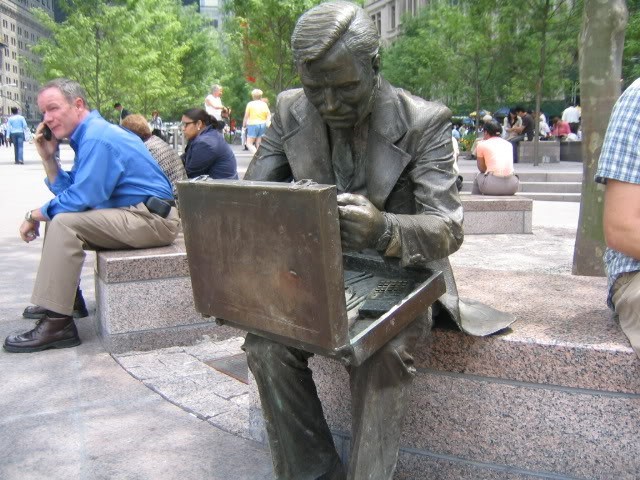
I first met him that August. He sat in a park at One Liberty Plaza, New York, New York, tucked in a corner, glancing into his briefcase. He lived in harmony with the workers and tourists meandering through the area; he paid them no mind, nor they him. 

At that time, autumn was creeping up on me like it always did, promising cooler air and brighter colors. Autumn was always good to me. I met my girlfriend at the time in the autumn. And years before, I’d met the woman I would eventually marry, also in the autumn. 

This fall was especially welcome, especially after a summer of unemployment and unhappiness. I’d finally been granted temporary work throughout the file vaults of various banks in the financial district. I spent my lunch breaks in the park at One Liberty Plaza, smoking cigarettes and trying to draw; the latter was particularly galling, inasmuch as I seemed to have forgotten how.  

One day I glanced around the park, looking for inspiration that wasn’t in this anatomy book that seemed to be the source of my frustration, and there he was, sitting on a marble step in the shade. I wondered who he was. I wondered what he was thinking. Was he relaxing, or was he about to stand up? And what was in his briefcase? Was it his lunch? 

As the days of tedious filing stretched into weeks, I crept ever-so-closer and peeked over his shoulder—subtly, so as not to offend him. I remember seeing an adding machine, and a few other items. But for the life of me, I don’t recall what these other items were, only that they were archaic. 

The last time I saw him, I stood up from the bench, tossed my sketchbook (weakened from the stress of erasers and my dissatisfaction) into my satchel, and dropped a quarter into a payphone. My girlfriend’s thirtieth birthday was that Thursday, and I was trying to arrange something fun; she hadn’t been my biggest fan over the past several months, and I needed to do something to fix that. 

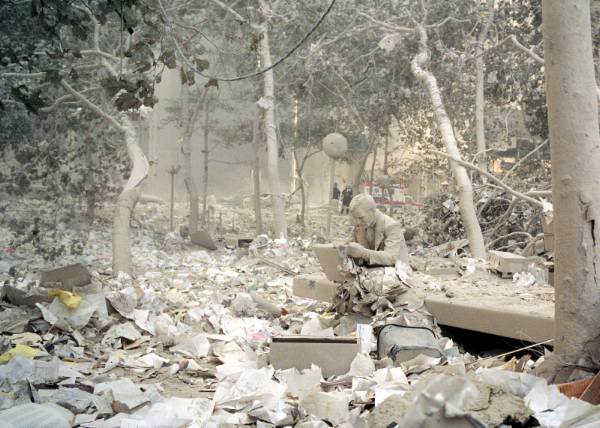
The last time I saw him was on a Monday, because on Tuesday, this happened: 

I’d originally wanted to write an essay about how much this country has changed in the past ten years—about how we’ve lost our way; about the silly phrases I used to love (i.e. “Bring ’em on” and “Dodged a bullet”) but no longer feel comfortable employing, as they have been soiled by those who have no concept of the value of a human life; about the collective, parasitic rage from that day that has turned us against cultures we don’t understand, against our own freedom, against our government, and against ourselves; about lost hope; about fear … 

And then I began running across never-before-seen photos from that day, begging the question: has somebody been sitting on them for ten years so they could release them for a big anniversary? And TV specials and stories and interviews on NPR and essays about what we’ve been up to over the past ten years … and stories from celebrities about what they were doing that morning. And I know that by noon on Sunday, we will have moved on to whatever it is we’re going to be saturating the media with this next cycle. It’s like the anti-Christmas. 

So I wasn’t going to participate. Regardless of everything I went through that day, I wasn’t going to participate. And then I remembered him. 

He’s since been moved around to museums and other parks. Now he’s been returned to where he once was, but in a prominent spot. I could go see him again, but it wouldn’t be the same. Nothing has been the same.  

I prefer to remember him from that late summer, when he and I were both alone, and we liked it that way.