Sister Act

I haven’t had any contact with one of my sisters for a year to the day. What weirds me out is that I don’t feel all that bad about it. I’m not sure what kind of person that makes me. 

You have a friend or relative like this. They’re the ones who say political opinions you find objectionable, and then defend their point-of-view in the nastiest way possible, using every fallacy in the book, and then pouncing on any admissions you make on the occasions they have a point and using this as a means of negating your entire argument. When you fight back against what they’re saying, they accuse you of trying to silence their opinions. In short, they are bullies. 

I hate bullies. My Evil Sister is a bully. She is the kind of person who imagines herself telling “the truth to power” or some self-aggrandizing bullshit like that. I don’t even know if she believes what she says; it’s almost as if she is daring people to argue with her. Every time I would see a status update or a comment on one of mine, I would clench up a little. There came a point, however, when I decided that I needed to stop. 

You see, thanks to the bravery and encouragement of my wife, I’ve learned to break off contact with people who make me uncomfortable. In the Facebook era of being “friends” with even with that lab partner from junior high, this is kind of difficult. But the fact is, it doesn’t matter your history—if you don’t like a person anymore, they’re not your friend. I cannot tell you how utterly liberating this is.  

When I began doing this back in 2005, it was extremely difficult, so much so that I had to justify to myself why. The guy in question was my best friend throughout high school. In the past when I behaved like a drunk as a bipolar, going to highs, wherein I was a selfish-but-charming douchebag, to lows, where I was a self-pitying Eeyore, he stuck around because he knew I’d even out and be the person he enjoyed. And yet, as I got older, I couldn’t stand to be around him anymore. And then I was advised, by my wife and by my therapist that I didnt have to

My usual method on Facebook is this: I block offensive status updates in an attempt to ignore them. When the offender rudely attacks me for something I say on my wall, I defriend them. Evil Sister had hit the first stage, which is where I had intended to keep her (she is my immediate family and shouldn’t be disowned). However, thanks to the miracle of that wonderful Facebook sidebar that allows you to see who comments on stuff, I discovered something she said that was too much. 

On September 11, 2001, a band of terrorists bombed the World Trade Center and the Pentagon, using an otherwise innocuous device—i.e. the passenger airplane—as a weapon. Most Americans are still processing what this has meant to us and to our world. 

Yes, I was there. But that doesn’t make my memories superior to others. On September 11, 2011, a friend in Albuquerque reflected movingly on his first trip to the USS Arizona in Hawaii, when he discovered that it was more than just a tourist destination—it was a tomb—and how that paralleled a reaming he received from a friend for requesting a jar of WTC ashes as a memorial. Another friend wrote an essay, entitled “My Narrative,” about the fear and isolation she’d felt in Colorado as the news barely trickled in over the sound of evacuations. I wrote a piece about how something as ordinary as a statue had been taken from me, using it as a metaphor for how my day-to-day life had been changed. 

Evil Sister for her part, accused everyone—everyone—who shared their “narratives,” (she used the word narratives very specifically) of trying to exploit the occasion to make it all about them—“it doesn’t matter how close you were.” This was a pretty direct, passive-aggressive swipe at me. It was a passive-aggressive swipe against her friend who wrote “My Narrative*.” It was an indirect swipe against my wife, who frequently spends months in Afghanistan, her job being to prevent this from ever happening again. It’s a swipe against the friend I was visiting that very day, a New York firefighter who lost literally dozens of the colleagues who ran into a burning skyscraper when the rest of us ran away from it. When I responded, in the gentlest terms possible (“I am disappointed and saddened that you feel this way, and that this is how you chose to express it.”), her response to me was predictable, but infuriating (“Oh, I forgot, you’re the only one who’s allowed to have an opinion.”). I informed her privately that I would not speak to her unless she apologizes, and that I don’t anticipate this ever happening. She (as I was told later) cussed me out behind my back and told me that I “always had to be right,” and told me that she didn’t care if she never heard from me again**. 

And so, after a year of stubborn silence, I’ve concluded that the only thing I’m pissed off about is how my family, who understandably don’t want to take sides, talks about the incident as if both of us are at fault. We are not equal here. I’m not perfect, but I am not an asshole. I do not treat people with disrespect and venom, nor do I expect my negativity to go unchallenged.  

I don’t miss my sister. I miss what she used to be—my favorite play partner when I was a child. I also miss the teenage version of the friend I mentioned earlier who now thinks that women who use birth control are sluts. Time has marched on, and so have I. 

But I still feel uneasy. I feel like I could have handled this differently. I wonder if maybe I am the asshole. I won’t discuss this with the people who witnessed this, because I don’t want to put them in an awkward position, so I feel alone. And yet, as I said, I don’t like bullies. I’ve dismissed at least five old friends, including my one-time best friend, for saying less. 

My life, as a result, has much less negativity than it used to. It’s also missing my sister. I’m very confused. And I will be for a long, long time. 

* On this particular friend’s birthday, Evil Sister complained in her status about how she hates it when, on friends’ birthdays, her feed gets clogged up by birthday wishes. As maid of honor at this friend’s wedding, Evil Sister accused her of being a “bridezilla,” because this friend wanted to go to a tanning booth to get rid of some of those lines that had built up over the summer, which would have ruined the aesthetic of her strapless dress. Evil Sister is not a very good person, is what I’m trying to say. 

** There are a lot of complications, of course, regarding the parallel and perpendicular relationships my parents have with their siblings, as well as my relationship with my niece. I won’t go into these, because I have rambled long enough. 
It’s Funny How We Never Look Up

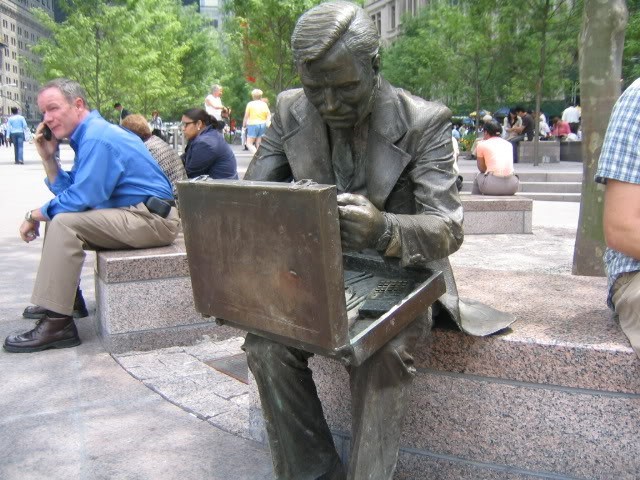
I first met him that August. He sat in a park at One Liberty Plaza, New York, New York, tucked in a corner, glancing into his briefcase. He lived in harmony with the workers and tourists meandering through the area; he paid them no mind, nor they him. 

At that time, autumn was creeping up on me like it always did, promising cooler air and brighter colors. Autumn was always good to me. I met my girlfriend at the time in the autumn. And years before, I’d met the woman I would eventually marry, also in the autumn. 

This fall was especially welcome, especially after a summer of unemployment and unhappiness. I’d finally been granted temporary work throughout the file vaults of various banks in the financial district. I spent my lunch breaks in the park at One Liberty Plaza, smoking cigarettes and trying to draw; the latter was particularly galling, inasmuch as I seemed to have forgotten how.  

One day I glanced around the park, looking for inspiration that wasn’t in this anatomy book that seemed to be the source of my frustration, and there he was, sitting on a marble step in the shade. I wondered who he was. I wondered what he was thinking. Was he relaxing, or was he about to stand up? And what was in his briefcase? Was it his lunch? 

As the days of tedious filing stretched into weeks, I crept ever-so-closer and peeked over his shoulder—subtly, so as not to offend him. I remember seeing an adding machine, and a few other items. But for the life of me, I don’t recall what these other items were, only that they were archaic. 

The last time I saw him, I stood up from the bench, tossed my sketchbook (weakened from the stress of erasers and my dissatisfaction) into my satchel, and dropped a quarter into a payphone. My girlfriend’s thirtieth birthday was that Thursday, and I was trying to arrange something fun; she hadn’t been my biggest fan over the past several months, and I needed to do something to fix that. 

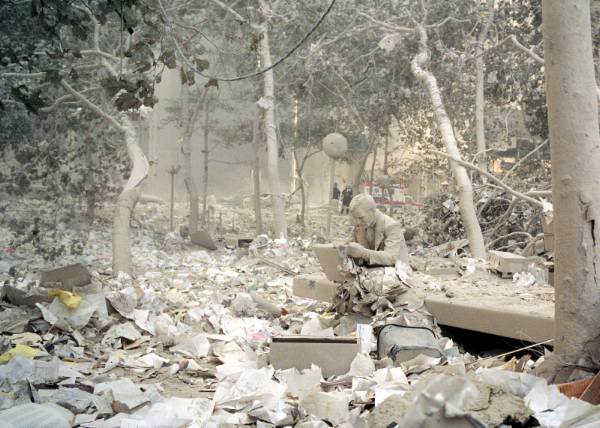
The last time I saw him was on a Monday, because on Tuesday, this happened: 

I’d originally wanted to write an essay about how much this country has changed in the past ten years—about how we’ve lost our way; about the silly phrases I used to love (i.e. “Bring ’em on” and “Dodged a bullet”) but no longer feel comfortable employing, as they have been soiled by those who have no concept of the value of a human life; about the collective, parasitic rage from that day that has turned us against cultures we don’t understand, against our own freedom, against our government, and against ourselves; about lost hope; about fear … 

And then I began running across never-before-seen photos from that day, begging the question: has somebody been sitting on them for ten years so they could release them for a big anniversary? And TV specials and stories and interviews on NPR and essays about what we’ve been up to over the past ten years … and stories from celebrities about what they were doing that morning. And I know that by noon on Sunday, we will have moved on to whatever it is we’re going to be saturating the media with this next cycle. It’s like the anti-Christmas. 

So I wasn’t going to participate. Regardless of everything I went through that day, I wasn’t going to participate. And then I remembered him. 

He’s since been moved around to museums and other parks. Now he’s been returned to where he once was, but in a prominent spot. I could go see him again, but it wouldn’t be the same. Nothing has been the same.  

I prefer to remember him from that late summer, when he and I were both alone, and we liked it that way. 

“Just like a New Yorker, she hauled a taxi.”

We lost a lot on that day. We’ve lost even more since then. Nearly three thousand Americans died that day. Nearly three thousand Americans have since died in deserts prosecuting the war on terror. Countless men, women, and children in two foreign countries have lost their lives, their limbs, and everything they own. Today, I will mourn that. 

Forgive me. I’m being dramatic. 

As I believe you know, I was there when this happened. As fate would have it, I had left my hometown of Gallup, New Mexico after their newspaper decided they didn’t need my skills. I ended up in New York. Three years later, I saw print in The Gallup Independent with a piece I wrote from my perspective of these events, which have reshaped the world. 

***

September 11, 2001 

Before I moved to New York from Gallup, New Mexico, in 1998, a friend warned me that I was seeking my fortune in a terrorist hotbed. 

“Washington is the capital of the United States,” he said, “but New York is the capital of the world.” I hate it when he’s right. 

On the morning of September 11, 2001, I’d arrived at work a block away from the World Trade Center a few minutes early, and my biggest concern was beating my envelope-stuffing record of 484. My watch sat with my other personal belongings near the window, so I had no idea what time it was when the building shook. It didn’t matter, because I thought it was only thunder – particularly loud thunder for such a clear day. Our building was much too close to see anything, anyway. Without a phone or the Internet in my office, I decided to sit tight and start stuffing envelopes. 

It didn’t take long for someone to tell me a plane had hit one of the towers. Accidents happen, and I’d help out in any way I could, but my commute was officially ruined. While waiting for further instructions from building management, word reached us that a plane had hit each tower. My stomach tightened and the rational side of my mind reassured me it was just a rumor. This couldn’t happen. 

I called my girlfriend, Andrea, to let her know I was safe and would call her back as soon as I could figure out what was going on. Then they evacuated our building. On the way down fourteen stories of emergency stairwell, I idly wondered if the terrorists were herding us for something worse. Once outside, however, the thought left my mind the instant I looked up. 

The background monoliths—as much a part of life as the hogback hills on the eastern side of Gallup during my youth, or the grain silos just outside of town during my young adulthood in Hastings, Nebraska—burned. This couldn’t happen. 

After realizing my escape route would lead me near a cemetery, I kept my eyes to the ground. Unfortunately, this meant shuffling through growing mounds of ash, tattered insulation and unreadable memos. Finally, seeing a charred leather cell-phone case made me look up again. Paper which had been on desks or in filing cabinets fluttered out of twin clouds of smoke and onto the streets. This did happen. 

Focusing all of my attention to my legs, I closed my eyes and moved my left foot in front of the right, then the right foot in front of the left. I couldn’t afford to think. 

A few blocks north I ran into a fellow temp named Joe. I asked him what he knew, but used a lot of swear words to do it. He chose to stick around, and I chose to find Andrea. I still don’t know if he ever left. Somehow I made it several more blocks north, where, incredibly, a subway station accepted passengers. While I escaped underground, reading words in a book I can’t remember, the towers fell. 

When I found out about the Pentagon attack, it was right after an event that shocked me even more. A man at a phone booth had just apologized for taking a long time to make his call. In New York, that was about as common as finding parking at a Wal-Mart on payday. But in reality, that’s how we do things in New York. Sure, we all got our own problems, but when handed something of this enormity, they don’t matter. 

During the first part of the day, the only way out of Manhattan was on foot. After pedestrians crossed the bridges, they found chairs and bottled water being handed out by concerned shop clerks. By mid-afternoon, hospitals were turning away blood donors and volunteer workers. 

The Twin Towers were an important symbol of New York and the United States, but we are not those buildings. We’re human. Nobody can take that away from us. 

***

On September 11, 1906, Mahatma Gandhi instituted his nonviolent resistance to the British occupation of his beloved country. Today, I am going to celebrate that.