Justice Stinks!

In west-central New Mexico there is a humble city. Maybe not that humble. Anyway, this city was a magnet for evildoers, and wherever and whenever crime, mayhem, and naughtiness struck, its humble (or not) citizens would cry out for the fragrant justice of their hometown champions!

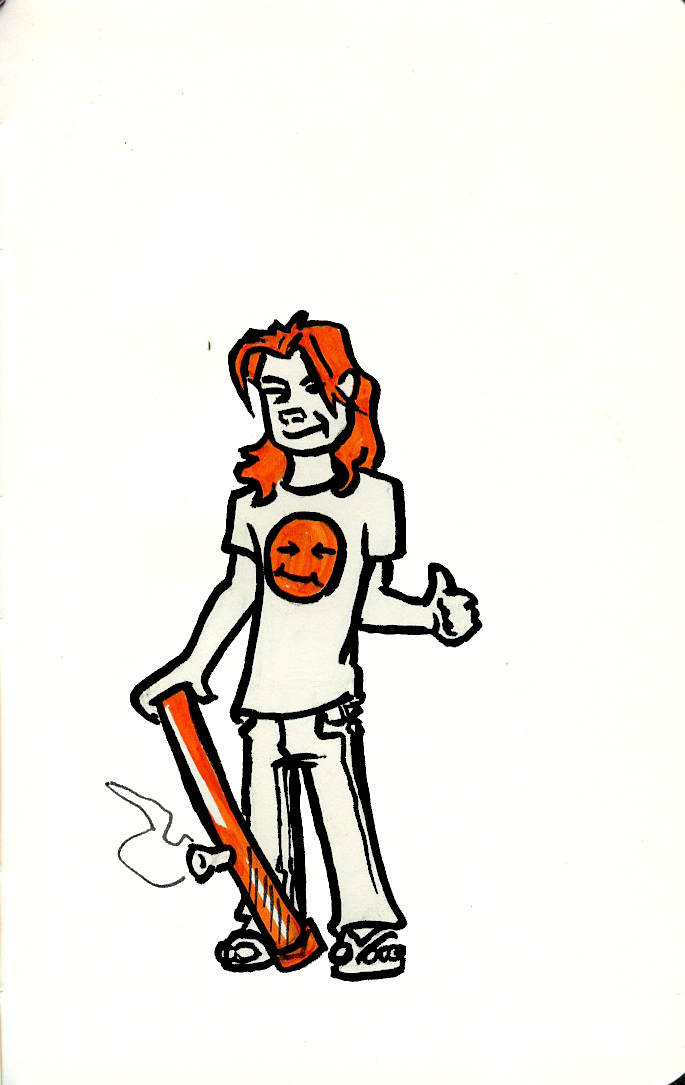
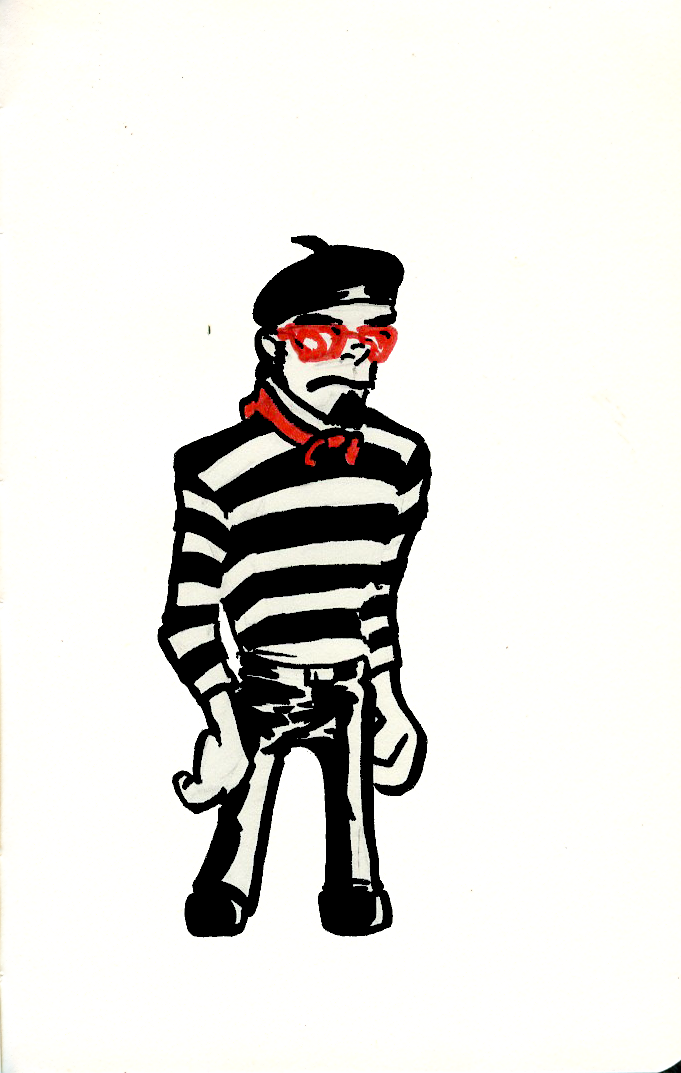
            When he was a child, young Barry fell into a radioactive sewer and gained the power and abilities of that sewer! From that day forth, he dedicated himself to the protection of Gallup, New Mexico as Sewerboy!

When he was a child, young Eugene sat down on a radioactive cactus and gained the power and abilities of that cactus! His idol, Sewerboy took him under his wing, and he fought by his side as the Kactus Kid!

Over the years, they developed quite the rogue’s gallery, including The Nitpicker (“You’re going to jail, Nitpicker!” “How can I be going to jail if I’m standing right here?”) …

The Passive-Aggressive Giant (“I guess I could go to jail. I feel bad about my mom, though, who has a bad back and can’t do any of the yardwork.”) …

And Irwin, God of Cannabis (“Perhaps we shouldn’t, uh, talk about Irwin.”)

But never was evil more powerful than with the caffeinated villainy of Major Jitters, who drank a radioactive cup of coffee and gained the power and ability of that coffee, and she chose to use it for nefarious ends. All it takes to unleash her awesome gifts is a wholesome mug full of Joe.

With her army of café-themed goons, she has cut a swath through the innocent (?) city of Gallup.

But when it comes to muscle, none can defeat the Percolator.

When evil is afoot, when all seems lost, you’ll hear the battle cry of Sewerboy and know you’re in safe hands.

“Justice Stinks!”

Does Whatever a Mortal Can

I love drawing comics. The comic book I’m working on, the second chapter of Best Fiends Forever, is not my first comic book. The first chapter of Best Fiends Forever was not my first comic book. The one I worked on nineteen years ago for those smug dudes in New York who badmouthed me after I quit was not my first comic book. My first comic book was MortalMan, in 2003, and I dug up some of my sketches from back then.

You probably don’t know this if you’ve picked up comic reading in the past twenty-five-to-thirty years, but once upon a time, issues were self-contained, and the only thing you needed to know was in a one- or two-sentence summary near the logo. For example: “When Peter Parker was bitten by a radioactive spider, he developed abilities of a spider and learned that with great power comes great responsibility.” From there, you’d pretty quickly catch up on Spider-Man’s specific powers and enemies, usually through narration.

For MortalMan, the banner was: “When Joe Branford was bitten by a radioactive spider, he had a rash for three weeks and learned that with no power comes no responsibility.” Joe (first pic) was a good-natured teenager who watched TV and read comics perhaps a little too much. However, this prepared him for some of the weird shit to hit Gallup, New Mexico. For example, he was not fazed when he met a talking dog named Pete, figuring he was just bilingual. Pete is a goth. He sees the world as gray and bleak, he writes dark poetry, and he attempts suicide in the first issue (if I were going to write this again, I’d probably change that last bit). He and Joe hit it off, and they hang out at the mall.

This is Kgnydjll and Fphihln (pronounced “Nigel” and “Phil”) emissaries for the Galactic Empire who come to Earth in the first issue to welcome us to the fold. Unfortunately, they arrive in time for a Science Fiction Convention, and no one believes they’re aliens.

I had a lot of big plans for MortalMan, and I wrote a lot of scripts, but I never followed through with them. Joe and Pete were going to run afoul of a pair of John-Woo-inspired super spies and a mob of Tarantino-esque gangsters at a Mafia Convention being held in Gallup, and they were going to rediscover the long-retired superhero guardians of Gallup, Sewerboy and the Kactus Kid.

One of their rogues’ gallery was Irwin the God of Cannabis.

More on Sewerboy et al on a separate post.

At one point, Joe was going to get sucked into hell and would escape when a pair of little boys, attempting to tunnel to China, dig a hole in Perdition’s walls, leaving Joe stranded in Hastings, Nebraska. On his way home, he’d run into my most ambitious creation, M: the scourge of I-80, based on my dear friend, Emilie. With her sidekick, Pixie (based on our friend Abby), she leaps from car to car and liberates the change from drivers’ ashtrays. To pull her off, I’d have to learn how to draw a lot of cars and some very kinetic poses. Twenty years ago, I knew I had it in me. Now, I’m a little more humble.

I still have the original art for the comic, sans word balloons, but I don’t have the script, nor the scripts for future issues because Newcastle liked to sit on my laptop, and 18 years ago, he was much heavier and broke my hard drive.

And yet, I am starting to look for a projects after I’m finished with Best Fiends Forever

Call It A Draw

I’ve been prepping for a while now, and I have one more pre-production task to do, but this weekend, I’m going to start working on my third comic (technically my seventh, but the other four were done roughly two decades ago). I’m looking forward to this. I’ve got a script that’s been broken into pages and panels, and a lot of the obnoxious stuff has been edited out. All I need to do is finish layouts before I pull out the Bristol boards.

I learned some lessons from the last two comics I did, and I want to incorporate them into this one:

  1. Don’t rush. I’m not on a deadline, and no one is clamoring to see it. I need to take my time on each page.
  2. Don’t settle. I have an eraser, and I can use it as much as I need to. I’m never happy with the art I finish because I’m frustrated or I just want to get it over with.
  3. Watch the eraser. I’ve come to realize that the larger erasers I’ve been using are smearing the paper. I need one I can control.
  4. Backgrounds, backgrounds, backgrounds. I need to put as much work into those as into what I’d rather be drawing. A good background is invisible, and an over-simplified or missing background is glaring.
  5. Most importantly, practice. If I don’t know how to draw something, I shouldn’t learn on the page.

On the last point, the first page of my new comic focuses on children. When you’re used to drawing adults, it’s tough to remember that they’re not miniature adults. Take this panel from acclaimed comic artist, John Byrne. These are toddlers.

Mindful of this, I gave it a try for myself (while also practicing how to do a playground and mountains, both which also feature on page 1). I did way better than acclaimed comic artist, John Byrne.

On the left is Max Fuentes, Criminal Mastermind of the Third Grade. To the right is his enforcer, Lisa Green.

Another problem I have is likenesses. My former neighbor, the eccentric bombshell Cleo, guest stard, so I gave that a shot (while also working on backgrounds). I still need to do her roommate, Brandyn, who also puts in an appearance, but I have plenty of time to practice until I get there.

No more excuses. Time for layouts so I can get started. Wish me luck!

Not the B’s! Not the B’s!

I’ve become kind of obsessed with Scott Adkins.

First, let me back up a little.

I used to really love B-movies. It was one of the few things I had in common with my ex-wife. What makes a B-movie? Well, back when going to the movies was an event, as opposed to the chore it is today (in my opinion), there was a newsreel, a cartoon, a serial (including the original 1944 Captain America), a B-movie, and the marquee film. That’s how people my dad’s age saw cartoons before they were rerun on TV ad nauseam, without the nauseam part. The serial kept people coming back for more. The B-movie had a smaller budget, wooden acting, bad writing, and was usually sensationalist. When TV became ubiquitous, B-movies could be seen late at night on the networks or during the day when the soap operas (or as I called them when I was a kid, “soap poppers”), weren’t on. They also made straight-to-television movies that were often failed pilots, like the original 1979 Captain America, made shortly after I was born, but rerun over and over again, so I saw it in the eighties, back when I was too young to know how bad it was.

During the cable era, they were moved to networks like USA and HBO, and later, Cinemax, where they were known as straight-to-video releases. That horrible disappointment in film, the original 1990 Captain America, was a straight-to-video release. B-movies could be anything, from horror movies (the gorier the better), to sex thrillers (one of two non-scrambled places to see nudity before the Internet), to action (this is where Chuck Norris’s infamy comes from), to raunchy sex comedies (the other place to see nudity), to cheap sci-fi flicks (which were my favorite at the time), and more.

B-horror movies were the most popular overall because they would produce more gems, like The Evil Dead, which did have a minor theatrical release, but found a wide audience on cable and video. Fans were thrilled by the low production values and the over-the-top plots and action. Also, watch enough B-movies, and you begin to recognize the actors, who nowadays will appear in small roles in big-budget movies or on the CW. They are popularly known as “character actors,” I refer to them as “Hey, that guys!”

And that brings me to Scott Adkins. Scott Adkins doesn’t have a lot of roles in big movies. The biggest role (ha!) I’ve ever seen him in was in John Wick 4, where he wore a fat suit and wiped the floor with Keanu Reeves. He’s got a big following, though. He’s good-looking, a gifted martial artist, and a pretty decent actor. I’ve seen him in serious roles, like Ninja 2: Shadow of a Tear (“A man who seeks revenge must dig two graves.” “They’re gonna need a lot more graves than that.”), comedic roles, like Max Cloud, and movies that are both, like The Debt Collector. My favorite of his is Accident Man: Hitman’s Holiday, during which he flashes his dreamy smile a lot and fights a clown armed with a cinder block on a stick.

I don’t know why he’s not a leading man. Actually, I attribute that to the fact that actors are no longer chosen for their natural physicality. Instead, they’ll hire an out-of-shape comedian like Chris Pratt, make him lift weights and not eat carbs for six months, make him dehydrate for a day or so, and dunk him in a bathtub of ice water, just to film a thirty-second shirtless scene. Meanwhile, their stunts are performed by wirework or a CGI engine, like in the 2011 original Captain America They didn’t hire real martial artists for The Matrix even, until The Matrix Reloaded, where they found three of the top B-movie action stars of the decade and made them agents probably because they had charisma (not in this movie) and because they didn’t have to train them.

There’s the fact that action starts pushing sixty, like Keanu Reeves and Tom Cruise, won’t retire and still insist on doing their own stunts. Also, Hollywood execs are Gen-X, the Nostalgia Generation, and will only do movies based on comics or toys from their childhood and will drop $300 million on an Indiana Jones movie, despite the fact that only people over forty even care about the character anymore.

As for me, I wanted to watch a movie the other day, and I couldn’t find anything that appealed to me on any of the dozens of streaming services I’m subscribed to. I blame this the single-take sequence in Guardians of the Galaxy Vol. 3: Hope You’re Not Here for Anything Fun. I think single-take sequences are really cool. I watched the one from Oldboy over and over again, and when there was one on True Detective, followed by one on Daredevil, it was jaw-dropping. Fast-forward to the last few years, and we had one on Loki, and it was fine, I guess. And we had one at the climax of Guardians 3, which was almost completely computer-generated characters. It was cheating. The single-take tracking shot went from a stunning achievement in directing, choreography, and the persistence of repetition into something you could do if you had enough VFX artists. What used to be a rare treat was turned into something I was getting tired of.

This in mind, I chose a Scott Adkins movie, the goofier, the better, and it had a single-take sequence that was actually fun. This wasn’t because a digital tree was jumping over a digital monster, but because Scott and his co-heroes were in a hallway, beating up a bunch of faceless bad guys. The only special effects (as far as I can tell) were the plasma blasts from the bad guys’ sci-fi guns. Mostly it was Scott kicking space ninjas in the face and hamming it up as an over-the-top video-game hero. I made it all the way through the movie in one sitting. The next day I watched another one, which started with Scott having four fights in the first thirty minutes, three of which he got his ass kicked hilariously, and ending on a note as heartbreaking as watching small animals get tortured and murdered and have it be the most important part of the movie. (Guardians of the Galaxy: A Silly Comedy Series. You know, for kids!)

The appeal of a good B-movie is that, without computers that have the processing power of an entire country and producers cranking out increasingly unprofitable blockbusters again and again, they depend on human beings. Their writers may not have the allegedly witty banter of a Marvel movie, or their biggest star may be Ryan Phillipe, but they’re not afraid to play with the formula. I know a lot of these movies are crap. I’ve complained about them on this blog before. They’re real, though, and they deserve our love. There’s not a lot of Scott Adkins movies on the multitude of streaming services I’m subscribed to, but I’ve put them all in my lists (“my stuff,” “my watchlists,” whatever), and I’m going through them one at a time. I’ve given up on blockbusters, and by the looks of the box office receipts for 2023 (Barbie and John Wick 4 notwithstanding), the rest of the country is starting to as well.

Pop Goes the Culture

I’ve had a bad attitude about pop culture for a while now, ever since 2007, when they released Hairspray, a movie based on a Broadway musical that was based on a movie. Don’t get me wrong, I love pop culture. I love(d) Marvel movies and TV shows. I learned how to read from comics, along with some very patient teachers. I even bought and assembled a (very inexpensive) Short Circuit MOC Lego set. On the other hand, there are other things going on.

I get it, though. I barely read the news because it’s infuriating. I’ve gotten into shouting matches with people because of the news, and these are people who agree with me. But when I scroll down Facebook, 75-80 percent of the posts are related to pop culture somehow. And they are extremely popular posts. When I post art of a character I conceived and developed and painstakingly drew and colored, I consider it a raging success if it breaks six likes. When I posted pictures of the aforementioned Johnny 5, a character whose only connection to me was that I saw the movie a bunch when I was a kid and I spent less than an hour putting it together via detailed instruction, I got dozens of likes.

While that sticks in my craw on principle, the fact is, I write and draw to impress myself. Do I want more people to appreciate my forms of expression? Of course I do. Can I live without it? Half of the six likes I’ll get are regulars, so I know I have fans. And I know for certain that a number of my friends and family see and appreciate my posts without saying anything. (It’s not like I’m consistent about visibly appreciating others’ posts.) Besides, since I found out how bad writers have it, from novelists, to TV and screenwriters, to comic book writers, I’m perfectly content with a Dropbox full of unread manuscripts.

In my last sentence, I used the word content, but pronounce it differently, and it’s content. Content is what you get on streaming services and YouTube. It’s art as a commodity that can be bought and sold, but most importantly, it’s disposable. Last year, I complained about the Willow TV show on Disney+. Well, it’s gone. If you enjoyed it, tough, because Disney pulled it, and physical media is obsolete. The actors, writers, and directors will never be paid again for all the work they put into it, and the worst part is it’s not because the show was bad (I mean, it was), but because pulling it saved Disney a bundle on taxes. Since art is disposable, there’s no point in paying the “content creators” decently, or at all, for their work. How do you think YouTube got so successful? But that’s okay, if you don’t want to create for pennies, they’ll just find someone else who will. That’s why this strike is so important.

With art as a commodity, you’ve got CEOs and presidents of a rapidly shrinking number of entertainment conglomerates saying that they won’t even consider a work if it doesn’t represent an existing intellectual property. That’s how you get the Fatal Attraction streaming TV show, which was delightful trash to be sure, but it had all the soul of worn-through shoe. Meanwhile, as I’m walking out of the Metro, I see posters of Moulin Rouge the stage musical, based on a movie musical which was based on previously recorded music. There’s a True Lies series. What the hell is the point of True Lies without Arnold and Jamie Lee, but instead a generically attractive couple in just another generic spy show.

Meanwhile, a genius like Greta Gerwig has to make a movie about a doll to get the recognition she deserves. Yes, it was a very good movie, and there were more layers to it than any of her previous movies, but it was fucking Barbie. Naturally, the studio response to this is not to make more deep movies with important social messages but to make more movies about toys. There are seven Transformers movies, and only one of them is good (Bumblebee) and two terrible GI Joe movies. The Lego Movie was amusing and meta, but had no substance at all.

*deep breath*

I’ve been meaning to rant about this for a while, but I still haven’t formed any really coherent thoughts about it. The reason I had to say something about it now is because I had indulged in some McDonald’s, and I was sitting outside, watching Newcastle creep around our backyard, and I saw written on my iced tea, “The McDonald’s Cup, as seen on” and then it listed over a dozen TV shows and music videos and movies, going back as far as Coming to America, up to Loki, season two, which isn’t even out yet.

What. The actual. Fuck.

The Printed Menace Revisited

I learned how to read from comic books. My dad had a huge stack of The Amazing and The Spectacular Spider-Man, The Avengers, and my personal favorite, the first fifty or so issues of The Defenders, all from the seventies and early eighties, and I read them obsessively. He had an original copy of Amazing Spiderman #129. In many ways, my dad was awesome.

I stuck with comics through the nineties, and I refused to take sides during great rivalry between adjectiveless Spider-Man and X-Men #1s. I remember my friend Tony telling me I was stupid for not picking up Superpro #1 because it was a NUMBER ONE, DUDE! I foresaw the collapse of the speculator boom when this guy I knew bragged about how he bought five copies of Spawn #1, and I thought, “If he has five copies, and his friends have five copies, who’s going to buy them? (And sure enough, twelve years later, when Chris Claremont did a surprising signing at Jim Hanley’s Comics in New York City, I bought a copy of the gatefold cover of X-Men #1 for a buck, or 20 percent of what I paid for it in 1990.)

When a guy named Robert opened a comic book store in my tiny hometown in 1993, I had found home, as well as Grendal, and I hung out there until 1994, when I went to college and became an intellectual, reading only Sandman. After that, I branched back out into the comics world and discovered lots of new stuff, a collection only confined by the size of the tiny apartments that my ex-wife (X-Wife?) and I lived in. When we moved to the DC metropolitan area, she surprised me with tickets to DC’s AwesomeCon, where I met my first muse, Peter David. But one day, I just stopped reading, even books by my favorite writers, such as Ed Brubaker.

However, my youngest sister, who prior to this point, read only Garth Ennis Punisher comics, suddenly became fascinated by Robin, and from there has become her own encyclopedia. When I told her who Snapper Carr was, she found out quickly that I had no idea what I was talking about. The student has surpassed the master.

Which brings me to the main event. Originally written to pit Brian Michael Bendis and Warren Ellis against each other. I love them both. They’re both very clever, very exciting, very cerebral writers, but they couldn’t be more different. To explain this to my friends (and later to my sister), I let them both write Star Wars. As I’ve revisited this, I’ve added more writers with distinctive voices.

Brian Michael Bendis:
LUKE: I got a bad feeling about this.
HAN: You got a bad feeling about this?
LUKE: I got a bad feeling about this.
HAN: About this?
LUKE: Yes.
HAN: A bad feeling?
LUKE: Yes.
HAN: You got a bad feeling about this?
LUKE: I got a bad feeling about this.
LEIA: This?
LUKE: This.
LEIA: This is what you got a bad feeling about?
LUKE: It is.
LEIA: You got a bad feeling about this?
LUKE: I got a bad feeling about this.
CHEWBACCA: WRAURGH!
LUKE: Chewie’s got a bad feeling about it, too.
LEIA: About this?
LUKE: He does.

Warren Ellis:
LUKE: I got a bad feeling about this.
HAN: Me, too. Let’s shoot it in the head.
LEIA: (Lights cigarette) Bloody right, then.
CHEWBACCA: WRAURGH!

Frank Miller:
LUKE: I got a bad feeling about this.
HAN (In captions): I had a bad feeling about this, too. A real bad feeling. A bad feeling burning ice cold in my gut. It tells me things are bad. Real bad. I watch the boy. Luke Skywalker. Age eighteen. He thinks he knows what he’s getting into, but he has no idea how bad it’s going to get. This feeling he’s got? It’s roses. Roses and picnics and apple pies to how it’s really going to get. Luke Skywalker. Age eighteen. He’s in for a world of hurt.
LEIA: Oh, Han! I can’t stand it anymore! I have to have you! You’re so manly! Take me, you wicked, manly space pirate! Smuggle yourself inside of me! Take me now!
CHEWBACCA: WRAURGH!
HAN (In captions): The Wookie screams a dark, primal scream into the cold, dead interstellar void. A void colder and deader than that bad feeling in my gut. The Wookie screams. I know how it feels.

Joss Whedon:
LUKE: I got a bad feeling about this.
HAN: Then maybe we should go all Buck Rogers on it and kick its evil ass! Set phasers to awesome!
LEIA: Totally!
CHEWBACCA: WRAURGH!

Garth Ennis:
LUKE: I got a bad feeling about this.
HAN: Fuck!
LEIA: Cocksucker!
CHEWBACCA: WRAURGH!

Kevin Smith:
LUKE: I got a bad feeling about this.
HAN: That’s because my cock is in your mouth!
LEIA: You guys are so gay!
CHEWBACCA: Han, I think your bluster hides the fact that you do, in fact, have sexual feelings for Luke, but are conflicted because there is also something there for Leia, as well.
LUKE: Snoochie-boochies!

Chris Claremont:
LUKE: I got a bad feeling about this.
HAN: Of course you got a bad feelin’ about this, old friend, because the evil we face is the Empire, which has caused us no end of difficulties. If you’ll recall, Darth Vader has revealed himself to be your father as part of his master plan to overthrow his lord and master, Emperor Palpatine [See The Empire Strikes Back—Ed.]. We’ll need to face this together …
LUKE (In a thought bubble): Han’s talking tough, but it was only recently that I was able to rescue him from the clutches of Jabba the Hutt, and he may still be suffering from the side-effects of carbonite hibernation [See The Return of the Jedi—Ed.]. He can’t keep pushing himself like this. Hey, is that an Imperial Storm Trooper about to shoot at us? It is! I’d better warn the others. (Out loud) Look out!
LEIA: (Thought bubble as she jumps over the blaster fire): Incredible! It was only months ago that I was a helpless princess in the clutches of Grand Moff Tarkin [See A New Hope—Ed.], but now that it has been revealed to me that I am the daughter of the once-noble-Jedi-turned-evil, Anakin Skywalker [See The Return of the Jedi—Ed.], and with the training I’ve received with the rebels, I can easily evade this blast! (Out loud, still mid-jump) Luke! Use your lightsaber and Jedi training to deflect the blast! Chewbacca! Use your crossbow gun to stop the Storm Trooper before he can get another shot off!
CHEWBACCA: WRAURGH! [See The Revenge of the Sith—Ed.]

Jimmy Palmiotti and Amanda Conner
LUKE: I got a bad feeling about this.
LEIA: What are you gonna do about it?
LUKE: Are you going to wear the metal bikini all the time now?
HAN: I have no objection to this.
CHEWBACCA: WRAURGH!

Ed Brubaker:
LUKE: I got a bad feeling about this.
HAN: It’s about to get a lot worse. (Shoots Luke in the back) Now we can be together, Your Highness, without him standing in our way.
LEIA: (Points her gun at Han) Oh, Han, don’t you see? It was never about you and me. You were the one standing in my way.
HAN: No!
LEIA: (Shoots him.) Now, Chewie, we can take the money and get away from it all! Just you and me.
CHEWBACCA: (Strangles Leia) WRAURGH! (Wipes a single tear from his cheek.)

Neil Gaiman:
LUKE: I got a bad feeling about this.
NARRATOR: The bad feeling drifts through the hearts and minds of the galaxy, like the smell of something foul, yet bittersweet, like kimchi. The words cross their lips as the feeling overcomes them. The Correllians know it …
HAN: I got a bad feeling about this.
NARRATOR: The Mon Calamari know it …
ACKBAR: I got a bad feeling about this.
NARRATOR: The Gungan know it …
JAR-JAR: Meesa got a bad feelin’!
NARRATOR: The Hutts know it …
JABBA: Botaka! Hoo hoo hoo …
NARRATOR: The Ewoks know it …
WICKET: Yub yub!
NARRATOR: The Wookies know it …
CHEWBACCA: WRAURGH!
NARRATOR: But never is it more real than in the dreams of the exiled royalty of a world that is no longer there …
LEIA: I got a bad feeling about this.

Peter David:
LUKE: I got a bad feeling about this.
HAN: Are you sure it’s not “More Than a Feelin’”?
LEIA: (punches Han in the shoulder) Han, this is serious.
HAN: Oh, dry up, Princess.
CHEWBACCA: WRAURGH!

Grant Morrison:
LUKE: I got a bad feeling about this.
HAN: The only way we can get through this is if break the parsec barrier and cause a chain reaction. This will require everything we got, all of us. And if we fail, we run the risk of turning every living creature in the galaxy into yarn.
LEIA: (turns to camera) That is if it’s okay with the writers.

Ben Edlund:
LUKE: As he stares out across The Galaxy, the galaxy far away, our intrepid hero stands there, asking himself the same tough questions. What is it far away from? If Darth Vader is indeed his father, why don’t they have the same last name? Do they have Chinese food in space? It’s these questions and more that make him think. They make him cry out to the stars! The warring stars! I! GOT! A! BAD! FEELING! ABOUT! THIS! AND I’M OKAY WITH THAT!
HAN: Who are you talking to?
LUKE: Hello there, old chum. I’m just setting the mood.
CHEWBACCA: WRAURGH!

My favorite writer is Matt Wagner, but he doesn’t have any consistent tropes to hang one of these on. I was also going to do Mark Millar, but thinking about it made me want to throw up a little.

Two Strikes; No Outs

I’ve been in favor of the Hollywood strike for a while now, but for each day that passes, I hear something that strengthens my resolve. For example, did you know that actors make an average of $28,000 a year? And if you don’t remember how averages work, they add up all the yearly earnings of actors, including the ones who make over $30,000,000, divide by the number of them, and you get a figure: $28,000, around minimum wage. Meanwhile, streaming services are pulling all kinds of fuckery to keep from paying residuals. Writers have it worse because studios hire a writer’s room, then fire them before the scripts are finished, and I believe that absolves them of residuals. As a writer, I’m glad I never made it because, if I have to go out stumping for peanuts every few months, I wouldn’t be enjoying my craft or my life.

Now that I’ve got this out of the way, I saw something that really put actors’ plight in stark relief. I like to have bad TV shows or movies on in the background while I draw—I need the noise, and I really don’t pay attention. The one I picked this morning was BAD. The story was terrible, the dialogue was terrible, the lead and supporting actors wouldn’t have passed auditions for a high school production of Our Town. The cinematography (or what I saw when I looked up) looked like it was filmed through a plastic grocery bag. The lead had no charisma, and the plot twist at the end was so unbelievably stupid I was haunted by it. The budget was about as much money as I have in my checking account (i.e., I’m not broke, but if I have to go to the hospital I will be).

And yet, the top-billed actor in the movie, like Anthony Hopkins was top-billed in The Silence of the Lambs, was Morgan Freeman. Let that sink in for a moment. This was not a B-movie. It was a D, maybe a D-minus. There are a couple of explanations for this. Maybe he owed the director a favor. Maybe he had signed a contract that locked him into it. Most likely, it was the same reason Harrison Ford made an Indiana Jones movie at eighty years old: he needed the money.

Morgan Freeman has way more money than me, I know that. I know he gets paid more cash than I’ve ever seen for each role that he plays (and his presence in this rubbish film probably used up most of the budget). But I learned something when I went to Doha ten years ago. You expand. Kate and I went from a thousand-square-foot apartment to three thousand square feet. When we returned three years later to 1,200 square feet, we couldn’t fit. Likewise, prior to moving there, we had some debt, but mostly we were living comfortable off of her good salary and generous stipend from her father (which he gave to her as a way of getting out of paying taxes because he’s wealthy, and that’s what wealthy people do). We moved to Doha, where we didn’t pay rent, everything was cheaper, her salary went up dramatically for overseas pay, and since Doha was considered part of a war zone (it was not), we also got hazard pay. When we returned to the United States, all we had left was the salary and stipend, and we went broke. It took a couple of years to stabilize our finances (then she kicked me out).

Before I got married, I lived on half of what I’m making now (about two-thirds adjusted for inflation), and these days, I’m spending slightly more than I make, mostly because of the geriatric cat. You get used to it, is what I’m saying.

Imagine being one of the most acclaimed actors—and an actor of color no less. Imagine you played God in a big-budget Jim Carrey movie. Imagine starring in a movie (The Shawshank Redemption) that’s so iconic, everyone wants you to narrate your life. Imagine being a meme. Imagine not being able to find work anymore, and being broke. Imagine having to play a small important character in this turd of a movie. He did a good job, but clearly his heart wasn’t in it.

Part of the reasons actors are paid a lot, even the little guys, is a lot of time passes between projects, unless you’re Antonio Banderas, who appears to make a movie a month. I don’t know who his bookie is. Scarlett Johannsen sued Disney because Black Widow was mostly streamed, and her contract only covered theater sales. Nobody feels sorry for the actors, despite that most of them are barely getting by. This is exactly what the millionaires and billionaires in the studios want you to feel.

Acting is a hard job, even for the stars. Can you imagine being one of the Marvel’s Chrises and have to work out for hours a day and have a strict diet just so you can do a two-second shirtless scene? Does anyone remember when Chris Pratt was fat? He will never enjoy a donut again.

Meanwhile, execs are getting paid millions when product that’s fattening them up is not getting adequately recognized for their efforts. Do not listen to them. There are millionaires on both sides, but the difference is, on one side, they’re showing solidarity (except for Matt Damon).

I haven’t even brought up AI, which fills me with rage as a writer and artist and as someone who doesn’t want to see his favorite actors digitized.

In a few months, we’re going to see the movies and TV shows in the pipeline run out. A lot of people, including people I know, are mad that there will be no new content. To which I say, out of the dozens of streaming services out there, are you really going to tell me you’ve seen all the TV shows and movies? What about all the TV shows and movies you own? Read a book. Go to the park. This is not quarantine anymore.

Oh yeah, also in the awful movie was Peter Stormare for about one minute. He chewed scenery like we’ve come to expect from him. I suspect he didn’t even know he was in a movie.

Past is Profit

The nineties are an important decade to me. I went to high school and college and New York in the nineties. Most of my favorite music is from the nineties. I, for one, couldn’t be more thrilled that it’s going through a revival. And, frankly, I’m sick of it.

My streaming services are showing all the same playlists labeled “90s nostalgia.” All the movies I remember from that decade are being converted into TV series or further sequels (True Lies the series? Come on! Does anyone my age or older remember the plot of that movie? No, they remember Jamie Lee Curtis stripping and Arnold Schwarzenegger making quips as he murdered people, not the generic hotties in the TV show being chaste like all TV shows and movies these days—but that’s another rant.)

The nineties are fucking everywhere, with major brands getting in on it and middle-aged celebrities coming out of their coffins and getting botox. I imagine this must be how LGBTQ people feel about Pride Month, when all the corporations put rainbows on their packaging and continue to give money to hateful, bigoted politicians.

I feel like this is my time, and I can be the old-man expert on the decade, but young people don’t want to listen to me.

On the other hand, my soon-to-be-published novel, Hanííbááz Rising, is set in 1995. I love that teenagers are seeking out and trading CDs like my generation did with vinyl records. (Millennials didn’t really get to do this because nostalgia for the eighties meant tapes, which were the single worst way to store music.)

But I know I’m being pandered to, and that never fails to piss me off.

Can You Hear the People Sing? 

In an unexpected plot twist, I spent yesterday afternoon in the Kennedy Center, watching Les Miserables. The plot twist is because I don’t particularly like musicals, and I can’t spell Les Miserables without miserable. I had just started working on page one of my new comic, and I wasn’t ready to call it quits for the day when my friend used the telephone function on her cell and told me she had an extra ticket for that afternoon.  

I have never seen Les Miserables all the way through before. It had never popped into Popejoy Hall in Albuquerque during one of my GATE trips, and Broadway was prohibitively expensive when I was there. (I’ve seen Rent on Broadway, but that was via shenanigans.) I saw the movie with my ex-wife, and we got an hour into it when we had to give up. However, I’m trying to accept invitations now (despite my art) because I’m thrilled someone thought of me.  

I enjoyed it a lot more than I expected. The set was dumbfounding, and damn, these people could sing. And I knew that kid was dead the instant he climbed the barricade. Sure Marius and Cosette had the personalities of wet cardboard, Marius’s bestie (whose name I forgot because I can’t remember anything) was fun and memorable and dead early into the second act. It was nice to be able to hear what Javert was singing about.  

But what really made my brain jump out of the top of my head and jump off a bridge was the aforementioned sets. Les Mis (as all those in the know call it) is epic. It takes place in France as revolution after revolution happens, in the streets, in the slums, in gated residences, etc., and through a miracle of engineering, they made it happen, from the docks at night to a wedding in a palace. There were no people in black moving scenery around—the scenery moved itself. And it did it so smoothly, the lights didn’t have to go down.  

One day in the office a while ago, when there were more people willing to stand around and chat for a half-hour, one of them, who is only a couple of years younger than I said, “You have to watch A New Hope. Just try to ignore the bad effects.” I almost broke my keyboard. The original Star Wars did not have CGI. It had dozens of craftsmen making the rantings of a filmmaking lunatic look like something you’d see in real life. They were sculptors, metalworkers, electricians. Like the lighting tech and the people ultimately running the sets, they were engineers. They were artists. Tom Savini, Stan Winston, they were artists.  

What disappoints me is that with CGI, you can make literally anything happen. There is no limit to the scope of your movie. As a practical effects artist, you are limited by what you have. Sometimes, while accommodating your limitations, you create something even better (i.e. hiding the shitty-looking shark in Jaws). You can’t freestyle with digital effects. The sound of the TARDIS in Doctor Who is a planer running over a piano. How did that guy figure out to do that? 

Something else I don’t like about digital art is that you don’t have to make mistakes anymore. If the brushstroke you just made bleeds into the background, hit control-Z. I have correction fluid, which doesn’t take paint or most inks. It’s my responsibility to leave my error on the page or make it a part of the picture. And I love it. I have hardly any experience with photo-editing software, but I have enough that I could erase every mistake I’d made in any painting or sketch. I won’t do it. I scripted, laid out, penciled, painted, inked, and lettered a whole comic, paint and ink on paper, because I love limitations. Limitations inspire me. The woman who designed the first Cyberman on Doctor Who had some tights and a vacuum cleaner (true story). That’s part of the reason I love Classic Who so much. What they created was cheesy, but it was genius. 

Digital artists are artists. I could never get into it because it required a completely different set of skills that I had been honing in my adulthood, but I recognize how hard these artists work. Sam Yang is a digital artist I admire, for example. I try to discuss it as easier than what I do, but it’s not. It’s just different. 

Going back to Les Miserables and the various Cirque du Soliel performances I’ve seen**, and Rent, they have a budget, but everything they create must be seen from as close as a hundred feet away, and it has to be convincing. Everyone who’s ever done theater knows this, and it takes a particular kind of maestro to pull it off, performance after performance, play after play.  

Bravo, set designers!  

*My ex-father-in-law, a stoic, strong, soft-spoken, masculine man, lived near Vegas, and he had a thing for shows, especially showtunes, and he was a millionaire. I saw a lot of shows. 

“This,” He said quietly as he got onto the bus, “is cool.”

Every couple of years this comes up.

In 1991, I was sitting in drama class with the person I most looked up to in early high school, and we came up with some truly bizarre, baffling, high-energy situations to share with our friends. It was a tale that couldn’t be told by one story. It needed three stories. It needed “Three Stories in One.” Since I made a noble effort of illustrating the whole thing, getting distracted at fifty-six pages, I have a clear idea what they look like, and I like to revisit them. I can’t just pick up the last 10-15 pages because comparing my style to the style I had seventeen years ago is like asking Michelangelo to fill in some of the gaps on a cave painting. I’m proud of the work I did, but I’ve made some improvements.

This time, I thought hard about these faces as I worked on them. Since everybody’s based on a real person, I concentrated on features I remember most and spent a lot of time erasing. Luke didn’t look like that. Amber didn’t look like that, and Wendy didn’t look like that, except for the parts that totally did. Amber smiles with her eyes (still does), Wendy always looked annoyed at me—but with affection. Luke was robbed for the Best Dressed in the Class of ’93 (I mean that sincerely). Naturally, Jeremiah looked exactly like that in 1991. Boone really did have that playful smirk when she was up.

And now we need to have a quick word about Boone. A few years ago, Boone transitioned into Severian, a woman. I have not spoken to her as a woman, I have not even seen photos. I’m not even sure I got her name right. The only conception I have in my mind of Severian is when she was presenting as Boone, and the only reason I know about the transition at all is because one of our mutual friends chewed me out for dead-naming her in my last “Three Stories in One” post. Once I knew, I don’t refer to her as Boone anymore.

Last summer, I presumptively wrote my memoirs, each chapter representing the most influential figures in my life. And she was, without a doubt, going to be a very important. I did not dead-name her once, not even in my first draft. I believe that you should be who you need to be. A trans woman is a woman, period.

That said, I’ve spent a lot of time debating this in my head, and I’m not going to change Boone’s name or gender in “Three Stories in One.” The reason I won’t is because Boone is not Severian. Boone is a character based loosely on Severian when she was sixteen. While Severian was throwing bullets at elaborate Lego constructions with her buddy, Matt, Boone was picking up cheerleaders and playing meaningless board games with them.

On the same token, Luke is not a complete bastard, only kind of a bastard. Wendy was not a good driver back then, but at least she wasn’t driving her sweet Karmenn Ghia like it was the Batmobile. Amber was perky, but she was more than just a smile and the attention span of a hamster. (What I remember most about Amber was how kind she was to me. The popular girl treated me as just another student she was on a first-name basis with, not a nerd on the lowest rung.) And if I suddenly found myself, on my bike, in the middle of the Indy 500, I’d be a smear. At the risk of grandiosity, “Three Stories in One” is a historical document.

To be clear, if Severian tells me that “Three Stories in One,” particularly my decision to leave Boone as is, is offensive to her, then I’ll stop making these posts. I hope she doesn’t. I hope she appreciates it for the playful, teasing nostalgic spirit that went into these illustrations.

I’m not George Lucas. I tend to let things go when I’m done with them, but sometimes present circumstances demand that you change the past. Once again, I’m not going to. They were a product of their time.