Simply the Best Man

I met Shane in 1992, and he was a year and a half older than me. I quickly looked up to him as a mentor. My senior year of high school was full of a lot of new and old friends and adventures, but sitting in his studio apartment while he painted, and chatting and bullshitting was probably the highlight.

When I moved New York adjacent, he was there for the first several months. He showed me around, including a method of buying weed that landed us in the middle of Louis Farrakhan’s Million Youth March. While I taught myself how to draw, he was my biggest cheerleader, and the first person to call me an artist.

He and his family moved upstate, which is where I spent my three-day weekends, working on two screenplays, one of which was lost to poor archiving and a then-sixteen-pound Newcastle sitting on my laptop. The other was completed, and because it was absurdly long, he and I spent a week last summer lengthening it into a five-episode series.

Our relationship had its ups and downs, and he’s not the best at long-distance communication, but we have stayed tight. An eternity ago, he was my Best Man. My ex-wife hated him and schemed to keep us apart, and it worked. However, we’ve reconnected since then, and I’m constantly sharing with him some of the many little drawings I’ve been doing.

I’ve prematurely written my memoirs, with each chapter representing an important character in my life, and you can bet Shane got one. With his help, I was able to correct a lot of the misinformation drilled into my head by someone I was married to, and now I have an accurate chronicle of our relationship until June 2022. I should probably update that.

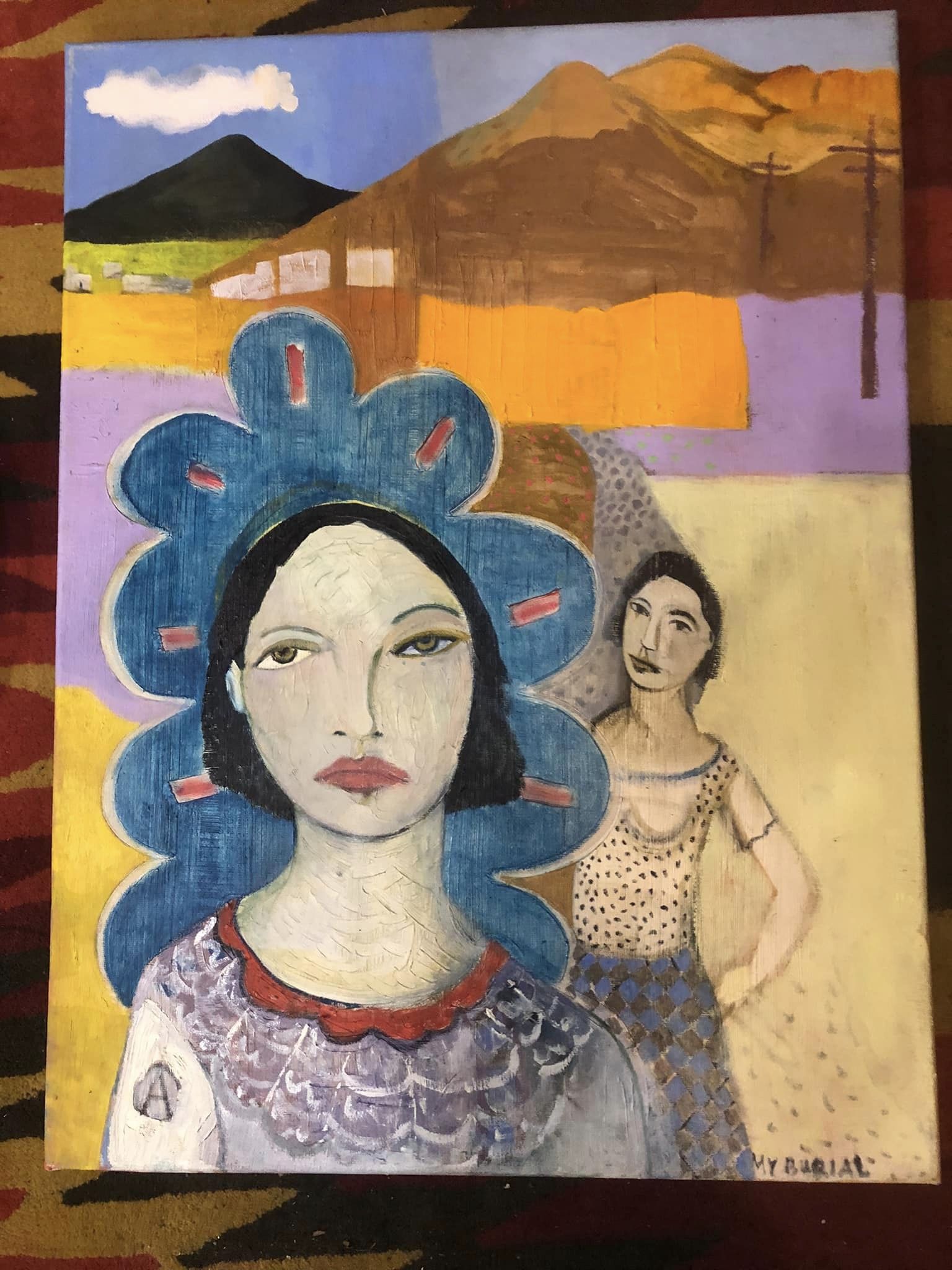
The reason I’m calling you all here is because Shane is an accomplished painter, with shows across the US and a distinctive style I’m proud to say I’ve watched evolve, from awkward (but still beautiful) nudes of Sherilyn Fenn to the Cubist/Outsider style that is his brand, which seem to feature the same woman. I can’t judge because I frequently draw the same woman. Long story short, nobody paints like him.

As artists, we couldn’t be anymore different. His medium is oils and large canvases. Mine is pencil, ink, and watercolors. His subjects are deserts and cityscapes and surreal costumes. My subjects are characters from my writing oeuvre. He’s a painter, I’m more of a cartoonist.

Even though we see each other as equals and have been mistaken as brothers, I still look up to him, and I thought it would be really cool if I drew one of his paintings in my style. The result isn’t nearly as good as the original, but the process was fun and engaging and exactly the reason I’m an artist. (Mine’s on the right, in case you couldn’t tell.)

Tales from the Cubicle

*thunder and organ music*

Gather round, boys and GHOULS, for I bring you DOUBLE the frights in tonight’s chilling tale: “Terror in Team Room 5.”

*lightning*

It seemed like such a normal day. The sky was overcast, and the air was warm, but not too warm. It was more of a cuddle than a scalding. I had done a great deal of work that day, I made a drawing I can’t wait to share, and I gathered in Team Room 5 with the managers and the giant TV to talk to the editors and those who couldn’t make it that day.

Then there’s Brandy (not her real name). Brandy’s desk is fifty yards from Team Room 5, but she Zooms into the weekly meeting. I’m sure there’s a good reason. She’s our staff influencer, and there might be some reason she can’t leave her desk. Whatever.

The meeting was pretty typical, until three-quarters through, when a figure stepped into Brandy’s blurred background. I was watching the editor-in-chief at that moment, so it took Clara (not her real name) whispering at me around the Vice President of Publishing for me to notice. When I looked over Brandy’s shoulder, I saw me.

My height, my build, my bad posture, my complexion, my burgundy T-shirt, my jeans, and platinum blond or white hair were all there. There was no way to communicate to Brandy while he just stood there, shuffling around, giving me the heebie-jeebies.

The Vice President of Publishing, visibly bored, got the editors to stop talking and set us free. After confirming on Brandy’s screen that I was still there, Clara and I raced to her desk. We were between my doppelganger and the elevator, so there was no way he was getting out. And yet, he was nowhere to be seen.

We asked Brandy who he was, and she told us she never got a look at his face. Who was he? Where did he go? We will never know. Watch the background. Always watch the background.

Well, that tale was TWICE the scares! Hahahahaha! It was TWO frightening! Hahahahaha! That’s a tale you enjoy with a hot cup of COPY! Hahahahaha! It gives a whole new meaning to “talking to yourself”! Hahahahaha! I hope you enjoyed this DOS of horror and tune in next time to Tales from the Cubicle. Hahahahaha!

*thunder and organ music*

Convenience Store Maniac: an Ode

It’s only natural to mourn the things you loved and are no longer with you, whether it be a person, a pet, a childhood house, etc.

Convenience Store Maniac was a semi-autobiographical portrayal of a man working at an S-Mart gas station and convenience store too seriously. who only lives for his job. One day he snaps, believing that commerce is a religion, and he is the but a humble minister. This means an inquisition of sorts with his regular customers, some of whom really piss him off. And then he starts killing people. It was clever and a little over-the-top, and that’s exactly what we were going for.

I remember when Shane first conceived of it, in depraved journals he wrote in during his overnight shift at the convenience store he’d been shipwrecked in. I read a few of the entries, and what I saw was a rambling, incoherent, violent mess, and I told him, “I don’t know what this is, I want in.” I loved what I saw, and together we breathed life into Leonard, playing to each other’s strengths, arguing over the use of a single word, as well as brainstorming our way around corners we’d painted ourselves into. We named all of the regular customers after classic country-western performers (except for the teenage assholes, who were Kurt, Chris, and Dave). Even though the names were never said aloud, they helped shape the personalities of people who got maybe one line in the whole movie. We manufactured and fine-tuned chaos. We wrote the first act, at the end of which Leonard takes his first victim, and then I got married, and my asshole cat broke my hard drive, and the first part of Convenience Store Maniac is lost forever.

What isn’t lost forever is the memory of the long weekends I spent in his house on Bear Town Road twenty years ago, getting baked and joining forces with my best friend to create something great. We haven’t talked about it in decades, and if we put our minds to it, we could bring it back to life. On the other hand, there’s nothing I could type that will live up to the first fifty pages that lives in my memory.

Mud Simple

When I was a kid in the mid-eighties in a neighborhood called Indian Hills at the eastern border of Gallup, New Mexico, there were these dirt ditches. One of them was behind my house, and it was like Disneyland for kids who couldn’t go to California.

Every August at that time, we’d get a monsoon, and the eponymous hills of Indian Hills (known colloquially as the Hogbacks) would disgorge thousands of pounds of mud, which would flow down the street, mix with the ditches, and pour down our cul du sac like a river, and when the clouds parted, all that was left was a thick layer of muck.

It was glorious. My friends, Eric from a block over would join me, along with Will, who lived on the other side of the neighborhood, and Max, the coolest guy I knew, who lived at the end of our cul du sac, would join my sisters and me in this celebration of unbridled ickiness. I remember finding cat poop buried in these ditches. When we got hungry, my parents hosed us off, and we could come inside again. It was the most fun we’d have all year.

In 1986, we moved away, but two years later, we returned to rent a house identical to our previous one, only across the street. And those assholes had paved the ditches and installed drainage so that the mud was directed in an orderly fashion into what passed for the Rio Puerco, the river that was technically not there. I was twelve at the time and on the cusp of being over that kind of thing (thirty-five years later, this is decidedly not true), but I still enjoyed the majesty of those mini-mountains gifting us kids with the thing we wanted most: to become utterly disgusting.

Never again.

I know why they did it. The mudslides crippled the neighborhood every year, like clockwork. It took countless dollars to clean it up, and as Indian Hills expanded and grew more popular, that kind of thing just wasn’t acceptable in a functioning city.

But I still remember getting shoved into the muck by Max, who would get shoved in return, and shouting and being a goddamned kid, and I remember it being taken away from me, and this being my first real taste of how adults can suck the fun out of everything.

Snippets from Romania

When I came to Romania, I was unprepared for how many leather pants I would see.

Nobody wears plaid in this country. Usually, the service industry will start talking to me in English when I say hello, but when I wear plaid, I don’t have to say a damned word.

In addition, they don’t put lids on anything. You are required to do that yourself.

Everyone in Bucharest dresses like circa 2000s hipsters.

Of all the countries in the world, it is least surprising that Romania has a Goth shop.

Prompt customer service is not really a thing in. They only use beverage lids when you ask.

Pop Cola tastes like cloves and redundancy with a subtle hint of redundancy.

The Romanian toy museum is really fun. They have them organized by type, and I swear I’ve never seen so many abacuses in one place. During communism, they had a ripoff of Monopoly called “Capitaly.” But what got under my skin was the Game Boy. In a museum. And before you Millennials start to get all uppity about how old Gen-X is, they had Pokemon Gold in there too.

White Trash Cola tastes like ginger, with a splash of mullets and trucks on blocks.

I was ready to praise Bucharest for not having hostile architecture, but clearly they’ve perfected it.

As we visited Dracula’s (alleged) castle, the weather, cold and rainy, would have been better with lightning. There was a torture room.

Most Romanians look like they’re middle-aged. The reason for this is that everyone smokes, even (no exaggeration) children.

“This,” He said quietly as he got onto the bus, “is cool.”

Every couple of years this comes up.

In 1991, I was sitting in drama class with the person I most looked up to in early high school, and we came up with some truly bizarre, baffling, high-energy situations to share with our friends. It was a tale that couldn’t be told by one story. It needed three stories. It needed “Three Stories in One.” Since I made a noble effort of illustrating the whole thing, getting distracted at fifty-six pages, I have a clear idea what they look like, and I like to revisit them. I can’t just pick up the last 10-15 pages because comparing my style to the style I had seventeen years ago is like asking Michelangelo to fill in some of the gaps on a cave painting. I’m proud of the work I did, but I’ve made some improvements.

This time, I thought hard about these faces as I worked on them. Since everybody’s based on a real person, I concentrated on features I remember most and spent a lot of time erasing. Luke didn’t look like that. Amber didn’t look like that, and Wendy didn’t look like that, except for the parts that totally did. Amber smiles with her eyes (still does), Wendy always looked annoyed at me—but with affection. Luke was robbed for the Best Dressed in the Class of ’93 (I mean that sincerely). Naturally, Jeremiah looked exactly like that in 1991. Boone really did have that playful smirk when she was up.

And now we need to have a quick word about Boone. A few years ago, Boone transitioned into Severian, a woman. I have not spoken to her as a woman, I have not even seen photos. I’m not even sure I got her name right. The only conception I have in my mind of Severian is when she was presenting as Boone, and the only reason I know about the transition at all is because one of our mutual friends chewed me out for dead-naming her in my last “Three Stories in One” post. Once I knew, I don’t refer to her as Boone anymore.

Last summer, I presumptively wrote my memoirs, each chapter representing the most influential figures in my life. And she was, without a doubt, going to be a very important. I did not dead-name her once, not even in my first draft. I believe that you should be who you need to be. A trans woman is a woman, period.

That said, I’ve spent a lot of time debating this in my head, and I’m not going to change Boone’s name or gender in “Three Stories in One.” The reason I won’t is because Boone is not Severian. Boone is a character based loosely on Severian when she was sixteen. While Severian was throwing bullets at elaborate Lego constructions with her buddy, Matt, Boone was picking up cheerleaders and playing meaningless board games with them.

On the same token, Luke is not a complete bastard, only kind of a bastard. Wendy was not a good driver back then, but at least she wasn’t driving her sweet Karmenn Ghia like it was the Batmobile. Amber was perky, but she was more than just a smile and the attention span of a hamster. (What I remember most about Amber was how kind she was to me. The popular girl treated me as just another student she was on a first-name basis with, not a nerd on the lowest rung.) And if I suddenly found myself, on my bike, in the middle of the Indy 500, I’d be a smear. At the risk of grandiosity, “Three Stories in One” is a historical document.

To be clear, if Severian tells me that “Three Stories in One,” particularly my decision to leave Boone as is, is offensive to her, then I’ll stop making these posts. I hope she doesn’t. I hope she appreciates it for the playful, teasing nostalgic spirit that went into these illustrations.

I’m not George Lucas. I tend to let things go when I’m done with them, but sometimes present circumstances demand that you change the past. Once again, I’m not going to. They were a product of their time.

Trigger Warning

This post has a pretty big trigger warning on it, for reasons that will become apparent very quickly in the next paragraph.

This past Thursday, during my commute home, so about four o’clock, I was sexually assaulted on the DC Metro. I won’t tell you exactly what happened because I’ve been reliving it pretty steadily for the past week, and I don’t feel like immortalizing it. I can tell you what happened after. I was in a crowded train, and I screamed at the guy, and nobody saw or heard a thing. They didn’t mind looking at me until I looked back, then it was the floor or the person next to me. I was sexually assaulted in front of dozens of people, and no one saw anything. 

My attacker sat down in the closest available seat and stared at me, who was standing by the door. When a couple got between us, he changed seats, moving through the crowd like he wasn’t even there, his eyes always following me. I knew right then that this guy was going to follow me home. Sure, I picked this place because it was right by the stairs to the mezzanine at my stop, but there was only one exit, a long escalator ride, and no Metro personnel in the station at all. This guy could assault me again or worse, and no one was coming to help me. When we reached my station, I waited until the door was closing, then I slipped out and went home.

I still spent most of the evening with the blinds closed, hoping that he didn’t backtrack to my stop to find me. When I woke up the next day, I wondered if he wouldn’t be waiting at my station for me when I would have to go back to work on Tuesday. Maybe he remembered which train I was on and which car I’d chosen, and he’ll be waiting for me when I get out of work. 

I feel like I should underscore how utterly alone I felt when I got home Thursday. I was the only other person in a crowded train car, and when I thought about who to talk to about this, I was reminded that I had no one to talk to. I have texting friends, and I reached out to a few of them, and they got back to me after an hour or so. Nicole was in bed in Romania. I called my mom, which I’d rather have avoided, but I had to speak to someone with a voice. One of my friends did call me several hours later, and she was a godsend, but for the first hour or so after the incident, I was on my own, and I wasn’t sure that was a bad thing. 

With the exception of the few of the friends I’d reached out to on Thursday, as well as an HR rep I spoke to on Friday, I hadn’t told anyone about this. I’m not ashamed—violated, but not ashamed. This wasn’t my fault. The reason I’m avoiding it is because I hate how everybody looks at me. I hate the catch in their voice when they process it. They’re not doing anything wrong—it’s a natural reaction to hearing something awful like this. But I still hate it. 

I felt alone on the Metro. I felt alone at home. And I felt alone because I’m a man. This is not someone who believes that men have it worse than women, but they don’t warn a guy this could happen, do they? No, they don’t. In fact, unless it happens to you, the only thing you are likely to hear about male sexual assault is how goddamned funny it is. From “Federal pound-me-in-the-ass prison” in Office Space to Ving Rhames getting hilariously raped in Pulp Fiction, to little kids make dropping-the-soap jokes, male sexual assault is fun for the whole family.

Victims are made to be overly feminine, like the “bitch” trope in prison (Ben Kingsley had a bitch in a Marvel short that can be seen on Disney+)    . The reason why is that a real man would never let that happen to them. Fuck that, I don’t want to be a real man. Real men are assholes. Besides, what was I going to do? Was I going to punch or kick the guy into unconsciousness? Wrestle him down and present him to the non-existent Metro cops? What if he had a knife? What if he kicked my ass back even harder? I couldn’t count on concerned citizens coming to the rescue, that’s for sure. 

I’ve chosen not to go to the police with this. It will accomplish nothing. I left him on a Maryland-bound train. I don’t have any details on the train itself that would lead them to the guy. The suspect was wearing a Covid mask, a hat, and a black parka. In this city, he’s invisible. They will never catch him, there will be no justice, and he’ll do it again. But I will not spend hours in the station telling and retelling my story to be the thing they joke about in the break room. My HR rep is kind of angry with me for this decision, and she spent most of Friday trying to talk me out of it.

I don’t spend a lot of time wondering what I did wrong because I didn’t do anything wrong. He came from blind corner behind me. He didn’t make a sound. There was nothing I could have done to prevent it, which is both a relief and a reason to be terrified. (On Friday morning, when I was still paranoid, I asked myself aloud, “Is this what it feels like to be a woman every day?”) I’m an overweight, forty-six-year-old, pale dude. This could happen to anybody.

But what makes me really sad is that I don’t really put a lot of thought into my appearance anymore, but on Thursday, I put in the effort. I wore a dress shirt that matched my beloved sweater vest and my business casual shoes, and I braved the frigid air walking from the train to my office because I knew that, when work was over, it was going to be the perfect weather for my corduroy blazer, and I looked good and I felt good, and I never want to wear those clothes again. There’s the part of me that notes it was the one thing I did differently that day. No, I don’t think the person who attacked me was attracted to me. This kind of thing isn’t about sex. It was about scaring me, and well done, sir. 

It’s not the physical act of what he did that has kept me trapped in my apartment for the past week, it’s the helplessness. The things I thought I could count on to stay safe—bright lights, public spaces, crowds, back to the wall, all failed me. And the recent break-in showed us that you can lock the house all you want, but if the locking mechanism fails in one of your windows, they’re coming in.

I’m grounding myself by writing a novel about the oldest characters I’ve created and reteaching myself how to ink and preparing for my inevitable comic book, but this weekend, I couldn’t. A lot of the initial horror of what happened has faded, and I was able to go out and buy a latte (I was concerned that the barista was my attacker because he was the same size and skin tone to my attacker) Mostly what I have is mild agoraphobia, and I don’t know if I could do that again. 

I’ll be fine. I’ll work from home this week and see if I can use the Metro again soon. There was a bit of a tug of war between my supervisor and HR about this, including the question, “Can you Uber into work?”; which stunned me in its tone-deafness, but HR won. My supervisor was demanding more information, and I think she was looking forward to having something to gossip about. I’ve discovered that I’m less willing to let things in my apartment slide. If my socks don’t both make it into my laundry basket, I now pick up the stray immediately, as opposed to letting it enjoy its freedom for a couple of days. There’s been little housekeeping projects I’ve been putting off that are now getting done.

Don’t worry, I’ll leave the apartment again. I’ll ride the Metro again. I won’t be watching out over my shoulder anymore. It might take a while, but I’ll be fine again. I got two cats counting on me.

Don’t You Know That You’re Toxic?

I smoked an average of twenty cigarettes a day from October 1994 to May 2007. I was not a person who smoked, I was a smoker. And I was all in. I’d had a total of three Zippos in my life, and I had a hip pocket devoted to pack and lighter (currently for the cell phone). I followed the lead of top intellectuals like Denis Leary and sang the praises of smoking. And while I became much less of an evangelical about tobacco after cancer took a beloved aunt, I still enjoyed it.

I tried quitting, but I never wanted to, so every attempt was a failure. Sure, they made you cough, and sure, if enough time passes without having one, you turn into the Incredible Hulk. Sure they turned my fingers and teeth yellow, and sure they were just pumping carcinogens into my lungs, I wanted to keep doing this. I was young. I was immortal.

I enjoyed the taste of the filter on my lips. I enjoyed the pageantry of lighting a cigarette. When I was in college, anybody I knew who had a Zippo pulled elaborate stunts with them to light a cigarette. Not me—I flicked open the lighter, ignited it, lit the cigarette, and flicked the lighter closed. It was out and back into my pocket in less than five seconds. According to some, my technique wasn’t necessarily the coolest, but it was up there. I enjoyed a cigarette in my hand. I wasn’t so much holding a cigarette, as much as the cigarette was an extension of my fingers.

I was the kind of person who would say things like, “You want a cautionary tale about smoking? I bring you George Burns.” (To my Hastings College contemporaries, substitute “Darryl Lloyd” for “George Burns.”) At the time of my being the most militant about smoking, I was no better than any Trump fan. Give me irrefutable proof that the tobacco corporations were breeding and cultivating the perfect piece of toxic waste to make you keep sticking toxic waste in your mouth until you died, and I’d make up excuses. I can’t remember any of the excuses because when I had my epiphany about them (several years after I quit), I purged every single positive thing I could say about big tobacco.

I didn’t quit smoking because of the horrible things it did to me. I found out about the horrible things it did to me because I quit. For example, I’ve never had a masculine musk, and I do sweat a lot, but in the middle of August with the A/C broken was Drakkar Noir compared to how I smelled as a smoker. You can’t smell yourself when you’ve caused permanent damage to the inside of your nose. When it grows back, and a smoker is nearby, you know it. You know it before the get within ten feet. It was a Doppler effect with smell. I smelled like that. All. The. Time. How could anyone stand to be around me? How were women ever attracted to me?

I have been a non-smoker for fifteen years. I can’t say I haven’t smoked in fifteen years because I’d had two cigarettes since, a little over ten years ago. They were both really horrible, and I have not wanted to go near one in the past twelve years. One of the cigarettes was a blatant attempt to start a conversation. It worked. Cigarettes used to be really good for that. I had a lot of friends whose relationship with me could withstand five-to-ten-minute bursts every hour, and that was about it. Smoking was a solitary or a social activity, depending on how you were feeling that day. There was something magical about that. I wanted to capture that.

I was full-on smoker when I created a number of my enduring characters, and as a result, many of them were full-on smokers—in the stories I wrote during that thirteen-year period of my life. In stories I’ve written about them since, they’d either quit, or I’d completely forgotten about the smoking thing. I wrote one story last year where I paid lip service to tobacco for continuity’s sake, but otherwise ignored it.

Smoking is intertwined through much of my early oeuvre, but it’s not crucial to the story. I only call attention to it as a set piece of something cool happening. (Girl puts a cigarette out in boy’s coffee. Boy, eyes on the girl, drinks the coffee.) I’ve started writing scripts set in the time period where most of these characters would have been smokers, and I’m choosing not to write the smoking. The way I see it, I have three choices.

One: I can add tobacco to the contemporary stories. It wouldn’t be hard because I’m still in the draft phase, and I’ll be going over them several more times.

Two: I can go back into the classic stories, some of which have been quasi-published, and strip the smoking out. That would mean removing non-essential but still fun scenes and exchanges. The boy meets the girl when he creeps out while bumming a cigarette from her. This is the most important relationship in this series of stories. So I’d have to completely rewrite it.

Three: Or, I could leave the smoking in the classic stories and not include it in the contemporaries. I don’t have to explain it. Let the smoking and non-smoking characters be alternate universes. Whatever. The important thing is, this requires the least effort. Why do I want to be giving this vile habit anymore thought than I’d already put into it?

The world is evolving, and I am there for it. Popular opinion has turned against tobacco, Homosexuals have the same marriage rights as the rest of us. You cannot function without a cell phone now. The creator of the most beloved contemporary series of children’s novels is currently on blast for being anti-trans. Dr. Oz is not Senator Oz. The legalization of cannabis in New Mexico kind of ruined the screenplay Shane and I wrote about the hunt for a vicious pot dealer on the Navajo Reservation. It took us days to figure out how to fix that.

There was a time, not that long ago, when public opinion was generally cool with cigarettes. I used to smoke in my dorm room. You could smoke while you were eating at restaurants. There were ashtrays in hospital waiting rooms. Can you imagine? That’s when these characters were born. And while some of these stories have been rewritten from the ground up (one twice), they are still a product of their time.

I am definitely going with option three, for nostalgia’s sake.

Totally Sketch

When I was 22, I decided to learn how to draw. I started with stick figures, then I started fleshing them out. I learned to ink, and eventually I even learned to color, first with markers, then with watercolors (with pastels when I was feeling it. It took years for me to draw a decent person, but at the time, I was so excited with every breakthrough I made. I illustrated two comics of my own and two comics for a pair of untalented writers. I gave up on drawing comics, but I illustrated 56 pages of Three Stories in One.

But in 2015, a few months after we got back from Doha, after all the excitement of finally being home after so long, I crashed, and I stopped writing and drawing. When I got my mojo back, I tried drawing again, and I got frustrated. I went through looking at the stick blobs I would get so excited about to every imperfection completely ruining the art.

The joy I found in the act of drawing and painting was gone. I created for the destination, not the journey. I also ran into the problem of what I want to draw. I had no inspiration. I still did my yearly self-portrait, and maybe for about a week or so, I’d get a wild hair and make some stuff. It’s been 2 years since I’ve drawn for fun.

I just treated it as a thing I don’t do anymore,’like drinking too much or watching rock concerts at crowded bars. I’ve been encouraged to pick it up again—my parents ask after the art nearly every time we chat.

Slowly, over the course of weeks, I thought about what I could do to jumpstart that again. I found references, I bought a sketchbook that I could live with if the paper was being torn by an eraser.

I thought, if I learned how to draw with a pencil and eraser, then by God, that’s what I was going to use. I had sacrificed precision for speed, and I was going to use that. If I wanted to skip to the completed drawing, then I was going to take my time, erase some things.

Saturday, I said, “It’s time.” I sat with my sketchbook for an hour, learning to draw faces and figures from the ground up. I repeated it on Sunday, same thing with the eraser.

I feel like the old prizefighter training to get back into the ring.

Blackjack Anniversary

My neighbors are all women in their late twenties, and they have the priorities people their age have, like dating and FWBs. We have a picnic table in our backyard, and they like to hang out there when the weather is good, sometimes with the company of gentlemen callers. A handful of times, when I’m taking out the trash, they will invite me to sit with them. A handful of those times, I’ve taken them up on it. I never say anything, I just listen.

On one occasion, the subject of September 11 came up. They weren’t kind. They treated it as an overrated, overhyped spectacle that people needed to get over. If I really wanted to make them awkward, I could have told them where I was that day, but I’d probably no longer get invites to enjoy their show. Plus they’re kids. When I was twenty-seven, I wasn’t a kid, but twenty-seven-year-olds now are kids. Prior to September 11, 2001, I was pretty flippant about Vietnam and the people affected by it.  

I wasn’t offended, and that’s because I’ve been writing a novel where two twenty-six-year-old women fall in love. They’re in Battery Park, New York City, and the subject of the 9/11 Memorial comes up, and it occurred to me as I was writing that the Twin Towers on fire looked just like a movie. If you were a kid, say five years old, when this happened, how would you be able to tell the difference? Maybe I should ask a Baby Millennial/Geriatric Zoomer.

My main character: “September 11 is Generation X’s defining moment, like Vietnam was for Boomers.”

Love Interest: “What’s the Millennials’ defining moment?”

Main Character. “Look around. Take your pick.”

If disaster and disaster came my way just as I’m becoming an adult or trying to settle down with my young family, and if the people in power don’t represent your viewpoint anymore and are legislating hard against people like you, somehow two buildings falling down doesn’t seem like that big a deal.

September 11 is old enough to drink or, in select states, purchase cannabis. What’s happened is that it, like every memory, grew hazy with time. September 11 was bad, but twice as many Americans died in Iraq fighting a war that was proven beyond a reasonable doubt to be manufactured by people who profited immensely from it and were never punished. Almost that amount died in New Orleans when a hurricane they should have been prepared for ravaged a US state, and many more died because relief efforts were so poorly planned. And so on, to this decade, when a virus spread through the country, killing almost a million people, which could have been contained if leadership wasn’t incompetent. Now we have mega-billionaires bending the country to their will and a reactionary minority preparing to take rights away from all of us.

All that in mind, what does 9/11 mean to me? It’s not the worst thing to happen to this country in the past thirty years. Why do I feel something heavy in the pit of my stomach every time I see the date on a calendar? Is it because I was there? Because everybody’s memory of September 11 is one tower burning while a plane crashes into the second, while mine is from a different angle, on the ground, looking up buildings so tall, you couldn’t see the top, now covered in flames and smoke.

My experience with COVID was disappointing, to say the least. I was hoping to be bedridden for a few days, but all I got was a headache. But twenty-one years ago, for about four hours in the morning, the world was on fire. Strangers would grab you and yell in your face that they destroyed the Pentagon! They’re taking out the bridges! And the guilt. I actually believed I could run in there and help people. I didn’t care how or what I did, I thought I could help. Instead, I ran. I’ve made a lot of decisions in my life, but that was probably the smartest.

This essay doesn’t have a clear thesis. Like September 11, there’s no lesson to be learned here. It reveals nothing about our humanity. My generation likes to think they’re jaded, latchkey kids who’ve seen it all. But we were spoiled. America won the Cold War and was riding high when we were young. We were the punching bags of the Boomers until Millennials came along with their avocado toast, and that’s really as bad as it got for us collectively. (Individually, I know a lot of Gen-Xers who’ve suffered unfairly in life, but as a whole, we’ve done pretty well.) Our innocence died on September 11, and as a result, the subsequent generations never really had any. Maybe that’s why I go back to that day, again and again, starting in August every year. It was the morning that changed everything, even for the Millennials and Zoomers who don’t realize it.It was the morning America got so scared that it went completely mad and hasn’t recovered since.

Imagine growing up in that.