The State I’m In

I’m going to be completely honest with you right now: I’m fucking miserable. I don’t want to be. I think Qatar is awesome, and my cats are the best ever, and I love my wife. 

But I’m beyond lonely, and she’s not helping. 

In general, I’m in an awkward time zone, so most people are in bed when I wake up, all the way until my early evening, when my wife comes home. This has meant that I have quietly dropped out of the routine of most of my friends. Every Wednesday evening, I went to a writer’s group and hung out with some great people who hardly seem to miss me anymore. My roomie, who was my best friend, is too busy with her new career and, you know, sleeping to be around for me. 

The compound where I live is populated mostly by entitled parents and international yuppies, and so it’s been difficult to make friends here. And it’s five kilometers to the nearest store, through roundabouts full of traffic that’s not afraid to drive onto sidewalks (not an exaggeration), and another ten kilometers to anyplace that might be fun to explore. 

And then there’s the madness of My Evil Sister’s Wedding from Hell and her little dog too, which have utterly consumed my thoughts. My father took a big step to include me in everything, but once that fell through, there’s been nothing—not a picture, not a Facebook message, nothing. Same thing with the dog—once I stopped asking, nobody told me anything. My Evil Sister lives in the same town as my parents, and it seems like, in regard to this feud, they’ve decided that life is more convenient without me. 

When it comes down to it, the only person other than myself I see most days my wife. 

She is not doing well either. Her job is twice as difficult as it should be, because her predecessor made a huge mess out of it, and there’s a lot of mess and mistrust left to clean up. She comes home from work in the foulest of moods—impatient and indecisive and exhausted, and sometimes just plain fuming. Her response to the stress of it all (and I can’t blame her for it) is to withdraw into herself and her iPad games. I don’t even know if she likes being around me anymore. When I’ve tried to discuss how her bad moods affect me, she either defensively tells me how tired she is, or she tells me about all the times she hasnt been rude or short with me. 

Lately, I’ve been aggressively writing query letters to literary agents. On Thursday afternoon (shortly before opening of business on the East Coast), I sent out the first batch. Early Thursday evening, I received the first rejection. I shouldn’t feel embarrassed, but I do. I mean, I spent at least an hour on each one, researching their books and their likes to tailor-make a pitch for them, but they don’t want to waste their time on it. It’s not their thing. Is it anybodys thing? It makes me wonder if it’s any good; I mean, after all, I can hardly get people online to read what I post, and these are my friends (there are many legitimate reasons for this; I’m just describing what the mean voice in the back of my head is telling me). 

I need my wife right now, so, so badly. And she’s not there. In fact, she’s the opposite of that. 

So I keep it to myself. Because my loneliness and rejection feel petty compared to her job. Her criticisms of the way I went about dealing with the dog situation (or the way my family or Gallup Animal Control handled it—all her anger directed at them by proxy through me, of course) make me want never to discuss the issue again, even if it still has me worried. In fact, she’s just too flat-out exhausted to deal with my depressive episodes, which have been exacerbated by the isolation and culture shock. And worst of all, she’s incapable if just listening without offering advice. Because that’s all I need right now. 

I’m really suffering, and I don’t know what to do … 

It’s Funny How We Never Look Up

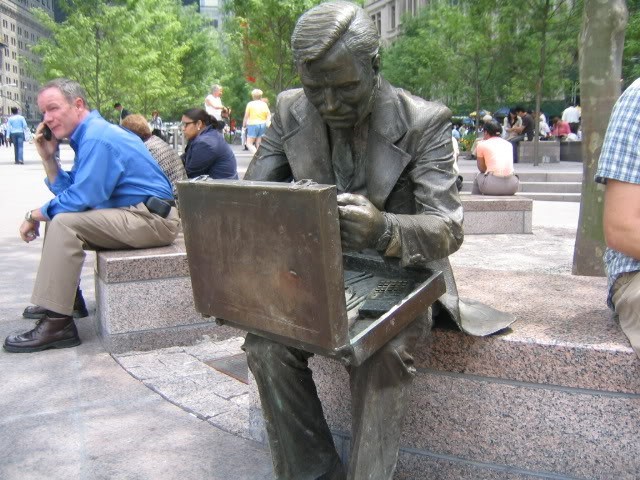
I first met him that August. He sat in a park at One Liberty Plaza, New York, New York, tucked in a corner, glancing into his briefcase. He lived in harmony with the workers and tourists meandering through the area; he paid them no mind, nor they him. 

At that time, autumn was creeping up on me like it always did, promising cooler air and brighter colors. Autumn was always good to me. I met my girlfriend at the time in the autumn. And years before, I’d met the woman I would eventually marry, also in the autumn. 

This fall was especially welcome, especially after a summer of unemployment and unhappiness. I’d finally been granted temporary work throughout the file vaults of various banks in the financial district. I spent my lunch breaks in the park at One Liberty Plaza, smoking cigarettes and trying to draw; the latter was particularly galling, inasmuch as I seemed to have forgotten how.  

One day I glanced around the park, looking for inspiration that wasn’t in this anatomy book that seemed to be the source of my frustration, and there he was, sitting on a marble step in the shade. I wondered who he was. I wondered what he was thinking. Was he relaxing, or was he about to stand up? And what was in his briefcase? Was it his lunch? 

As the days of tedious filing stretched into weeks, I crept ever-so-closer and peeked over his shoulder—subtly, so as not to offend him. I remember seeing an adding machine, and a few other items. But for the life of me, I don’t recall what these other items were, only that they were archaic. 

The last time I saw him, I stood up from the bench, tossed my sketchbook (weakened from the stress of erasers and my dissatisfaction) into my satchel, and dropped a quarter into a payphone. My girlfriend’s thirtieth birthday was that Thursday, and I was trying to arrange something fun; she hadn’t been my biggest fan over the past several months, and I needed to do something to fix that. 

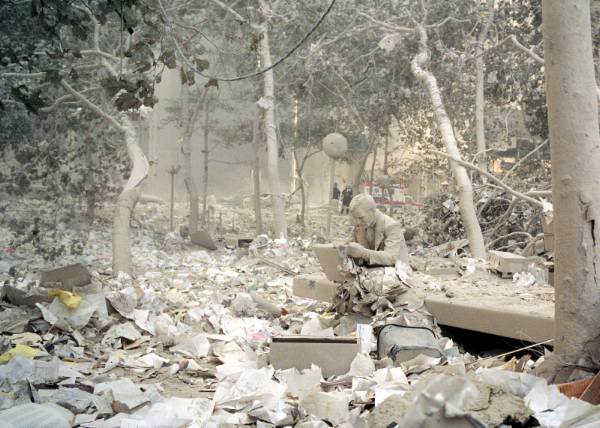
The last time I saw him was on a Monday, because on Tuesday, this happened: 

I’d originally wanted to write an essay about how much this country has changed in the past ten years—about how we’ve lost our way; about the silly phrases I used to love (i.e. “Bring ’em on” and “Dodged a bullet”) but no longer feel comfortable employing, as they have been soiled by those who have no concept of the value of a human life; about the collective, parasitic rage from that day that has turned us against cultures we don’t understand, against our own freedom, against our government, and against ourselves; about lost hope; about fear … 

And then I began running across never-before-seen photos from that day, begging the question: has somebody been sitting on them for ten years so they could release them for a big anniversary? And TV specials and stories and interviews on NPR and essays about what we’ve been up to over the past ten years … and stories from celebrities about what they were doing that morning. And I know that by noon on Sunday, we will have moved on to whatever it is we’re going to be saturating the media with this next cycle. It’s like the anti-Christmas. 

So I wasn’t going to participate. Regardless of everything I went through that day, I wasn’t going to participate. And then I remembered him. 

He’s since been moved around to museums and other parks. Now he’s been returned to where he once was, but in a prominent spot. I could go see him again, but it wouldn’t be the same. Nothing has been the same.  

I prefer to remember him from that late summer, when he and I were both alone, and we liked it that way. 

Somebody I Know Died on Thursday

I wasn’t close enough to call him a friend. I wasn’t distant enough to call him an acquaintance. I don’t know what I should call him. I have always wanted to know him better, but our lives didn’t sync up enough, as sometimes happens. He has existed almost exclusively through Facebook posts and my friends. I can tell you this for sure: I liked him a lot. 

Back in the nineties, we served time together as copy kids at The New York Post. A copy kid is, if you don’t know, is an intern. Actually it’s a step below an intern. And, like it says on the label, you make and deliver copies. Sometimes you went out for coffee. Sometimes you delivered fresh copies of the paper to editors and departments around the office. On very rare occasions, you are sent out to cover a story—usually ones that there are no reporters available to do, or the boring hot potatoes that reporters would like to avoid. There’s not a lot of dignity to being a copy kid, but it was kind of an honor. 

The men and women I worked with at the desk were an interesting bunch. Some were changing careers—not for the money, but to be journalists. For all its bluster and front-page comedy and right-wing agenda, The New York Post was and still is to an extent a very old-fashioned paper, and there was something to be said about running out in the night with a Bic pen and one of those small notebooks with logo stamped on it. 

I think he’d intended to start out as a reporter, but it wasn’t really his thing. Instead he became a copy editor. Just like me. Also like me, he was making things up as he went along, and that meant a lot of mistakes and frustration. We were both simultaneously kind and weary and devastatingly clever. We sometimes had a beard and sometimes didn’t. 

Once I asked him why he was there, and he told me that he’d worked for years as a doorman at a fancy apartment building. The job was incredibly easy, and the money was good. “I went and spent it all on drinks and cab rides. I don’t have anything to show for it.” Well over a decade later he is married with children. 

At the age of forty-three, while his family was out of town on vacation, he suffered a sudden, unexpected stroke, possibly a seizure. It’s not entirely clear what happened, but it appears that he fell while walking, sustaining physical injuries. Police were called, and he was taken to the hospital. For weeks, things were hopeful. He recoiled slightly from physical discomfort. He opened his eyes. He responded to humor. He began to squeeze his wife’s hand. He moved his foot. Soon after that, he raised his hand. And then he took a turn for the worse. On Thursday, his breathing tube was disconnected, and he died. His touching obituary ran in The Post—even in The Wall Street Journal

I don’t know if he had a DNR. All I know is that, at some point, his wife had to be told that somebody was going to be responsible for performing an action that was going to be responsible for his death. Never mind the seizure or stroke—his heart and a lot of his organs were still working. By now they’ve cut him open and removed parts of him and put them into the bodies of others. 

How do you cope with that? How would my wife cope with that? How would I cope with that? 

I’m reminded of the days and nights I sat in an uncomfortable chair after my wife broke her ankle, only to have it reconstructed. Her pain was something I couldn’t comprehend, and throughout the hours of the morning, she held my hand, crushing it. She asked me to tell her a story. She asked me to read for her the comics I had with me for when she slept. She asked me for more meds. I’ve had a loaded gun held to my head; I survived the attacks on the World Trade Center by virtue of showing up to work a little early; last month I almost drowned; I’ve ridden the Cyclone at Coney Island; I can’t remembering being as scared as I was then. And she was fine. It was only her ankle. But she was so helpless. 

I’m reminded of the night my aunt died of lung cancer, only a few hours after I had seen her last. I’d been asked by my uncle or one of my cousins—I don’t remember who—to sit with her alone for a few minutes while they took a break. I didn’t want to. My lively, hilarious, child-like aunt was in so much pain I don’t think she knew who she was. I wish I could say that this pale, shriveled-up person in bed didn’t look a thing like her, but I’d be lying. I don’t know what she saw when she stared into the distances. Sometimes, when I’m not careful, I remember the breaths she took in—about two or three times a second, for days. The effort it took was loud and gasping. They told me I needed to hold her hand and talk to her. Her fingers were cold, and I couldn’t think of a thing to say, and so I sang the first song that came to my head: “Yellow Submarine,” by the Beatles.  

What did he look like on the hospital bed, bandaged from surgery, IVs in his arms, a tube in his throat, his eyes sometimes closed, sometimes open and glassy? I can’t get the question out of my head. I’m drowning in work—both editing and art; I’m going to New York to see one of the people dearest to me and to re-explore the city I consider a lover; immediately after that, I have a visitor I’ve never met in person, but I am really dying to. I can’t close my eyes without seeing him, or my aunt, or my wife. 

I wasn’t close enough to call him a friend. I wasn’t distant enough to call him an acquaintance. I don’t know what I should call him. I have always wanted to know him better, but our lives didn’t sync up enough, as sometimes happens. He has existed almost exclusively through Facebook posts and my friends. I can tell you this for sure: I liked him a lot. 

Oh, Bleh …

I had one of those mornings when I wake up and feel like I don’t have anything to show for my life. None of the stuff in the apartment feels like mine, my job feels fake, and writing takes me nowhere. 

Usually when I feel this way, I remind myself how much flat-out fun I’ve had (ignoring, of course, the crippling depression) and how awesome it is to be married, but that doesn’t seem to be doing the trick today. What makes it really weird is that now, since I am properly medicated, I should be able to shake this easily—more easily, in fact, than before. But not today … 

What I need is to do something useful, and then I’ll feel better.  But first … my day awaits. 

Bleh. 

Lest I Forget

This week my wife and I watched a documentary about the Oklahoma City bombing and Tim McVeigh, and I had a … moment

As you probably know, I was ridiculously close to the World Trade Center on that sunny, beautiful morning in 2001 when everything changed. Eight and a half years later, I’ve nearly forgotten how it felt. Maybe it’s because a lot of time has passed. Maybe it’s because the imagery—whether it be from “Never Forget” bumper stickers, news stories featuring video of the second plane smashing into the tower, or movies like War of the Worlds and Cloverfield—has become so ubiquitous. Maybe because it’s been used as a tool to justify things that are morally and politically questionable, or things not even remotely related (see Glen Beck’s “9/12” anti-tax rallies). Everything I saw that day has been so mixed in with everything that came afterward that I’ve become numb to it. 

But then this documentary reminded me of something the news and the movies and the chest-beating had all but forgotten: that sound. 

My most vivid memory of the day is not the ashes or the falling office supplies or those boring buildings that housed so memories on fire. It’s sitting in a mostly empty room with no computer, earning twelve bucks an hour for stuffing envelopes, and hearing a loud, deep boom that rumbled through my cheap aluminum desk. It’s going to the window to see what could have caused it. It’s thinking that it couldn’t be that big a deal, and five minutes later believing that everything I knew had come to an end. 

I suppose I could be forgiven for forgetting that. It’s been a long time. 

But then I heard survivors talk about how they thought it was construction or something, or just how flat-out confusing they were for that one moment between the time they heard that sound and the time they realized their lives had been forever destroyed. It reminds me why I flinch whenever I hear any sudden, low-pitched, loud noise. 

Old Friends

I’m tired and cranky and restless. Even with functional air conditioning, my apartment is confining and choking me, like a necktie. There are no less than four parties in my little corner of this condo complex this evening, blowing laughter and smoke over to me. Nobody’s being obnoxious or rude. Even the partygoers lining the sidewalk don’t chat too loudly. But still they chafe. 

I haven’t felt like this in a long time. I had a few options when I did. In Jersey City, salvation lay on my stoop, where I’d sprawl out on the stairs, take a hit off a hash pipe, light up a cigarette or two, and let my mind wander. In no time at all, I’d be jotting down colorful words, whether they be the musings of disgraced demigods, the rantings of confused college students, or the minimalist observations of a boy and his depressed, talking dog. 

If my imaginary friends weren’t speaking to me, it was just a short jog down the block to the corner pub to a cute bartender who knew what I wanted to drink, a foaming-at-the-mouth divorcee, a tough old broad, and a guy I’m positive worked for the mafia.  

In Bloomington, Indiana, things were simpler. I had wine, cigarettes, and the company of my wife. 

Tonight, though, my wife is out of town for a little bit. But more than anything, I want to kill this mood with a bottle of rye and some menthol. I’m trying to remind myself why I can’t have those things anymore. I mean, why can’t I slip around the corner to the drinking establishment, ordered a drink and a pack of cigarettes? Why can’t I creep downstairs to the kids on my sidewalk, bum a smoke and a paper cup of rum? What if I just stopped there? What’s the harm? 

The harm is that I can’t stop there. I’ve proven that to myself repeatedly. I had my fun, and now it’s time for the echoes on the sidewalk and the balconies around me to have theirs. I’ll just yearn from my yonder window and soak up some ambience. 

It’s midnight now, and the crowds are thinning out.  

Kids these days: no stamina. 

“Needless people are dying and suffering.”

My therapist and I are talking about my post-traumatic stress disorder, specifically related to September 11. I’ve been thinking a lot about it lately, and that’s mostly because I’ve acquired a real taste for apocalyptic entertainment, whether it be my obsession with The War of the Worlds (the book or the movie); with the TV shows, LOST and the new, improved, Battlestar Galactica; or comic books like Y the Last Man (which, like Snakes on a Plane, tells you everything you need to know in the title).  

I have an inexplicable craving for the feelings that come out of losing everything like this—not in the Goth, “I-am-the-Crow” way, but in the way everything changes and there is a single-minded focus on survival. I think it might either be an almost addictive reaction to the extreme situations I was in, or it might be like looking at pictures of the World’s Ugliest Dog—it’s hideous and awful, but you have to keep staring.  

I don’t know. 

But since I don’t want to be too much of a bummer, let me tell you what happened this morning when my alarm clock made its horrible, daily yowling sound. When I reached over to pound on it with my fist like I always do, I was blocked by a fat black pussycat who was pressing his paws as hard as he could on the snooze button. That’s right, Magik was trying to turn my alarm clock off. These animals are getting too smart for their own good. Thank the heavens that Newcastle has a mind like a steel trap—that’s been left out in the rain for a week and beaten with a hammer. 

“He Had a Gunshot Womb.”

It’s been nearly thirty months since it was declared “Mission Accomplished,” and over two thousand American soldiers have died in Iraq. Accurate numbers on the deaths of American civilians and American wounded are not forthcoming, nor are numbers for Iraqis, whether they be soldier or civilian, dead or injured. 

Today, Special Prosecutor Patrick Fitzgerald has left the press blue-balled again regarding indictments, but it’s clear he’s looking into the “Niger Yellowcake” memo—the one that many US Senators and Representatives claim made them decide, almost unanimously, to give the president war powers. 

Today, my baby sister, whose first word I still remember, whose diaper bag I carried, and who has gotten me as drunk—if not more so—than a bunch of twenty-and-thirty-something bar veterans in New York City, woke up in the deserts of Kuwait, fixing vehicles that are scheduled to drive through hostile anti-American towns without sufficient armor. 

Today, some young man who was born and raised under a brutal regime is going to wake up in a town surrounded by barbed wire, with no running water, being pulled out of his car by his liberators, who will wave guns at him and demand that he do things in a tongue he doesn’t understand. 

Today, some patriotic kid from a Jesus-fearing state in the middle of his country will find himself in a strange village halfway across the world from his mother, deciding whether or not to shoot the person in the car before him, with no way of knowing if it’s someone minding his own business, or someone who’s going to kill or maim him with plastic explosives hidden in the trunk.  

Today, I attended a candlelight vigil, along with one hundred and fifty other Bloomingtonians, honoring all we’ve lost since March of 2003 and earlier. 

War blows. 

So, all my regular readers (both of you), I need you to do me a favor and pray to whatever gods or goddesses you speak to, or meditate if you are your own God or Goddess, for some sanity. 

I’m feeling sad, as if you couldn’t tell. 

“For Dinner They Had Wine and Crap Cakes.”

I’ve left most of the friendships I’ve cultivated in faraway lands, including one that had just started six months before I came here, and had the potential to be really incredible. Many of the departed friends seem to have forgotten about me, but others have kept in touch, and still other friendships have flourished. 

I live and sleep with the best (and sexiest) friend I’ve ever had. 

Her friends are, likewise, some of the coolest people I’ve met (a bit odd, at times, but aren’t we all?). Her Hometown Friend and I have formed a pretty good bond of comic books and silliness. I adore my coworkers, the Radio Guy and the Buff Hippie. 

I’ve been having meals and firepit chats with many of these new people, and having an incredible amount of fun with them. With my new life, I am happier than I’ve ever been; but I can’t seem to shake this weird disconnect from them. I can’t explain it.  

I don’t necessarily miss the fun and games of New York. But I miss the people I played with. E-mail isn’t the same. 

I seem to remember feeling this way in New York, before the fun and games. Maybe it’s just an adjustment period. I’m asking the runes, since their advice told me a lost (turns out she was sick) friend would show back up. They say “Mannaz,” in reverse, which I guess, is “Zannam.” That means I won’t find the clearing of my “blockage” from outside of myself; and to “Strive to live the ordinary life in a nonordinary way.” 

Sounds good to me. Feeling sad, but full of hope, which brings joy with it. 

“They agreed to a parting of the waves.”

Dear friend,

I know I haven’t returned your phone calls, as difficult as it’s been for me. After the desperation in your last message, I wanted to dial your number and see how you were, but I can’t. I can’t be your friend anymore.

I’m sure you think it’s my wife’s idea, but it’s not. She’s merely given me the strength to avoid calling you back. We’re not the same people we used to be, and no matter how much time has passed since we met, I can’t let history define my relationships.

To put it bluntly, I don’t want to compete with you, but you leave me little choice when we’re together.

You insist on expressing your viewpoints, which are contrary to mine—and those most of the people I know. Normally, I wouldn’t hold this against you, but you are so pushy and downright mean with your beliefs. You belittle the intelligence of those who disagree with you, and the worst part is, you don’t even think you are doing it. You fully believe you have an open mind, but I listen to you parrot the opinions of blowhards and deny facts, and ignore me when I try to change the subject.

Being the Devil’s Advocate is in your nature, but the point of such a role is not to crush your opponent, but to strengthen them. I can be friends with and respect people with your public philosophy, but that is because they, in turn, respect people with my philosophy. It’s one thing to have a certain ideology, but it’s another to proclaim this ideology, then do nothing to support it. Your morality is inconsistent and shallow. I could rattle off examples, but that would do no good. You, in your own eyes, are never wrong.

Mostly, in regards to respect, I don’t see it in the way you treat others. You are pushy, selfish, and bristle against anyone who finds offense at your behavior. The thing that appalls me the most, these days, though, is your behavior towards women. Your chivalry is merely misogyny. Your interest in the welfare of the female species exists in entirely in the realms of their undergarments. You expect others to get out of your way if you’ve chosen a female, and you take any obstacle as a challenge, as if the person you’re pursuing is merely a prize. You’ve butted chests with me over the affections of one particular woman, not considering that I don’t look at her in a sexual manner, nor considering that she may not look at you in a sexual manner. And when we last saw each other, you asked a friend of mine to stay out of the way of another object of your desire, despite the fact that this “object” had no interest in you.

Over the years, we’ve been good friends. I’ve laughed in your company as much as—if not more than—I have with anybody. You’ve been loyal and consistent and honest with me at all times. That’s what makes this hard. I’ve thought long and hard about what it takes to be my friend, and I’ve found a few qualities to be non-negotiable. One is “Criticism.” My friends have to be able to take it constructively, and they have to dispense it to me when I need it. Another is “Respect.” Not just to me, or, as I suspect is the case is with you and I, to our history, but to my thoughts and beliefs, and the thoughts and beliefs of those I hold dear. You don’t have to like my friends, but I insist that you appreciate the fact that I like them. You don’t have either of those qualities.

It saddens me to say this, because you have been like a brother to me. But I don’t respect you anymore. You haven’t, and won’t, mature. I’ll always look back on our past with a smile, but I can’t say the same about the future.

Sincerely …