Yesterday Never Knows

Long ago, I was cleaning out the rain gutter crowning my old home back in New Mexico. Because I was a teenager, I was really fucking stupid. Rather than employing a ladder or a solid surface of any kind, I chose to stand on one of those green, wide-lidded mini-dumpster things we called a herbie because beats the hell out of me. Naturally, every part of it that could collapse or roll waited just long enough for me to get comfortable before pitching me backward onto the dirt of my backyard. 

I wish I could say that I was lucky I didn’t land on concrete, but I can’t. This was desert clay, which, when dry, resembles dust-covered iron. This is the kind of firm that young concrete dreams of growing up to be. Because that didn’t suck enough, random chunks of sandstone jutted out of the surface here and there. You know, for garnish. 

And so, one moment, I was performing one of those tedious chores that are a consequence of living under your parents’ house, your parents’ rules; and the next, every single molecule of oxygen that wasn’t already tied up in hemoglobin fled my body. Blunt pain rattled my spine, and my heart stopped doing what it was it did out of confusion, as my lungs had evidently forgotten to breathe properly. I couldn’t move—less because of said pain and more because of the very tangible fear that I wouldn’t be able to. 

And that, dear readers, is exactly how I felt when I saw her picture last week. 

Her eyes were still mocha and enormous, with thick, dark lashes. Her hair was still an impossible blend of gold and platinum. And the way she smiled still inspired me to do the same. It reminded me how inhumanly gorgeous she was, making even overalls look sexy. And how she was confident enough to be visibly bored every time some boy came over to feign interest in her conversation, a fist clenched around a beer and a thumb hooked on a belt loop—yet only those who were really paying attention could make out the mournfulness hiding there. 

I remembered my reaction upon seeing her for the first time on the other side of a spirited party. (“That girl is way out of my league.”) I remembered my reaction when she waded through that crowd for the sole purpose of finding out who I was. (“Wait. Me?”) I remembered my reaction when she and her sister sought me out at a different, equally spirited party the next night. (“Seriously. Me?”) And I remembered my reaction to the fact that I had started to flirt with her. (“Okay. Clearly not me.”) 

But that’s not what knocked the wind out of me when I saw that picture last week. What did was the fact that I’d forgotten how deeply we were in love with each other. 

It’s been nearly fourteen years since I learned her name, and about thirteen since we last communicated. Over that time, I’ve convinced myself that I made all of these feelings up. We were simply two people with nothing in common, whose hunger for any kind of attention led us to comfort each other during the intense transitions we were subjecting ourselves to. Hell, we’d never even kissed; we were afraid to, because we couldn’t possibly be falling for someone we’d known for a handful of days. 

Except we were fooling ourselves. And for too long, I’ve been fooling myself. The intimacy of our letters and phone calls was real, and it was exquisite. It really was love. Eventually, I found my footing in New York City, she found her footing where she was, and we didn’t need each other anymore. 

And time passed. 

I don’t know how she remembers me. Was I a fling? An overreaction? A friend? A mistake? A pen-pal? An ex-boyfriend, even? I doubt I’ll ever know. That doesn’t matter, though, because somewhere, she is smiling. 
Inconceivable

The events of which I speak transpired in the year of Our Lord, two thousand and four, in the final week of the eleventh month, in the city of Bloomington, Indiana. Bloomington isn’t much of a metropolis, but the vast number of students at Indiana University certainly try to make it one. The side-effect of this is the sudden decline in the town’s population during holiday breaks. 

And so, during Thanksgiving week, peace reigns. That night, so long ago, the air was brisk enough to require a light jacket, but not so cold as to prohibit cycling. The hour was late, in that I had finished a long shift at the copy shop whose name I will not mention (it rhymes with “Pinkos”), and the quiet inspired me to push my bike home and relax.  

On my right loomed the vast parking lot for the IU Stadium, on my left sat the houses unfortunate enough to be across the street from the stadium, and on my cell phone spoke the man who, unbeknownst to either of us, would one become known as “Best.”  

We’d been trading vulgar jabs, as usual, through most of the journey, until a police car whispered up behind me and continued on. Given my history, I still flinch whenever I see a representative of the law, but tonight, I tried not to show it. I don’t have a firm grasp on the statutes of limitation on said history, so it was best I not draw attention to myself.  

“Be cool,” I told my friend.  

“Why should I be cool?” he replied.  

 “Heat.”  

He laughed. “You know I’m not actually there, right?”  

“Be,” I repeated. “Cool.” 

“Okay, okay.”  

“Oh, shit,” I muttered, because even the most law-abiding of citizens tenses up when a representative of the law flashes its lights and performs an action-movie U-turn in his or her direction, which this one just did.  

It took only a second for it to occur to me that the officer in that car was not after me. It’s not like I was carrying around a trunk-load of cocaine; I didn’t even have a trunk. The inspiration for this act of vehicular drama must have been quite spectacular, and I was sorry I had to miss it. I mean, this town was dead.  

As the cruiser sped away, reflections of its lights receded behind me … except … except they weren’t actually receding. My heart leapt.  

“Okay,” I said, “I think something really entertaining is about to happen nearby.”  

“You’re going to have sex with a bunch of goat farmers?”  

 “I’ve been doing that the whole time we’ve been on the phone,” I replied as I looked over my shoulder, just in time to witness the same cruiser executing another U-turn in my direction.  

This time, it took almost three whole seconds for it to occur to me that the officer in the car was not after me, even when the siren whooped that singular whoop that heralded an upcoming punishment for a traffic violation. Because that would be ridiculous—so ridiculous in fact, that the officer had to stop his car, jump out, and trot over to my side to get my attention.  

“I’ll have to call you back,” I told my phone. “I just got pulled over.”  

“What?” he replied. “I thought you were walk—” 

I flipped the phone closed and faced the civil servant who was only a little bit out of breath. He asked, “Do you know why I stopped you?”  

There are so many things I wanted to say at this moment. The first was, “Speeding?”; the second was, “That may be the dumbest question I’ve been asked in some time.” However, the police packed pepper-spray in this town, so I went with number three: “No.”  

Before he could respond, a second cruiser came up from behind, passed by, flipped on its lights, turned with even more urgency and panache than the officer who currently held my attention, and came to a screeching halt directly in front of me. The driver swung open the door and stepped out, one boot at a time. The time of night forbade the use of the mirrored sunglasses clipped to his shirt, but in his heart, he was whipping them off with cocky menace. He swaggered up to the other cop, looked me up and down, and muttered something in his ear. Officer One muttered something back, which caused Officer Two to study me more intently.  

I would have been more self-conscious, were I not more clean-cut at that moment than I had been at any other point in my life—up to and including my First Communion twenty years before. This left my current state of being squarely between “What” and “The fuck”—so much so that I was completely numb to the third cruiser that whipped around the corner. The fact that its siren was already wailing and its lights were already strobing ferociously meant that someone had dispatched it. For me.  

The third cop’s assessment of me was much more appropriate given the situation. Frowning, he muttered to the other two, and they muttered right back.  

After some intense chatter, Officer One stepped away from the group and asked me, “Do you have any idea—” 

“No,” I replied. 

“Well,” he explained, “this time of year, there is a rash of bike thefts while all the students are on vacation.”  

Officer Two watched my reaction before adding, “And walkin’ on the side of the road like that, you look awful suspicious.”  

“Can we see your ID?” asked Officer One. I complied, and he took it back to his car for further scrutiny.  

Officer Two folded his arms. “That really yours?”  

“Yes, it is.”  

“Prove it.”  

This was a challenge, inasmuch as there was no registration I could pull out of my glove compartment, inasmuch as I had no glove compartment. And yet, somehow, a clear thought jumped into my head just as Officer One returned, license in hand. “If I unlocked this chain,” I asked, “would that do it?”  

Officer One frowned at Officer Three while Officer Two unfolded his arms so he could fold them again. “Sure,” Officer One replied with a shrug.  

It took only a moment for them to witness my demonstration, return my ID, thank me for my cooperation, and drive off. The blue and red flashing from their roofs gradually faded into the amber of the streetlights above my head. That night, I learned very important lesson: if I ever want to steal a bicycle in Bloomington, Indiana, I should bring my own lock and chain. 

It’s Funny How We Never Look Up

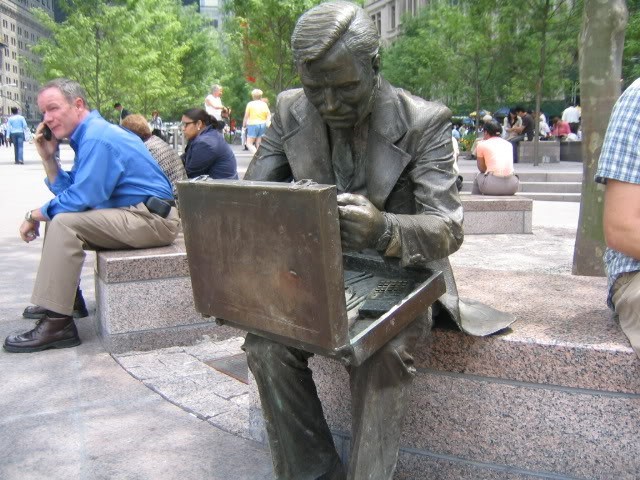
I first met him that August. He sat in a park at One Liberty Plaza, New York, New York, tucked in a corner, glancing into his briefcase. He lived in harmony with the workers and tourists meandering through the area; he paid them no mind, nor they him. 

At that time, autumn was creeping up on me like it always did, promising cooler air and brighter colors. Autumn was always good to me. I met my girlfriend at the time in the autumn. And years before, I’d met the woman I would eventually marry, also in the autumn. 

This fall was especially welcome, especially after a summer of unemployment and unhappiness. I’d finally been granted temporary work throughout the file vaults of various banks in the financial district. I spent my lunch breaks in the park at One Liberty Plaza, smoking cigarettes and trying to draw; the latter was particularly galling, inasmuch as I seemed to have forgotten how.  

One day I glanced around the park, looking for inspiration that wasn’t in this anatomy book that seemed to be the source of my frustration, and there he was, sitting on a marble step in the shade. I wondered who he was. I wondered what he was thinking. Was he relaxing, or was he about to stand up? And what was in his briefcase? Was it his lunch? 

As the days of tedious filing stretched into weeks, I crept ever-so-closer and peeked over his shoulder—subtly, so as not to offend him. I remember seeing an adding machine, and a few other items. But for the life of me, I don’t recall what these other items were, only that they were archaic. 

The last time I saw him, I stood up from the bench, tossed my sketchbook (weakened from the stress of erasers and my dissatisfaction) into my satchel, and dropped a quarter into a payphone. My girlfriend’s thirtieth birthday was that Thursday, and I was trying to arrange something fun; she hadn’t been my biggest fan over the past several months, and I needed to do something to fix that. 

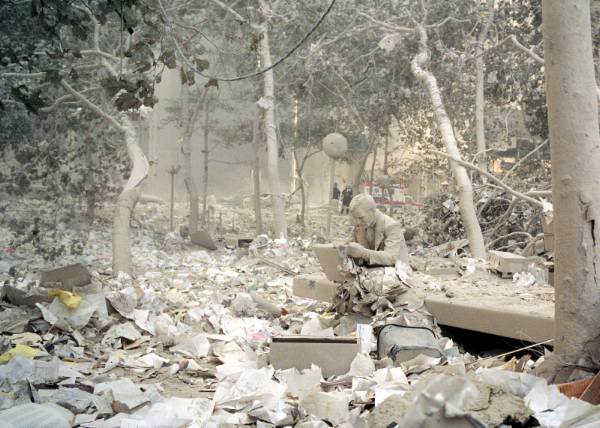
The last time I saw him was on a Monday, because on Tuesday, this happened: 

I’d originally wanted to write an essay about how much this country has changed in the past ten years—about how we’ve lost our way; about the silly phrases I used to love (i.e. “Bring ’em on” and “Dodged a bullet”) but no longer feel comfortable employing, as they have been soiled by those who have no concept of the value of a human life; about the collective, parasitic rage from that day that has turned us against cultures we don’t understand, against our own freedom, against our government, and against ourselves; about lost hope; about fear … 

And then I began running across never-before-seen photos from that day, begging the question: has somebody been sitting on them for ten years so they could release them for a big anniversary? And TV specials and stories and interviews on NPR and essays about what we’ve been up to over the past ten years … and stories from celebrities about what they were doing that morning. And I know that by noon on Sunday, we will have moved on to whatever it is we’re going to be saturating the media with this next cycle. It’s like the anti-Christmas. 

So I wasn’t going to participate. Regardless of everything I went through that day, I wasn’t going to participate. And then I remembered him. 

He’s since been moved around to museums and other parks. Now he’s been returned to where he once was, but in a prominent spot. I could go see him again, but it wouldn’t be the same. Nothing has been the same.  

I prefer to remember him from that late summer, when he and I were both alone, and we liked it that way. 

Somebody I Know Died on Thursday

I wasn’t close enough to call him a friend. I wasn’t distant enough to call him an acquaintance. I don’t know what I should call him. I have always wanted to know him better, but our lives didn’t sync up enough, as sometimes happens. He has existed almost exclusively through Facebook posts and my friends. I can tell you this for sure: I liked him a lot. 

Back in the nineties, we served time together as copy kids at The New York Post. A copy kid is, if you don’t know, is an intern. Actually it’s a step below an intern. And, like it says on the label, you make and deliver copies. Sometimes you went out for coffee. Sometimes you delivered fresh copies of the paper to editors and departments around the office. On very rare occasions, you are sent out to cover a story—usually ones that there are no reporters available to do, or the boring hot potatoes that reporters would like to avoid. There’s not a lot of dignity to being a copy kid, but it was kind of an honor. 

The men and women I worked with at the desk were an interesting bunch. Some were changing careers—not for the money, but to be journalists. For all its bluster and front-page comedy and right-wing agenda, The New York Post was and still is to an extent a very old-fashioned paper, and there was something to be said about running out in the night with a Bic pen and one of those small notebooks with logo stamped on it. 

I think he’d intended to start out as a reporter, but it wasn’t really his thing. Instead he became a copy editor. Just like me. Also like me, he was making things up as he went along, and that meant a lot of mistakes and frustration. We were both simultaneously kind and weary and devastatingly clever. We sometimes had a beard and sometimes didn’t. 

Once I asked him why he was there, and he told me that he’d worked for years as a doorman at a fancy apartment building. The job was incredibly easy, and the money was good. “I went and spent it all on drinks and cab rides. I don’t have anything to show for it.” Well over a decade later he is married with children. 

At the age of forty-three, while his family was out of town on vacation, he suffered a sudden, unexpected stroke, possibly a seizure. It’s not entirely clear what happened, but it appears that he fell while walking, sustaining physical injuries. Police were called, and he was taken to the hospital. For weeks, things were hopeful. He recoiled slightly from physical discomfort. He opened his eyes. He responded to humor. He began to squeeze his wife’s hand. He moved his foot. Soon after that, he raised his hand. And then he took a turn for the worse. On Thursday, his breathing tube was disconnected, and he died. His touching obituary ran in The Post—even in The Wall Street Journal

I don’t know if he had a DNR. All I know is that, at some point, his wife had to be told that somebody was going to be responsible for performing an action that was going to be responsible for his death. Never mind the seizure or stroke—his heart and a lot of his organs were still working. By now they’ve cut him open and removed parts of him and put them into the bodies of others. 

How do you cope with that? How would my wife cope with that? How would I cope with that? 

I’m reminded of the days and nights I sat in an uncomfortable chair after my wife broke her ankle, only to have it reconstructed. Her pain was something I couldn’t comprehend, and throughout the hours of the morning, she held my hand, crushing it. She asked me to tell her a story. She asked me to read for her the comics I had with me for when she slept. She asked me for more meds. I’ve had a loaded gun held to my head; I survived the attacks on the World Trade Center by virtue of showing up to work a little early; last month I almost drowned; I’ve ridden the Cyclone at Coney Island; I can’t remembering being as scared as I was then. And she was fine. It was only her ankle. But she was so helpless. 

I’m reminded of the night my aunt died of lung cancer, only a few hours after I had seen her last. I’d been asked by my uncle or one of my cousins—I don’t remember who—to sit with her alone for a few minutes while they took a break. I didn’t want to. My lively, hilarious, child-like aunt was in so much pain I don’t think she knew who she was. I wish I could say that this pale, shriveled-up person in bed didn’t look a thing like her, but I’d be lying. I don’t know what she saw when she stared into the distances. Sometimes, when I’m not careful, I remember the breaths she took in—about two or three times a second, for days. The effort it took was loud and gasping. They told me I needed to hold her hand and talk to her. Her fingers were cold, and I couldn’t think of a thing to say, and so I sang the first song that came to my head: “Yellow Submarine,” by the Beatles.  

What did he look like on the hospital bed, bandaged from surgery, IVs in his arms, a tube in his throat, his eyes sometimes closed, sometimes open and glassy? I can’t get the question out of my head. I’m drowning in work—both editing and art; I’m going to New York to see one of the people dearest to me and to re-explore the city I consider a lover; immediately after that, I have a visitor I’ve never met in person, but I am really dying to. I can’t close my eyes without seeing him, or my aunt, or my wife. 

I wasn’t close enough to call him a friend. I wasn’t distant enough to call him an acquaintance. I don’t know what I should call him. I have always wanted to know him better, but our lives didn’t sync up enough, as sometimes happens. He has existed almost exclusively through Facebook posts and my friends. I can tell you this for sure: I liked him a lot. 

All-American Gallic

What I am about to tell you is absolutely true. I have changed only the names of those involved. The events depicted occurred in the Year of Our Lord 2011, during the month of April. But the road that led me here had been paved six months earlier, in the lobby of a hair salon. 

“That’s an awesome jacket!” the receptionist said as she carried my battered, vintage, leather pea coat to the closet. “Where’d you get it?” 

“A place on Broadway and Houston in New York City,” I told her. As I waited for my designated appointment time to roll around, I poured myself a cup of coffee and added, “What was really cool was that I walked in the door to buy a black blazer like all the men in New York are required to wear, but the guy at the register wouldn’t sell it to me. He told me to go with brown, and even picked out a shape that matched with my body.” 

“Those places are really cool,” she agreed. “You know the one down the street called ‘An American in Paris’?” I shook my head. She prodded, “Just down the street?” I shook my head again. She asked, “An American in Paris?” I shrugged. 

“Anyways,” she continued on, regardless, “they’re a high-end boutique, so you don’t really get to pick anything out for yourself. I went in there for a dress, and the woman who owns it—she’s French …” 

“Imagine that.” 

“… and you tell her a ballpark of what you’re looking for, and she finds exactly what you need. Only for girls, though.” 

“That sounds really nice,” I said sincerely. I love women’s clothes. Part of that is my artist’s sensibility; I love color, shape, personality, and the mixture of all three. Yes, you can find these in the men’s department—and yes, the artist in me appreciates the smooth, masculine subtlety therein. However, men’s fashion is missing one important detail: women. I just love looking at women. It’s biological. 

And so, the following spring, I pointed to a gentle, hand-painted, pastel sign and said to my walking companion, “We should go here.” 

My friend Noel had never been to the DC area before. In fact, she had never been to an East Coast metropolis before. She had recently finished an undergraduate education at both a liberal arts college near her hometown and a university in western Europe. The sirens of her future are singing to her of riches, knowledge, love, and more if she would just follow them. She wants to follow her own damned song, though, and so she has taken a week to clear her head, consider her options, and goof around in the sandbox of our nation’s capital. 

And if there’s one thing I love to do, it’s goof around. And, as I said, if there’s another thing I love, it’s shopping.  

“Let’s do it,” she said with a smile and a nod. 

Since that day, we’ve told and retold the tale, trying to ascertain what exactly went wrong. Noel believes we should have left well enough alone when she pushed on the door, only to find that it wouldn’t budge. 

I told her, “The sign says to …” 

She shoved again. 

“… to knock,” I continued, “and they’ll …” 

With a click, a deadbolt slid open. She frowned, shrugged, and ducked inside; I did the same. 

Soft sunlight drifted in from the street through enormous display windows, illuminating row upon row of dazzling, yet somehow muted dresses, coats, and suits. The overall space was minimal, but somehow everything fit together without feeling remotely crammed. The shop, like the sign, was kind and inviting. We soaked it all in with a sigh and set immediately to investigating. 

Noel’s style tended toward vintage and soft, and as soon as we found a dress that matched these criteria, as well as her personal palette, she pinched the skirt and pulled it away from its companions for closer inspection. Her pose at that moment matched that of a simple cartoon figure in a bright orange sign on the wall that suddenly barked at me from the corner of my eye. The sign announced that Noel was committing a cardinal sin. 

“Um,” I started to tell her. 

Now, I’ve had plenty of time to meditate carefully on the events that occurred next, yet I still cannot comprehend them. The corner we occupied had boxed us in, surrounding us with two floor-to-ceiling windows and the row of clothing. That left the entrance. 

I am by no means a small man. Though my mass has decreased by about 25 percent over the past year, my shoulders are still wide enough to clog the only means of access to this particular corner. Not even vision could get past me. 

And yet, with nary a gust of wind, temperature fell, Noel froze, and a crooked old crone appeared before us the tape measure around her neck flapping about. Without violence, but with extraordinary menace, she eased Noel away from the rack and spoke with a thick, Gallic accident. “You should probably read signs before you try to shop.” 

Both Noel and myself were prepared to offer up an apology, but that was not to be. 

“This is not how you look,” shopkeeper told us, pulling on the skirt like Noel and figure on the sign had done. “No!” Holding onto the dress’s padded wooden hanger, she lifted it from the rack. “You look like this.” With great specificity, she returned it to its proper place. “And leave three-fingers’ space between articles. They get wrinkled if you don’t.” She repeated the offending motions. “Not like this.” She lifted the hanger. “Like this.” 

Noel and I made eye contact with each other. 

“This is not a secondhand store,” the shopkeeper explained. “This is not some mass-produced cloth. “This …” Again, she tugged on the skirt. “… is very delicate fabric. When you do this …” Tug. “… You damage this very delicate fabric. Do you understand?” 

She might not agree, nor might she even care; but Noel did, in fact, understand. More importantly, she wanted to escape. She believed, as did I, that conceding the crone’s point would enable that. She opened her mouth to do so. 

Unfortunately the question had merely been hypothetical. The woman gestured around the entirety of the shop. “This here? This is France.” 

Believing still that freedom meant following along, we nodded. 

“You?” She pointed to Noel. “You are American.” 

This we could all agree on. 

“That is why this store is called ‘An American in Paris.’” She examined both of our faces for any sign of comprehension. Luckily I was an English major and Noel is a Fulbright scholar, so we did grasp the metaphor. “American,” the crone repeated, “in Paris.” 

Certain that all of these basic facts had been absorbed by her audience, she advanced the lesson by combining them. “This is how an American shops.” She yanked on the dress. “This is how you shop in France.” She removed the dress and replaced it. “America.” She tugged. “France.” Finally, she concluded the lesson. “You are not in America. You are in France.” 

Noel and I looked at each other while the shopkeeper regarded us carefully. The concept of being an American in Paris was a tricky one, and the ability of folks like us to get it might elude us.  

She pushed through me, reminding us one more time as she passed, “Not America; France.” 

Once we were in the clear, Noel whispered, “Think she can hear us right now?” 

“I don’t know what to think,” I whispered back. 

“Let’s hang out for a little while so she doesn’t think we’re scared of her,” she said, “and then get out of here and go someplace less traumatizing.” 

That place turned out to be the Holocaust Museum. 

Three Little Pieces of Sunshine

I haven’t spoken to him since 2002. We didn’t have a fight or a falling out or anything spectacular like that; he just went about doing grownup things his way, and I went about doing grownup things my way. Recently, after a conversation with my wife, who knew him back in the day, I began to scour the Internets for him. It was shortly thereafter that he found me on Facebook. As is the case when rediscovering old friends through social networking, I took a look around his life, and that’s when I found a picture of his teenage daughter. 

She’s not the first child I know who’s grown up in the blink of an eye. There’s my ten-year-old niece, my best man’s twelve-year-old daughter, and my favorite college professor’s now sixteen-year-old son, for example. I don’t know why—most likely because I’ve had the pleasure of watching them transform—but seeing this young lady as a young lady really got under my skin, and it brought a lot back. 

In my collegiate youth, I was kind of (okay, very) moody. I’ve come to discover that this is a medical condition, but at that time, I just cycled and assumed I spent about half of my waking life as an asshole.  

Halfway through my sophomore year, in early 1996, I hit an upswing, cut my hair, wore some clothes with color, strapped on some confidence (albeit temporarily), and made some new friends. One of these had a freshman boyfriend who I knew I wasn’t going to get along with at all. For starters, he was a football player. Also, he was fit, both in athleticism and in the British sense of the word (i.e. hot); he was super-intelligent; and he was charming. Worst of all, he was genuinely kind, principled, and honest. So of course I hated him. And in no time at all, we were laughing, drinking, and smoking cigars together.  

That spring, I arranged to move into some off-campus, college-owned apartments, and I asked him to be my roommate. We found out quickly that sophomores were not permitted to live off campus, even in college-owned apartments. He persuaded the Dean of Housing to make an exception for him. (Have I mentioned that he was really, really persuasive?) 

Late summer, as football camp started up, he moved in, and he spent the next several weeks educating me on the finer points of the sport (which I’d never put much thought into before) and of East Coast versus West Coast (and “Mid Coast”— a term he invented) hip-hop. And all was good, until just before classes began, and his on-and-off-again girlfriend from back home was pregnant. 

So he did what any teenager would do: he quit the football team, brought her to his current home, found an apartment, found a job, and became a husband.* These things, of course, were all tricky: the first item because that robbed him of much of his financial assistance and social life; the second because he was asking her to leave her entire life behind to come to a place she knew nobody; the third because this was a college town, and there weren’t a lot of places to live for a family; the fourth because he would be supporting all two and a half of them, as well as his education, alone. The final proved to be exceptionally difficult, in that it cut him off from even more of his social life (at that age, nobody, including myself, understood why he would do all this). Also, his father, and his brother, aka his best man, were stranded in Colorado. 

The morning of his wedding, my friend showed up at my (formerly our) apartment, handed me a tuxedo, and said, “There’s been a change of plans.” If you’ve ever met this guy, you’d know that “There’s been a change of plans” coming from his mouth is the second most chilling phrase in the English language—the first being “We need to talk” coming from the mouth of a partner or spouse. And so I became his best man. To this day, pulling a toast out of my ass for the reception is one of my top-five achievements. 

They immediately became a unit. His identity was entirely husband and father; hers was entirely wife and mother; and this diminished them in no way whatsoever. In fact, it strengthened them. Most importantly, this unit was my friend.  

Our lives back then, as they are now, were separate from each other. For me the following years were full of turmoil, joy, and discovery. It was in the last year of college that I lost control over most of my life. His home (it wasn’t an apartment; it was a home) was safe. One of my favorite memories of that time, sitting cross-legged in the sun, chatting with her and watching the baby roll over. I don’t remember when exactly that was in my history, because the rest of that chaotic life didn’t exist inside those doors. Together, the three of them were vital to my survival back then, in ways I’ve never before expressed. 

I graduated, only barely; I became lost in my parents’ house; I became a man in New York; I became an adult and husband in my wife’s arms. Even though I’ve regenerated countless times, they’re the same: Her blue eyes are full of joy and excitement, even when she’s tired; his eyes are relaxed and confident; and the eyes of their baby, now a young woman, is full of life. They’re still a unit, and I can’t describe, no matter how much I want to, how happy that makes me. 

* Ha! Just kidding! Nobody would do that! 

Deconstruction

I was in love with her for a long time. 

When I was young, I thought I understood love, as we all did. We’re told, though, that this was not what love is. So we ask, what is it then? They assure us that we’ll know when we find it; they can only tell us where not to look. 

We won’t find it in those sweaty, panting, gooey, sheet-clenching hours with someone in the dark. That’s just lust, they say. We won’t find it in those shared jokes and air kisses and physical intimacy that begins and ends in a hug. That’s only friendship, they say. And we definitely won’t find it in those lonely thoughts that send us plummeting in glorious freefall into daydreams. That, they say, is a crush. 

A crush. The term itself diminishes and purifies the epic scale of our emotions, waving them away as a product of our youth. As our bodies stretched into the shape of the people we were fated to become, we lost control of everything—even our hearts. Placing the responsibility for our feelings into the paws of hormones frees us from them; our feelings are allowed to recede into the past, along with that haircut and the algebra. 

But we really liked that haircut. That algebra class choked the life out of us for nine months. And he or she was our entire world. 

They tell me that I never really loved her. I listened to them. I wanted to be free. They said that, if I ever needed convincing, all I had to do was see her again. The years she now wears will help strip off the chrome of both the present and the past, and she’ll have always been just a crush. 

And then she spoke to me like she always did. She rolled her eyes and pursed her lips and giggled. And then she smiled at me. 

They’re wrong. I was in love with her. Because with that smile, why wouldn’t I be? 

Failing To Live up to Expectations

I’ve seen the movies and TV shows and have read the books.  

I know that guys who, in the past, have shared drinks, drugs, friends, and song sometimes get back together for a little while, and I know how those reunions are supposed to go. The guys should take a vacation from their marriages, responsibilities, and restraint by coveting and sometimes even reliving those shared drinks, drugs, song, and friends, all the while bemoaning their having grown up. On rare, extreme occasions, one or more of these guys abandons his maturity to return to his past. 

So when two of these types of guys get back together and reminisce about their history before launching into full-on, effusive praise of their current marriages, responsibilities, and restraint, pop culture says they’re doing it wrong. 

A Moment of Clarity

I used to drink a lot. Like, a lot. And in retrospect, my dark, nightmarish days of drugs and alcohol weren’t really all that nightmarish. A lot of mistakes and illness can be attributed to those things, but half the time I spent on some kind of bender was actually fun. 

And so when someone asked me a few days ago if—after three years and change of sobriety—I missed drinking, I told them I did. If they’d asked me if I missed smoking, I’d also say yes. I am glad neither of those things are part of my life anymore, but I still remember them fondly. I feel that way about some of my ex-girlfriends and banished or long-lost friends. 

This conversation would have faded into the ether, where idle chitchat goes when it’s done passing the time, were it not for the follow-up question: “What do you miss about it?” And just like that, I was stumped. 

I can tell you what I don’t miss. That part is easy. I don’t miss vomiting, or day-long hangovers (or two-day, or my personal record, a three-day). I don’t miss the spinning beds and couches, or the falling down. I don’t miss saying or doing something really stupid because it seemed like a good idea at the time. I don’t miss the shouting. I don’t miss having another, and then another, and then another, and so on, because you lost count or you simply think you can handle just one more. I don’t miss the absolute certainty that this party’s going to suck without throwing a few back, or the worry that you and a friend won’t have anything to talk about until you are lightly toasted. * 

What do I miss? I miss red wine. I miss beer, because it comes in endless genus and species. I miss the sweet, mellow, citrus of a gin and tonic. I miss the shoulder-tightening kick of whiskey; the uplifting weight of rum; and the sweet simplicity of Jack and Coke. I love the smug bitterness that comes from walking around a room with a glass of scotch in your hand. I miss the difference between really good and really cheap tequila, and how the latter isn’t much of a problem when it’s on special. I miss the smell. 

It’s not just about the flavor, though. I mean, I miss donuts too, but I don’t wistfully remember gathering around conference tables or those donut shops (except for maybe Crescent Donuts in Bloomington, Indiana, because damn). So, what is it about alcohol that I miss? Is it the bonding? No, I can bond with people over a club soda, no problem, as I’ve proven time and time again. 

I miss the myth of drinking, from the awesome cocktail parties that in reality are too loud and full of desperation and insecurity and hip people, to the dark, smoky old-man bars full of soothing melancholy that are actually stinky and miserable. My memory is romantic and fallible, and in most cases I let it be so. But not today. Today I have a puzzle to solve that is harder than I thought it would be. 

So, taking away the taste and the legend, what is it about drinking that I actually liked? Alcohol makes you not care, but in a good way. I’m not talking about apathy; I’m talking about not worrying so much. It’s the lack of concern you have for what that stranger is thinking when you strike up a conversation. It’s knowing enough to forget issues that you are powerless to fix, especially at that moment. It’s feeling cool and funny and someone people should take the time to know. 

So, when you break it all down, what I liked the most about alcohol is that it made me feel like I do today, properly medicated and (80 percent) in shape. 

Huh. 

*I wish I could say that I don’t miss waking up in strange places, but that part was always kind of cool; I can only say that because I’ve never woken up in a place I’ve actually regretted. 

Talkin’ About My Regeneration

I am a proud Doctor Who fan, going back thirty years, for better (“Genesis of the Daleks”) and for worse (“The Twin Dilemma”), through sickness and health, and so on. But in all that time, I’ve given myself a headache over the Doctor’s mercurial identity. 

Sure, I could get behind the fact that eleven (as many as eighteen, depending on the source) actors were playing the same character in much the same way I could get behind Roger Moore and Daniel Craig playing the same character. What I’ve always had a problem with was the Doctor being the same person; i.e. how can William Hartnell and Peter Davison be the same dude? I know that some fans can totally grasp it, but I just can’t. I even spent two weeks last year trying to explain it to myself with art and everything, but I still couldn’t get it to click. 

Then the other day, I was talking to a friend who’s known me for over ten years, and it occurred to me how many separate lives I’d lived in that time. I’ve been an angsty artist, a frustrated writer, a lovelorn poet, and a cuddly cartoonist. I’ve been a doting boyfriend, a lonely single man, a terrible boyfriend, a loyal friend, and a caring husband. I’ve been a smoker, a pothead, a drunk, and sober. I’ve gone through sad periods, cheerful periods, angry periods, confident periods, and periods where I could only be described as an utter jackass. I’ve been social, and I’ve been solitary. Hell, I even went through a (brief, alas) period as a ladies’ man. I’ve worked as a devil-may-care temp, a dedicated manager, a temperamental waiter, a telecommuting freelancer, or have simply not worked. 

I haven’t even looked the same. I’ve been both fat and thin. I’ve had long hair, really long hair, short hair, black hair, blond hair, and brown hair. I’ve worn a chin beard; a Master-style, mustache-beard combo; careless weeks-long growth; and no facial hair at all.  

My uniform has veered sharply; one could tell who I was at what point by looking at my “uniform” at the time. I’ve dressed in baggy T-shirts, soccer jerseys, rugby shirts, and oxfords. My feet have gone from cowboy boots to combat boots; from bowling shoes to dress shoes; from Converse to New Balance. My pants have been cargo, khaki, and denim. When it’s cold, I could be seen in a leather pea coat, a denim jacket, a corduroy blazer, or an oversized cardigan sweater.  

Since I’ve graduated from college, I’ve been about a dozen different people, and I’m only in my mid-thirties. Yet I’ve always been the same; I mean, Who has traveled with me through every identity. So imagine if I’d had a thousand years to reinvent myself time and time again … 

And just like that, it all made sense to me–I can see that Six and Ten are the same guy. 

But more importantly, it is so much fun to look back and see who you used to be. You should try it sometime.